1What is the size of the Vietnam organic fertilizer market?
The Vietnam organic fertilizer market is valued at USD 646.71 million in 2026 and is forecast to reach USD 936.54 million by 2031, growing at a 7.69% CAGR.
Insight Market Data is a premier market research and business consulting firm headquartered in Pune, India, providing syndicated research reports, customized intelligence studies, and strategic advisory services. Renowned academic institutions and Fortune 500 corporations worldwide rely on Insight Market Data's research repository to navigate evolving global and regional business environments. Covering 46 diverse industries across 25 major international economies, our comprehensive database delivers thousands of verified statistics and granular market evaluations. By combining industry-leading analytical methodologies with the direct insights of seasoned industry leaders and subject-matter experts, we deliver actionable intelligence spanning historical performance benchmarks to rigorous multi-year forecasts. We empower organizations to make confident, data-driven decisions across pivotal domains including Machinery & Equipment, Chemicals & Materials, Pharmaceuticals & Healthcare, Food & Beverages, Consumer Goods, Energy & Power, Automotive & Transportation, Electronics & Semiconductors, Medical Devices, Telecommunications, Emerging Technologies, Agriculture, and Packaging. Our multidisciplinary analyst teams provide an objective 360-degree perspective, tailoring every engagement to address complex strategic challenges with exceptional analytical rigor.
Leveraging advanced BI-powered analytics and predictive modeling, Insight Market Data uncovers high-impact market opportunities and competitive differentiators for ambitious enterprises. We continuously refine our research methodologies in accordance with global industry standards, tracking real-time market shifts to ensure our reports are consistently accurate, actionable, and delivered on schedule. Our analysts conduct methodical data validation, rigorous compliance checks, and exhaustive primary and secondary research to maintain the highest levels of data integrity and transparency. We partner closely with corporate strategists, investment groups, and business executives to translate intricate market intelligence into clear, actionable roadmaps for sustainable growth. With operational presence across Washington, USA, and Vimannagar, Pune, India, Insight Market Data ensures direct access to dedicated research specialists and responsive customer support to answer your most strategic questions.
 Vietnam Organic Fertilizer Market
 by Product (Organic Residues, Biofertilizers), by Form (Dry Granules, Liquid and Suspension Concentrates), by Application (Grains and Cereals, Oilseeds and Pulses, Fruits and Vegetables, Turf and Ornamentals, Other Crops), by Southern Vietnam, by Northern Vietnam, by Central Vietnam Forecast 2026-2034

Research Associate


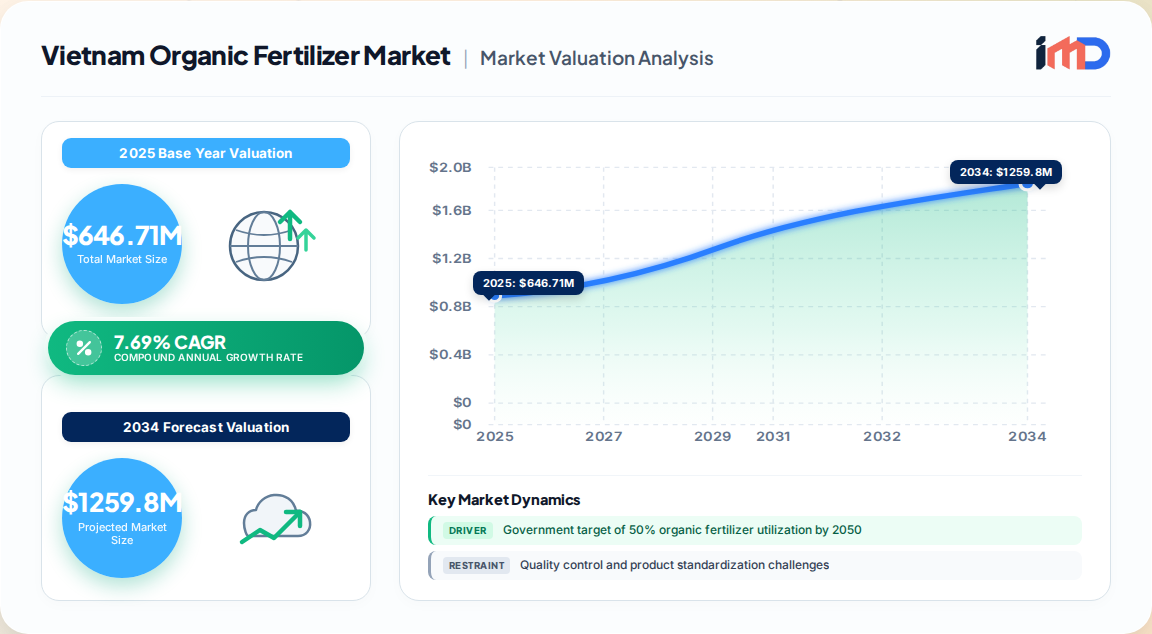
Vietnam's organic fertilizer market is a structurally expanding segment of the national agricultural input complex, with our proprietary primary research valuing the market at USD 646.71 million in 2026, on an upward trajectory to USD 936.54 million by 2031. This represents a robust 7.69% CAGR over the forecast window, materially outpacing the broader fertilizer sector's growth rate of approximately 3.47%. Organic fertilizers currently constitute approximately 25% of a total fertilizer market valued at about USD 3.55 billion, a share positioned for meaningful expansion as policy, soil-health economics, and export premiums converge.
The Vietnam Organic Fertilizer Market is a critical lever in the country's strategic pivot toward sustainable, high-value agriculture. This shift is underscored by the fact that Vietnam's average fertilizer application intensity is roughly three times the global average, a legacy that has produced nutrient imbalances, soil acidification, and water pollution across key production zones such as the Mekong Delta and the Red River Delta. Organic inputs are therefore transitioning from a niche supplement to a structural component of commercial crop nutrition.
A distinctive feature of this market is the breadth of its definition. "Organic fertilizer" in Vietnam encompasses products derived from natural organic substances processed physically or biologically, ranging from composted manure and agricultural residues to biofertilizers and microbial biostimulants. Certified-organic inputs represent a small, high-value subset. This broad definition means market volume is heavily weighted toward locally produced, waste-derived materials, which insulates a significant portion of supply from import-driven price shocks.
Our primary research identifies six principal growth drivers, led by government policy. The government's target of 50% organic fertilizer utilization in crop production by 2050, articulated through Decision 5190/QĐ-BNN-BVTV and allied initiatives, is the single most powerful demand catalyst, contributing an estimated +1.6 percentage points to the forecast CAGR.
Together, these drivers are forecast to add a cumulative positive impact on CAGR, weighted heavily toward Southern Vietnam and the medium term of two to four years.
The market's expansion is tempered by several structural constraints that will shape competitive strategy through 2031.
These restraints are most acute among smaller producers and in regions with limited technical extension infrastructure, reinforcing the case for consolidation and brand-led adoption.
Our proprietary data indicates a market in which established formats dominate today while premium and specialized formats drive future growth.
| Segment | Segment Share (2025) | Forecast CAGR (to 2031) |
|---|---|---|
| Organic residues (by product) | 63.78% | Baseline growth |
| Biofertilizers (by product) | — | 10.05% |
| Dry granules (by form) | 70.88% | Baseline growth |
| Liquid and suspension concentrates (by form) | — | 10.58% |
| Grains and cereals (by application) | 44.78% | Baseline growth |
| Fruits and vegetables (by application) | — | 8.95% |
The product mix is experiencing a decisive shift. Organic residues, including composted animal manure and crop residues, remain the volume backbone due to low cost and local availability. However, biofertilizers, which include Rhizobium, Azotobacter, and mycorrhizal fungi formulations, are the fastest-growing product category, forecast to expand at a 10.05% CAGR through 2031. Their appeal is rooted in cost-effectiveness for smallholders, adaptability across Vietnam's diverse agro-climatic zones, and capacity to restore soil microbial health.
By form, dry granules remain dominant because they suit mechanized broadcasting and field-crop applications. Liquid and suspension concentrates represent the premium growth frontier, forecast at a 10.58% CAGR, driven by fertigation adoption in high-value horticulture and the growing urban and greenhouse agriculture segment.
By crop application, grains and cereals command the largest revenue share, reflecting rice's dominance in Vietnamese cropping. Fruits and vegetables are the highest-growth application segment at an 8.95% CAGR, directly linked to organic export premium opportunities and domestic demand for safe produce.
The Vietnam organic fertilizer market is moderately fragmented. Our competitive benchmarking identifies the top five participants—Binh Dien Fertilizer Joint Stock Company, PetroVietnam Fertilizer and Chemicals Corporation (PVFCCo), Que Lam Group Joint Stock Company, Song Gianh Joint Stock Corporation, and Baconco Company Limited (a subsidiary of PM Thoresen Asia Holdings)—as collectively holding a significant share of market value.
Strategies cluster around three priorities: securing raw-material supplies through vertical integration, investing in biotechnology and certification credentials, and expanding distribution and farmer education platforms. Notable recent developments include:
Market consolidation is expected to continue as integrated players position for raw-material security and export-ready certification.
Vietnam's organic fertilizer trade is small relative to its chemical fertilizer trade but strategically important at the premium end. In 2023, Vietnam consumed approximately 11 million tonnes of fertilizers, of which 4.1 million tonnes were imported, predominantly chemical fertilizers from China. Organic imports, chiefly manure granulates, are sourced from the United States, the Netherlands, and Belgium, reflecting demand for standardized, high-nutrient organic inputs for horticulture and the certified-organic segment.
On the export side, certified Vietnamese organic produce—not raw fertilizer—is the principal value channel, with the United States and European Union absorbing approximately 90% of organic product exports. The EU-Vietnam Free Trade Agreement, in force since August 2020, eliminates or phases down tariffs on nearly all bilateral trade, reducing the landed cost of European organic inputs and technology while strengthening Vietnam's access to premium EU organic food markets. This asymmetry supports import of specialized organic and microbial inputs while creating a durable export pull for domestically produced organic fertilizer used in certified supply chains.
Domestic raw-material supply is abundant: self-produced organic fertilizer output rose from 16.8 million tonnes in 2020 to 21 million tonnes in 2022, indicating that the binding constraint is not feedstock availability but product standardization, certification, and market access.
Southern Vietnam, anchored by the Mekong Delta, is the dominant regional market, accounting for an estimated 52% of national value. The region benefits from favorable agro-climatic conditions, intensive rice and fruit production, and proximity to Ho Chi Minh City's export infrastructure. Northern Vietnam, including the Red River Delta, represents approximately 28% of value, with acute adoption potential among smallholders facing high chemical fertilizer costs. Central Vietnam accounts for the remaining 20%, with strong long-term necessity driven by soil degradation.
The investment case is strongest in biofertilizers, liquid formulations for fertigation, and certified-organic input supply chains linked to export horticulture. Urban and peri-urban agriculture represents a nascent but fast-growing white space, with product formats tailored to household and rooftop use already entering the market.
The Vietnam organic fertilizer market is poised for sustained expansion at a 7.69% CAGR through 2031, with several high-conviction opportunity areas:
Our outlook assumes continued policy execution, stable raw-material availability, and gradually rising farmer acceptance supported by demonstration and training programs. Upside risk is concentrated in faster-than-expected export certification and biofertilizer adoption; downside risk relates to quality-control failures and chemical fertilizer price normalization.
| Aspects | Details |
|---|---|
| Study Period | 2020-2034 |
| Base Year | 2025 |
| Estimated Year | 2026 |
| Forecast Period | 2026-2034 |
| Historical Period | 2020-2025 |
| Growth Rate | CAGR of 7.69% from 2020-2034 |
| Segmentation |
|

Analyst at Providence Strategic Partners at Petaling Jaya
I have received the report already. Thanks you for your help.it has been a pleasure working with you. Thank you again for a good quality report

Internationalization Director
Yes, as a matter of fact we are totally satisfied with both reports that we have purchased and will continue to do so during this process of the internationalization of our brand.

Head of Product Management and Marketing
We are using your report, and it gave us valuable information."

Regional Director, Marketing and Business Development
We've received the report and have reviewed the content. Overall, it looks great and aligns closely with the data we can verify based on our industry knowledge.

VP of Sales
Thank you very much for sharing the report. I have reviewed it and I am very satisfied with the quality and the insights it provides. It will certainly be valuable for our internal discussions.
By Application
| By Geography |
|
The Vietnam organic fertilizer market is valued at USD 646.71 million in 2026 and is forecast to reach USD 936.54 million by 2031, growing at a 7.69% CAGR.
Key drivers include government targets for 50% organic fertilizer use by 2050, certified organic export premiums of 20–30%, high chemical fertilizer prices, and soil degradation requiring organic matter replenishment.
Organic residues held 63.78% market share in 2025, while biofertilizers are the fastest-growing product segment at 10.05% CAGR through 2031.
Major players include Binh Dien Fertilizer Joint Stock Company, PetroVietnam Fertilizer and Chemicals Corporation, Que Lam Group Joint Stock Company, Song Gianh Joint Stock Corporation, and Baconco Company Limited.
Biofertilizers are cost-effective for smallholders, adaptable across Vietnam's agro-climatic zones, and improve soil health by restoring beneficial microbial activity, supporting sustainable yields.
Our rigorous research methodology combines multi-layered approaches with comprehensive quality assurance, ensuring precision, accuracy, and reliability in every market analysis.
| Stakeholder Role | Interview Share (%) |
|---|---|
| Procurement Director | 35% |
| Production / Plant Manager | 30% |
| Crop Nutrition Agronomist | 20% |
| Agricultural Cooperative Director | 15% |
| Company Type | Representation (%) |
|---|---|
| Organic Fertilizer Manufacturers | 40% |
| Agricultural Input Distributors & Retailers | 25% |
| Biofertilizer & Microbial Technology Providers | 20% |
| Commercial Farming Enterprises & Cooperatives | 15% |
 Related Reports
