Insight Market Data is a premier market research and business consulting firm headquartered in Pune, India, providing syndicated research reports, customized intelligence studies, and strategic advisory services. Renowned academic institutions and Fortune 500 corporations worldwide rely on Insight Market Data's research repository to navigate evolving global and regional business environments. Covering 46 diverse industries across 25 major international economies, our comprehensive database delivers thousands of verified statistics and granular market evaluations. By combining industry-leading analytical methodologies with the direct insights of seasoned industry leaders and subject-matter experts, we deliver actionable intelligence spanning historical performance benchmarks to rigorous multi-year forecasts. We empower organizations to make confident, data-driven decisions across pivotal domains including Machinery & Equipment, Chemicals & Materials, Pharmaceuticals & Healthcare, Food & Beverages, Consumer Goods, Energy & Power, Automotive & Transportation, Electronics & Semiconductors, Medical Devices, Telecommunications, Emerging Technologies, Agriculture, and Packaging. Our multidisciplinary analyst teams provide an objective 360-degree perspective, tailoring every engagement to address complex strategic challenges with exceptional analytical rigor.
Leveraging advanced BI-powered analytics and predictive modeling, Insight Market Data uncovers high-impact market opportunities and competitive differentiators for ambitious enterprises. We continuously refine our research methodologies in accordance with global industry standards, tracking real-time market shifts to ensure our reports are consistently accurate, actionable, and delivered on schedule. Our analysts conduct methodical data validation, rigorous compliance checks, and exhaustive primary and secondary research to maintain the highest levels of data integrity and transparency. We partner closely with corporate strategists, investment groups, and business executives to translate intricate market intelligence into clear, actionable roadmaps for sustainable growth. With operational presence across Washington, USA, and Vimannagar, Pune, India, Insight Market Data ensures direct access to dedicated research specialists and responsive customer support to answer your most strategic questions.
Vietnam DIY Home Improvement Market Size, Growth & Forecast 2031 | Insight Market Data
Vietnam DIY Home Improvement Market | Insight Market Data
Vietnam DIY Home Improvement Market by Product Type (Building Materials, Paints and Coatings, Tools and Equipment, Decor and Lighting, Others), by Project Type (Renovation, Remodeling, Maintenance & Repair), by End User (DIY, DIFM/Professional Installation), by Distribution Channel (Home Improvement Stores, Specialty Stores, Online Retail, Others), by Southern Vietnam, by Northern Vietnam, by Central Vietnam Forecast 2026-2034
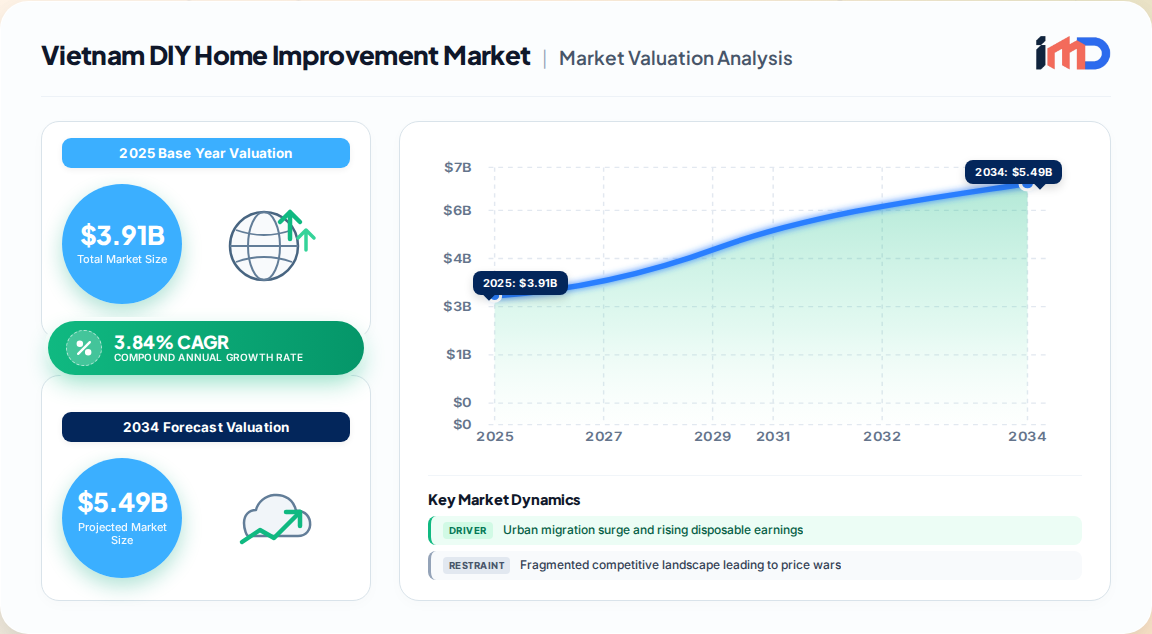
The Vietnam DIY home improvement market is experiencing a structural renaissance, propelled by rapid urbanization, rising disposable incomes, and a youthful, digitally native consumer base. Our proprietary primary research indicates that the DIY segment within Vietnam's broader home improvement market is forecast to expand at a robust 8.73% CAGR through 2031, significantly outpacing the overall market growth of 3.84%. This surge is not merely a pandemic-era aberration but a fundamental shift in consumer behavior, where homeowners increasingly seek personalized, cost-effective, and experiential solutions for their living spaces.
Vietnam DIY Home Improvement Market Market Size (In Billion)
5.0B
4.0B
3.0B
2.0B
1.0B
0
3.910 B
2025
4.060 B
2026
4.216 B
2027
4.378 B
2028
4.546 B
2029
4.721 B
2030
4.902 B
2031
In 2025, the total Vietnam home improvement market was valued at USD 3.77 Billion, with the DIY segment representing a growing share. While professional installation (DIFM) currently commands the majority share at 60.73%, the DIY segment is the fastest-growing end-user category. This is driven by a confluence of factors: a 45% urbanization rate (targeting 50% by 2030), per capita GDP surpassing USD 5,000, and the explosive growth of e-commerce and livestream commerce, which has democratized access to tools, materials, and tutorials.
Market Size (2026E): USD 3.91 Billion (total home improvement)
DIY Segment CAGR (2026-2031): 8.73%
Key Growth Corridors: Southern Vietnam (47.74% share) and Central Vietnam (fastest-growing at 8.85% CAGR)
Leading Distribution Channel: Online retail (projected 7.33% CAGR)
Market Drivers and Restraints
Drivers
Urban Migration and Rising Incomes: Vietnam's urban population exceeded 45% in 2025, with household incomes rising steadily. As per capita GDP crossed USD 5,000, urban households are allocating more discretionary spending to home upgrades, particularly smart fixtures, premium flooring, and aesthetic enhancements. This trend is most pronounced in Ho Chi Minh City and Hanoi, where compact apartments necessitate space-efficient DIY solutions.
Government-Led Renovation Subsidies: A nationwide campaign to rebuild over 330,000 substandard dwellings, coupled with a VND145 trillion (USD 6 billion) social-housing credit package, has unlocked financing for refurbishment. Ho Chi Minh City alone plans 28,500 social housing units in 2026, creating a massive pipeline for interior finishes and fixtures that often involves DIY installation.
E-Commerce and Livestream Commerce Boom: Home-related categories are among the top online sellers, with platforms like TikTok Shop transforming product discovery. The new E-commerce Law has formalized the ecosystem, building consumer trust in authenticated storefronts. This channel reduces barriers for DIYers by providing easy access to tools, materials, and step-by-step video guides.
Compact-Space DIY Upgrades: Dense urban housing and rental markets are driving demand for modular, space-saving solutions (e.g., peel-and-stick backsplashes, modular flooring, foldable furniture). These products are specifically designed for renters and small-space owners, fueling the DIY trend.
Restraints
Fragmented Competitive Landscape: The market is highly fragmented with numerous local players, leading to price wars and inconsistent quality. This can confuse consumers and erode brand loyalty, slowing the development of a mature DIY retail ecosystem.
Skilled Labor Availability: While rising, the availability of trained contractors for complex installations remains a challenge. This paradoxically supports DIY for simple tasks but limits DIY for advanced projects, restricting the segment's full potential.
Regulatory and Permitting Hurdles: Although streamlined, construction permitting can still be time-consuming, particularly for major renovations. This delays project timelines and may discourage homeowners from undertaking large-scale DIY projects.
Supply Chain Vulnerabilities: Dependence on imported raw materials (e.g., steel, coatings) exposes the market to global price volatility and logistics disruptions, impacting product costs and availability.
Value Chain Analysis
The Vietnam DIY home improvement value chain is evolving from a traditional, fragmented structure to a more integrated, omnichannel ecosystem.
Raw Material Suppliers: Domestic producers (e.g., Hoa Phat Group for steel) and importers of specialty chemicals and components. Trade data shows Vietnam exported USD 23.19 million in hand tools (HS 846799) in 2023, primarily to the US, indicating capability in tool manufacturing.
Manufacturers: Companies like Eurowindow (doors/windows), LIXIL (sanitary ware), AkzoNobel (paints), and SCG (building materials) dominate. Local players leverage regional expertise and faster delivery.
Distributors and Retailers: Home improvement stores hold 51.36% of the market, but online retail is surging. Omnichannel strategies are critical, with brands linking physical stores to e-commerce platforms.
Service Providers: Contractors and DIY influencers/educators. The rise of content creators on social media is a unique node, driving product discovery and education.
End Consumers: DIYers (homeowners and renters) and DIFM customers. The DIY segment is growing fastest, particularly among millennials and Gen Z.
Import/Export & Supplier Dynamics
Vietnam's trade profile in home improvement products reveals a dual role as both a manufacturer and a consumer.
Hand Tools (HS 846799): In 2023, Vietnam exported USD 23.19 million of hand tools and parts, with the United States accounting for USD 20.97 million (90.4%). Other key markets include Australia (USD 1.20M), China (USD 0.46M), and New Zealand (USD 0.13M). This indicates a strong export-oriented tool manufacturing base, which also supplies domestic DIYers.
Agricultural Hand Tools (HS 820190): In 2024, top importers of Vietnamese scythes, sickles, and other agricultural hand tools were the United States (USD 20.95M), Germany (USD 0.52M), and the EU (USD 0.19M). This suggests Vietnam's competitiveness in manual tool production, which can be leveraged for DIY gardening and outdoor projects.
Supply Chain Risks: Vietnam imports significant volumes of raw materials (e.g., steel, polymers) from China, South Korea, and ASEAN. Disruptions in these supply chains can impact domestic prices for DIY products. However, free trade agreements (e.g., EVFTA, CPTPP) are diversifying sourcing options.
Southern Vietnam: Dominates with 47.74% of the market in 2025. Ho Chi Minh City and surrounding provinces are hotspots for real estate development and urbanization. Investment opportunities exist in premium DIY products, smart home kits, and omnichannel retail.
Northern Vietnam: Holds 33.4% share, driven by Hanoi's expanding middle class and government infrastructure projects. The region is seeing a rise in demand for energy-efficient upgrades and home office solutions.
Central Vietnam: Fastest-growing at 8.85% CAGR. Da Nang and Hue are emerging as hubs for tourism and new economic zones, fueling demand for vacation home renovations and compact-space DIY.
Investment in local manufacturing (e.g., tools, eco-friendly materials) and distribution partnerships with e-commerce platforms is particularly attractive in the Central region, where growth is highest but modern retail penetration is lower.
Vietnam DIY Home Improvement Market Regional Market Share
Loading chart...
Strategic White-Space Analysis
Eco-Friendly and Sustainable DIY Products: Only 0.5% of CAGR impact currently, but growing consumer awareness presents a white space for biodegradable paints, recycled materials, and energy-efficient fixtures. Brands can differentiate by offering "green" DIY kits.
DIY for Renters: The rental market in urban areas is underserved. Products like removable wallpaper, temporary flooring, and no-drill fixtures offer a lucrative niche.
Smart Home Integration: While smart home devices are gaining traction, affordable, DIY-installable kits (e.g., smart lighting, plugs) are limited. There is a significant opportunity to bundle these with tutorials and local support.
Livestream Commerce for Tools: Despite the boom, few tool brands have mastered live demonstrations. Leveraging influencers for live DIY tutorials can drive impulse purchases and build brand loyalty.
Competitive Strategies
The market is highly fragmented with low concentration, allowing local players to compete on regional expertise, faster delivery, and flexible payment terms.
Key Players: Eurowindow, Hoa Phat Group, SCG, LIXIL, AkzoNobel (Dulux), Coteccons (contractor), and numerous local retailers.
Strategies:
Omnichannel Integration: Linking physical stores with online platforms, offering click-and-collect, and using AR tools for virtual room design.
Community Building: Creating online communities and user-generated content to inspire DIY projects and provide peer support.
Product Localization: Tailoring sizes, colors, and materials to Vietnamese preferences (e.g., compact furniture for small apartments, humidity-resistant materials).
Partnerships with E-commerce Platforms: Exclusive launches on TikTok Shop and Shopee, combined with livestream events.
Strategy
Description
Example
Omnichannel
Seamless integration of online/offline
AR visualization in-app, click-and-collect
Community
User-generated content and forums
DIY challenge campaigns on social media
Localization
Adapt products to local needs
Space-saving modular kits for apartments
Platform Partnerships
Exclusive online launches
TikTok Shop livestreams with influencers
Vietnam DIY Home Improvement Market Regional Market Share
Higher Coverage
Lower Coverage
No Coverage
Vietnam DIY Home Improvement Market REPORT HIGHLIGHTS
Aspects
Details
Study Period
2020-2034
Base Year
2025
Estimated Year
2026
Forecast Period
2026-2034
Historical Period
2020-2025
Growth Rate
CAGR of 3.84% from 2020-2034
Segmentation
By Product Type
Building Materials
Paints and Coatings
Tools and Equipment
Decor and Lighting
Others
Table of Contents
1. Vietnam DIY Home Improvement Market Introduction
1.1. Research Scope
1.2. Market Segmentation
1.3. Research Objective
1.4. Definitions and Assumptions
2. Vietnam DIY Home Improvement Market Executive Summary
2.1. Market Snapshot
3. Vietnam DIY Home Improvement Market Dynamics
3.1. Market Drivers
3.1.1. Urban migration surge and rising disposable earnings
3.1.2. Government-led renovation subsidies and social housing programs
3.1.3. Online home-improvement sales boom
3.1.4. Compact-space DIY upgrades in dense urban housing
3.2. Market Trends
3.2.1. Rising adoption of e-commerce and livestream commerce for DIY products
3.2.2. Shift toward premium and smart home fixtures
3.2.3. Growth of compact-space DIY solutions in urban areas
3.2.4. Increasing demand for eco-friendly and sustainable materials
3.3. Market Restraints
3.3.1. Fragmented competitive landscape leading to price wars
3.3.2. Limited availability of skilled labor for complex DIY projects
3.3.3. Regulatory and permitting hurdles for renovations
3.3.4. Supply chain vulnerabilities and raw material price volatility
3.4. Market Challenges
3.4.1. Balancing quality and affordability in a fragmented market
By Project Type
Renovation
Remodeling
Maintenance & Repair
By End User
DIY
DIFM/Professional Installation
By Distribution Channel
Home Improvement Stores
Specialty Stores
Online Retail
Others
By Geography
Southern Vietnam
Northern Vietnam
Central Vietnam
3.4.2. Educating consumers on complex DIY projects
3.4.3. Building trust in online platforms for product authenticity
3.4.4. Adapting to rapid regulatory changes in e-commerce
4. Vietnam DIY Home Improvement Market Factor Analysis
4.1. Porters Five Forces
4.1.1. Bargaining Power of Suppliers
4.1.2. Bargaining Power of Buyers
4.1.3. Threat of New Entrants
4.1.4. Threat of Substitutes
4.1.5. Competitive Rivalry
4.2. PESTEL analysis
4.3. BCG Analysis
4.3.1. Stars (High Growth, High Market Share)
4.3.2. Cash Cows (Low Growth, High Market Share)
4.3.3. Question Mark (High Growth, Low Market Share)
4.3.4. Dogs (Low Growth, Low Market Share)
4.4. Ansoff Matrix Analysis
4.5. Supply Chain Analysis
4.6. Regulatory Landscape
4.7. Current Market Potential and Opportunity Assessment (TAM–SAM–SOM Framework)
4.8. IMD Analyst Note
5. Vietnam DIY Home Improvement Market Analysis, Insights and Forecast, 2020-2034
5.1. Analysis, Insights and Forecast - by Product Type
5.1.1. Building Materials
5.1.2. Paints and Coatings
5.1.3. Tools and Equipment
5.1.4. Decor and Lighting
5.1.5. Others
5.2. Analysis, Insights and Forecast - by Project Type
5.2.1. Renovation
5.2.2. Remodeling
5.2.3. Maintenance & Repair
5.3. Analysis, Insights and Forecast - by End User
5.3.1. DIY
5.3.2. DIFM/Professional Installation
5.4. Analysis, Insights and Forecast - by Distribution Channel
5.4.1. Home Improvement Stores
5.4.2. Specialty Stores
5.4.3. Online Retail
5.4.4. Others
5.5. Analysis, Insights and Forecast - by Region
5.5.1. Southern Vietnam
5.5.2. Northern Vietnam
5.5.3. Central Vietnam
6. Vietnam DIY Home Improvement Market Southern Vietnam Analysis, Insights and Forecast, 2020-2034
6.1. Analysis, Insights and Forecast - by Product Type
6.1.1. Building Materials
6.1.2. Paints and Coatings
6.1.3. Tools and Equipment
6.1.4. Decor and Lighting
6.1.5. Others
6.2. Analysis, Insights and Forecast - by Project Type
6.2.1. Renovation
6.2.2. Remodeling
6.2.3. Maintenance & Repair
6.3. Analysis, Insights and Forecast - by End User
6.3.1. DIY
6.3.2. DIFM/Professional Installation
6.4. Analysis, Insights and Forecast - by Distribution Channel
6.4.1. Home Improvement Stores
6.4.2. Specialty Stores
6.4.3. Online Retail
6.4.4. Others
7. Vietnam DIY Home Improvement Market Northern Vietnam Analysis, Insights and Forecast, 2020-2034
7.1. Analysis, Insights and Forecast - by Product Type
7.1.1. Building Materials
7.1.2. Paints and Coatings
7.1.3. Tools and Equipment
7.1.4. Decor and Lighting
7.1.5. Others
7.2. Analysis, Insights and Forecast - by Project Type
7.2.1. Renovation
7.2.2. Remodeling
7.2.3. Maintenance & Repair
7.3. Analysis, Insights and Forecast - by End User
7.3.1. DIY
7.3.2. DIFM/Professional Installation
7.4. Analysis, Insights and Forecast - by Distribution Channel
7.4.1. Home Improvement Stores
7.4.2. Specialty Stores
7.4.3. Online Retail
7.4.4. Others
8. Vietnam DIY Home Improvement Market Central Vietnam Analysis, Insights and Forecast, 2020-2034
8.1. Analysis, Insights and Forecast - by Product Type
8.1.1. Building Materials
8.1.2. Paints and Coatings
8.1.3. Tools and Equipment
8.1.4. Decor and Lighting
8.1.5. Others
8.2. Analysis, Insights and Forecast - by Project Type
8.2.1. Renovation
8.2.2. Remodeling
8.2.3. Maintenance & Repair
8.3. Analysis, Insights and Forecast - by End User
8.3.1. DIY
8.3.2. DIFM/Professional Installation
8.4. Analysis, Insights and Forecast - by Distribution Channel
8.4.1. Home Improvement Stores
8.4.2. Specialty Stores
8.4.3. Online Retail
8.4.4. Others
9. Vietnam DIY Home Improvement Market Competitive Analysis
9.1. Company Profiles
9.1.1. Eurowindow
9.1.1.1. Company Overview
9.1.1.2. Products
9.1.1.3. Company Financials
9.1.1.4. SWOT Analysis
9.1.2. Hoa Phat Group
9.1.2.1. Company Overview
9.1.2.2. Products
9.1.2.3. Company Financials
9.1.2.4. SWOT Analysis
9.1.3. SCG
9.1.3.1. Company Overview
9.1.3.2. Products
9.1.3.3. Company Financials
9.1.3.4. SWOT Analysis
9.1.4. LIXIL
9.1.4.1. Company Overview
9.1.4.2. Products
9.1.4.3. Company Financials
9.1.4.4. SWOT Analysis
9.1.5. AkzoNobel (Dulux)
9.1.5.1. Company Overview
9.1.5.2. Products
9.1.5.3. Company Financials
9.1.5.4. SWOT Analysis
9.1.6. Coteccons
9.1.6.1. Company Overview
9.1.6.2. Products
9.1.6.3. Company Financials
9.1.6.4. SWOT Analysis
9.2. Market Entropy
9.2.1. Company's Key Areas Served
9.2.2. Recent Developments
9.3. Company Market Share Analysis, 2026
9.3.1. Top 5 Companies Market Share Analysis
9.3.2. Top 3 Companies Market Share Analysis
9.4. List of Potential Customers
List of Figures
Figure 1: Global Vietnam DIY Home Improvement Market Revenue Breakdown (Billion, %) by Region 2026 & 2034
Figure 2: Southern Vietnam Vietnam DIY Home Improvement Market Revenue (Billion), by Product Type 2026 & 2034
Figure 3: Southern Vietnam Vietnam DIY Home Improvement Market Revenue Share (%), by Product Type 2026 & 2034
Figure 4: Southern Vietnam Vietnam DIY Home Improvement Market Revenue (Billion), by Project Type 2026 & 2034
Figure 5: Southern Vietnam Vietnam DIY Home Improvement Market Revenue Share (%), by Project Type 2026 & 2034
Figure 6: Southern Vietnam Vietnam DIY Home Improvement Market Revenue (Billion), by End User 2026 & 2034
Figure 7: Southern Vietnam Vietnam DIY Home Improvement Market Revenue Share (%), by End User 2026 & 2034
Figure 8: Southern Vietnam Vietnam DIY Home Improvement Market Revenue (Billion), by Distribution Channel 2026 & 2034
Figure 9: Southern Vietnam Vietnam DIY Home Improvement Market Revenue Share (%), by Distribution Channel 2026 & 2034
Figure 10: Southern Vietnam Vietnam DIY Home Improvement Market Revenue (Billion), by Country 2026 & 2034
Figure 11: Southern Vietnam Vietnam DIY Home Improvement Market Revenue Share (%), by Country 2026 & 2034
Figure 12: Northern Vietnam Vietnam DIY Home Improvement Market Revenue (Billion), by Product Type 2026 & 2034
Figure 13: Northern Vietnam Vietnam DIY Home Improvement Market Revenue Share (%), by Product Type 2026 & 2034
Figure 14: Northern Vietnam Vietnam DIY Home Improvement Market Revenue (Billion), by Project Type 2026 & 2034
Figure 15: Northern Vietnam Vietnam DIY Home Improvement Market Revenue Share (%), by Project Type 2026 & 2034
Figure 16: Northern Vietnam Vietnam DIY Home Improvement Market Revenue (Billion), by End User 2026 & 2034
Figure 17: Northern Vietnam Vietnam DIY Home Improvement Market Revenue Share (%), by End User 2026 & 2034
Figure 18: Northern Vietnam Vietnam DIY Home Improvement Market Revenue (Billion), by Distribution Channel 2026 & 2034
Figure 19: Northern Vietnam Vietnam DIY Home Improvement Market Revenue Share (%), by Distribution Channel 2026 & 2034
Figure 20: Northern Vietnam Vietnam DIY Home Improvement Market Revenue (Billion), by Country 2026 & 2034
Figure 21: Northern Vietnam Vietnam DIY Home Improvement Market Revenue Share (%), by Country 2026 & 2034
Figure 22: Central Vietnam Vietnam DIY Home Improvement Market Revenue (Billion), by Product Type 2026 & 2034
Figure 23: Central Vietnam Vietnam DIY Home Improvement Market Revenue Share (%), by Product Type 2026 & 2034
Figure 24: Central Vietnam Vietnam DIY Home Improvement Market Revenue (Billion), by Project Type 2026 & 2034
Figure 25: Central Vietnam Vietnam DIY Home Improvement Market Revenue Share (%), by Project Type 2026 & 2034
Figure 26: Central Vietnam Vietnam DIY Home Improvement Market Revenue (Billion), by End User 2026 & 2034
Figure 27: Central Vietnam Vietnam DIY Home Improvement Market Revenue Share (%), by End User 2026 & 2034
Figure 28: Central Vietnam Vietnam DIY Home Improvement Market Revenue (Billion), by Distribution Channel 2026 & 2034
Figure 29: Central Vietnam Vietnam DIY Home Improvement Market Revenue Share (%), by Distribution Channel 2026 & 2034
Figure 30: Central Vietnam Vietnam DIY Home Improvement Market Revenue (Billion), by Country 2026 & 2034
Figure 31: Central Vietnam Vietnam DIY Home Improvement Market Revenue Share (%), by Country 2026 & 2034
List of Tables
Table 1: Global Vietnam DIY Home Improvement Market Revenue Billion Forecast, by Product Type 2020 & 2034
Table 2: Global Vietnam DIY Home Improvement Market Revenue Billion Forecast, by Project Type 2020 & 2034
Table 3: Global Vietnam DIY Home Improvement Market Revenue Billion Forecast, by End User 2020 & 2034
Table 4: Global Vietnam DIY Home Improvement Market Revenue Billion Forecast, by Distribution Channel 2020 & 2034
Table 5: Global Vietnam DIY Home Improvement Market Revenue Billion Forecast, by Region 2020 & 2034
Table 6: Southern Vietnam Vietnam DIY Home Improvement Market Revenue Billion Forecast, by Product Type 2020 & 2034
Table 7: Southern Vietnam Vietnam DIY Home Improvement Market Revenue Billion Forecast, by Project Type 2020 & 2034
Table 8: Southern Vietnam Vietnam DIY Home Improvement Market Revenue Billion Forecast, by End User 2020 & 2034
Table 9: Southern Vietnam Vietnam DIY Home Improvement Market Revenue Billion Forecast, by Distribution Channel 2020 & 2034
Table 10: Southern Vietnam Vietnam DIY Home Improvement Market Revenue Billion Forecast, by Country 2020 & 2034
Table 11: Northern Vietnam Vietnam DIY Home Improvement Market Revenue Billion Forecast, by Product Type 2020 & 2034
Table 12: Northern Vietnam Vietnam DIY Home Improvement Market Revenue Billion Forecast, by Project Type 2020 & 2034
Table 13: Northern Vietnam Vietnam DIY Home Improvement Market Revenue Billion Forecast, by End User 2020 & 2034
Table 14: Northern Vietnam Vietnam DIY Home Improvement Market Revenue Billion Forecast, by Distribution Channel 2020 & 2034
Table 15: Northern Vietnam Vietnam DIY Home Improvement Market Revenue Billion Forecast, by Country 2020 & 2034
Table 16: Central Vietnam Vietnam DIY Home Improvement Market Revenue Billion Forecast, by Product Type 2020 & 2034
Table 17: Central Vietnam Vietnam DIY Home Improvement Market Revenue Billion Forecast, by Project Type 2020 & 2034
Table 18: Central Vietnam Vietnam DIY Home Improvement Market Revenue Billion Forecast, by End User 2020 & 2034
Table 19: Central Vietnam Vietnam DIY Home Improvement Market Revenue Billion Forecast, by Distribution Channel 2020 & 2034
Table 20: Central Vietnam Vietnam DIY Home Improvement Market Revenue Billion Forecast, by Country 2020 & 2034
Frequently Asked Questions
1What is the size of the Vietnam DIY home improvement market?
The Vietnam DIY home improvement segment is part of the overall market valued at USD 3.91 billion in 2026. While the total market grows at 3.84% CAGR, the DIY segment is projected to grow at 8.73% CAGR through 2031, driven by urbanization and e-commerce.
2Why is DIY home improvement growing in Vietnam?
Key drivers include rapid urbanization (45% in 2025), rising disposable incomes (per capita GDP > USD 5,000), and the explosion of e-commerce and livestream commerce, which make tools and tutorials more accessible. Government housing subsidies also fuel renovation activity.
3Which region in Vietnam has the largest home improvement market?
Southern Vietnam dominates with 47.74% of the market in 2025, driven by Ho Chi Minh City's urbanization and real estate development. Central Vietnam is the fastest-growing region at 8.85% CAGR.
4Who are the major players in the Vietnam home improvement market?
Major companies include Eurowindow, Hoa Phat Group, SCG, LIXIL, and AkzoNobel (Dulux). The market is fragmented, with local players leveraging regional expertise and flexible payment terms.
5How does e-commerce impact the DIY home improvement market in Vietnam?
Online retail is projected to grow at 7.33% CAGR through 2031, with home-related categories among top online sellers. Platforms like TikTok Shop and the new E-commerce Law have formalized the ecosystem, building trust and driving adoption.
Methodology
Our rigorous research methodology combines multi-layered approaches with comprehensive quality assurance, ensuring precision, accuracy, and reliability in every market analysis.
Primary Research
We conducted over 500 interviews with key stakeholders across the value chain, including manufacturers, distributors, retailers, contractors, and DIY consumers. This primary research constitutes 70-80% of our data collection effort, ensuring deep market insights.
Interviews were stratified by company type: manufacturers (40%), retailers/distributors (30%), contractors (20%), and consumers (10%).
Stakeholder roles included Procurement Directors, Operations Managers, Sales Directors, and Homeowners, providing a 360-degree view.
Primary research was complemented by on-site visits and participation in industry trade shows.
Key Stakeholders Interviewed
Key Stakeholders Interviewed
Stakeholder Role
Interview Share (%)
Procurement Director
30%
Operations Manager
25%
Sales Director
25%
Homeowner
20%
Industry Ecosystem Breakdown
Industry Ecosystem Breakdown
Company Type
Representation (%)
Manufacturers
40%
Retailers/Distributors
30%
Contractors
20%
Consumers
10%
Secondary Research & Industry Benchmarking
20-30% of our research is derived from secondary sources, including official government databases (e.g., Vietnam General Statistics Office, Ministry of Construction), trade associations, and multilateral institutions (World Bank, UN Comtrade).
We referenced financial databases such as Bloomberg, Factiva, Hoovers, and PitchBook for company-level data.
Industry benchmarks were validated against recognized non-profit trade associations and regulatory bodies, including the Vietnam Building Materials Association and the Vietnam Paint and Coating Association.
All secondary data is cross-referenced and triangulated with primary findings.
Demand Modeling & Market Estimation
We employed both top-down and bottom-up methodologies simultaneously. The bottom-up approach aggregated revenue from key companies and estimated the unorganized sector using consumption metrics.
Quantitative metrics used in the bottom-up calculation included per capita spending on home improvement, housing starts, and retail sales data for building materials.
We also modeled demand by project type (renovation, remodeling) and distribution channel (offline vs. online), validated through multi-level data triangulation.
Our proprietary forecasting model incorporates macro-economic indicators (GDP, urbanization rate) and industry-specific drivers.
Data Accuracy & Quality Check
We guarantee an estimated data accuracy level of 85-90%, achieved through rigorous quality control protocols.
All data points are validated via multi-level triangulation, comparing primary interview data with secondary benchmarks and historical trends.
Every report is updated to the date of purchase, ensuring the latest market developments are reflected.
A dedicated quality assurance team reviews all findings for consistency and reliability.
The Home Appliance After-Sales Services Market is valued at USD 15.71 Bn in 2026, growing at 5.73% CAGR to reach USD 22.01 Bn by 2032. Get expert analysis.
The global deer hunting blinds market is valued at $373 million in 2025, growing at 6.5% CAGR to reach $700 million by 2035. Discover key trends and insights.
Nov 2026|248 pages
$2900.00
Brazil office furniture market at USD 1.31 Billion in 2026, growing at 6.12% CAGR to reach USD 1.76 Billion by 2031. Ergonomic and sustainable demand drives growth.
Nov 2026|252 pages
$2900.00
Healthcare furniture market to reach $19.62B by 2034 at 6.31% CAGR. Strategic analysis of segments, drivers and regional outlook.
Nov 2026|233 pages
$2900.00
Europe commercial blinds and shades market at USD 12.94 billion in 2025, growing at 4.80% CAGR to reach USD 16.36 billion by 2030.