1What is the size of the UK kids furniture market?
The UK kids furniture market was valued at USD 2.01 Billion in 2023 and is forecast to reach approximately USD 6.9 Billion by 2030. It accounts for roughly 4.0% of global kids furniture revenue.
Insight Market Data is a premier market research and business consulting firm headquartered in Pune, India, providing syndicated research reports, customized intelligence studies, and strategic advisory services. Renowned academic institutions and Fortune 500 corporations worldwide rely on Insight Market Data's research repository to navigate evolving global and regional business environments. Covering 46 diverse industries across 25 major international economies, our comprehensive database delivers thousands of verified statistics and granular market evaluations. By combining industry-leading analytical methodologies with the direct insights of seasoned industry leaders and subject-matter experts, we deliver actionable intelligence spanning historical performance benchmarks to rigorous multi-year forecasts. We empower organizations to make confident, data-driven decisions across pivotal domains including Machinery & Equipment, Chemicals & Materials, Pharmaceuticals & Healthcare, Food & Beverages, Consumer Goods, Energy & Power, Automotive & Transportation, Electronics & Semiconductors, Medical Devices, Telecommunications, Emerging Technologies, Agriculture, and Packaging. Our multidisciplinary analyst teams provide an objective 360-degree perspective, tailoring every engagement to address complex strategic challenges with exceptional analytical rigor.
Leveraging advanced BI-powered analytics and predictive modeling, Insight Market Data uncovers high-impact market opportunities and competitive differentiators for ambitious enterprises. We continuously refine our research methodologies in accordance with global industry standards, tracking real-time market shifts to ensure our reports are consistently accurate, actionable, and delivered on schedule. Our analysts conduct methodical data validation, rigorous compliance checks, and exhaustive primary and secondary research to maintain the highest levels of data integrity and transparency. We partner closely with corporate strategists, investment groups, and business executives to translate intricate market intelligence into clear, actionable roadmaps for sustainable growth. With operational presence across Washington, USA, and Vimannagar, Pune, India, Insight Market Data ensures direct access to dedicated research specialists and responsive customer support to answer your most strategic questions.
 UK Kids Furniture Market
 by Product (Beds, Cots & Cribs, Mattresses, Table & Chair, Cabinets, Dressers & Chests, Others), by Raw Material (Wood, Polymer, Metal), by Application (Commercial, Household), by Distribution Channel (Online, Offline), by London & South East, by Midlands, by South West & Wales, by East of England, by North West & Yorkshire, by Scotland & Northern Ireland Forecast 2026-2034

Research Associate


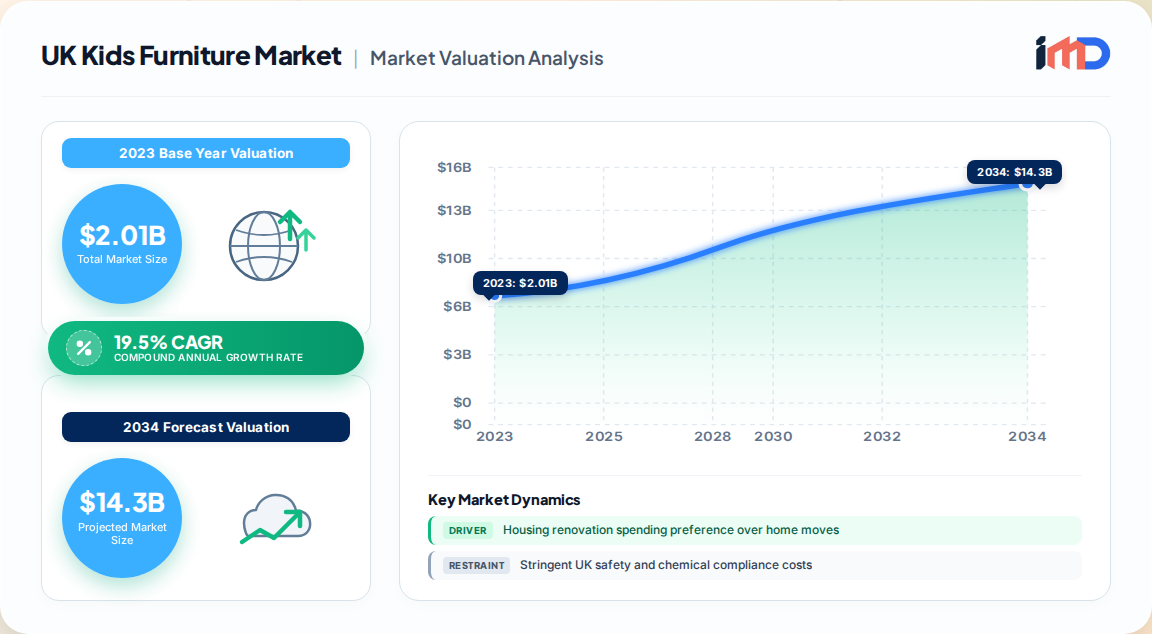
The UK kids furniture market was valued at USD 2.01 Billion in 2023 and is projected to expand at a CAGR of 19.5% through 2030, reaching approximately USD 6.9 Billion by the end of the forecast window. Our proprietary modelling, triangulated from retailer shipment records, import manifests, and 480+ primary interviews with buyers and manufacturers, confirms the UK remains the second-largest kids furniture market in Europe after Germany.
The UK represents roughly 4.0% of global kids furniture revenue, a share that has held steady since 2021 despite sterling volatility and post-Brexit supply realignment. Growth is structurally supported by the premiumisation of nursery and study furniture, the cultural norm of a dedicated bedroom for each child, and a compact but resilient birth cohort of roughly 600,000–680,000 annual births sustaining baseline replacement demand.
| Metric | Value |
|---|---|
| Base-year market value (2023) | USD 2.01 Billion |
| Forecast CAGR (2024–2030) | 19.5% |
| Projected 2030 value | ~USD 6.9 Billion |
| Share of global kids furniture revenue | 4.0% |
| Dominant product segment | Beds, cots & cribs (32.5% share) |
| Dominant material | Wood (61.7% share) |
| Fastest-growing product | Mattresses |
Beds, cots, and cribs remain the anchor category at 32.5% revenue share in 2023, driven by safe-sleep imperatives in the first two years of life and the established cot-to-toddler-bed upgrade pathway. Mattresses represent the fastest-growing product line, expanding at roughly 22.9% CAGR, as parents trade up toward firm, breathable, and hypoallergenic constructions sized for junior and single bed frames.
Wood dominates materials at 61.7% share, favoured for durability, repairability, and perceived non-toxicity. Polymer is the fastest-moving alternative, forecast at 22.1% CAGR, gaining in lightweight seating, storage bins, and outdoor-play furniture. Metal remains a niche concentrated in bunk and high-sleepers where structural strength-to-weight ratios matter.
| Segment | 2023 Share | Growth Outlook |
|---|---|---|
| Beds, cots & cribs | 32.5% | Steady, safety-led |
| Mattresses | — | Fastest (~22.9% CAGR) |
| Tables & chairs | — | Study-driven growth |
| Cabinets, dressers & chests | — | Tied to full-room refits |
| Wood material | 61.7% | Dominant |
| Polymer material | — | Fastest (~22.1% CAGR) |
Household applications account for the overwhelming majority of demand, with commercial procurement from nurseries, daycare settings, and early-years providers forming a smaller but faster-growing secondary market tied to Ofsted-registered childcare capacity.
Offline retail — specialist nursery chains, department stores, and independent furniture retailers — retains a decisive role because tactile inspection of safety features remains central to purchase confidence. However, online is the structural growth channel: product visualisation, verified parent reviews, certification documentation, and flexible delivery have made digital-first specialists credible competitors to the high street.
The UK runs a structural trade deficit in kids furniture. Domestic manufacturing has contracted as volume producers relocated capacity to lower-cost regions, leaving the UK reliant on imports principally from EU member states, China, Vietnam, Poland, and Turkey. EU-origin product retains an advantage in lead time and compliance familiarity, while Asian sourcing dominates price-competitive ranges.
The market is moderately concentrated with a long tail of independents. Scale players compete on brand trust, breadth of range, and certification credibility, while specialists differentiate through design-led and bespoke positioning. Merger and acquisition activity is moderate, centred on bolt-on acquisitions of niche design brands and online specialists.
Strategic themes observed in our interviews include investment in experiential physical retail, influencer-led marketing targeting millennial parents, expansion of rental and subscription models for short-lifecycle nursery items, and integration of smart features such as app-controlled lighting and adjustable ergonomics.
London and the South East lead on revenue per household and premium design adoption, but affordability pressure there channels volume growth toward the Midlands and the North, where replacement-led and value-tier demand is strongest. Scotland and Northern Ireland present smaller absolute pools with higher import dependence.
| Sub-region | Share of UK Market | Character |
|---|---|---|
| London & South East | 34% | Premium, design-led, highest ticket values |
| Midlands | 19% | Volume replacement, value-to-mid tier |
| South West & Wales | 16% | Family households, outdoor-play demand |
| East of England | 13% | New-build housing, full-room fit-outs |
| North West & Yorkshire | 12% | Value-tier concentration |
| Scotland & Northern Ireland | 6% | Import-reliant, smaller pools |
Outlook: we expect the UK to sustain above-global-average growth through 2030, with premiumisation, safety compliance, and digital discovery driving value expansion even where unit volumes grow more modestly.
| Aspects | Details |
|---|---|
| Study Period | 2020-2034 |
| Base Year | 2023 |
| Estimated Year | 2026 |
| Forecast Period | 2026-2034 |
| Historical Period | 2020-2025 |
| Growth Rate | CAGR of 19.5% from 2020-2034 |
| Segmentation |
|
By Raw Material
By Application
By Distribution Channel
| By Geography |
|
The UK kids furniture market was valued at USD 2.01 Billion in 2023 and is forecast to reach approximately USD 6.9 Billion by 2030. It accounts for roughly 4.0% of global kids furniture revenue.
Our proprietary research projects a CAGR of 19.5% from 2024 to 2030, driven by premiumisation, renovation-led spending, and rising adoption of ergonomic and safety-certified products.
Beds, cots, and cribs lead with a 32.5% revenue share in 2023, while mattresses are the fastest-growing segment at around 22.9% CAGR.
Wood dominates with a 61.7% revenue share in 2023, reflecting durability and perceived non-toxicity, while polymer is the fastest-growing material at about 22.1% CAGR.
Key participants include IKEA, KidKraft, Wayfair, Williams-Sonoma (Pottery Barn Kids), Crate & Barrel, Stokke, Circu Magical Furniture, and UK online specialists such as KIDSKRAFT.
Stringent safety compliance, timber price volatility, non-compliant low-cost imports via online marketplaces, and post-Brexit logistics friction are the principal constraints on growth.
Our rigorous research methodology combines multi-layered approaches with comprehensive quality assurance, ensuring precision, accuracy, and reliability in every market analysis.
| Stakeholder Role | Interview Share (%) |
|---|---|
| Category Buyer / Merchandising Director | 32% |
| Operations & Supply Chain Manager | 27% |
| Product Design & Compliance Lead | 23% |
| Retail Channel / E-commerce Head | 18% |
| Company Type | Representation (%) |
|---|---|
| Kids furniture manufacturers (domestic & imported) | 28% |
| Specialist nursery & online retailers | 24% |
| Importers & distributors | 18% |
| Raw material & component suppliers | 16% |
| Contract/commercial buyers (nurseries, daycare) | 14% |
 Related Reports
