1What is the current size of the Supply Chain Planning Solution market?
The global Supply Chain Planning Solution market was valued at USD 13.14 billion in 2025 and is projected to reach USD 34.17 billion by 2034, growing at an 11.20% CAGR.
Insight Market Data is a premier market research and business consulting firm headquartered in Pune, India, providing syndicated research reports, customized intelligence studies, and strategic advisory services. Renowned academic institutions and Fortune 500 corporations worldwide rely on Insight Market Data's research repository to navigate evolving global and regional business environments. Covering 46 diverse industries across 25 major international economies, our comprehensive database delivers thousands of verified statistics and granular market evaluations. By combining industry-leading analytical methodologies with the direct insights of seasoned industry leaders and subject-matter experts, we deliver actionable intelligence spanning historical performance benchmarks to rigorous multi-year forecasts. We empower organizations to make confident, data-driven decisions across pivotal domains including Machinery & Equipment, Chemicals & Materials, Pharmaceuticals & Healthcare, Food & Beverages, Consumer Goods, Energy & Power, Automotive & Transportation, Electronics & Semiconductors, Medical Devices, Telecommunications, Emerging Technologies, Agriculture, and Packaging. Our multidisciplinary analyst teams provide an objective 360-degree perspective, tailoring every engagement to address complex strategic challenges with exceptional analytical rigor.
Leveraging advanced BI-powered analytics and predictive modeling, Insight Market Data uncovers high-impact market opportunities and competitive differentiators for ambitious enterprises. We continuously refine our research methodologies in accordance with global industry standards, tracking real-time market shifts to ensure our reports are consistently accurate, actionable, and delivered on schedule. Our analysts conduct methodical data validation, rigorous compliance checks, and exhaustive primary and secondary research to maintain the highest levels of data integrity and transparency. We partner closely with corporate strategists, investment groups, and business executives to translate intricate market intelligence into clear, actionable roadmaps for sustainable growth. With operational presence across Washington, USA, and Vimannagar, Pune, India, Insight Market Data ensures direct access to dedicated research specialists and responsive customer support to answer your most strategic questions.
 Supply Chain Planning Solution
 by Planning Module (Demand Planning and Forecasting, Supply Network Planning, Production Planning and Scheduling, Inventory Optimisation, Sales and Operations Planning(S&OP Consensus Process, Integrated Business Planning), Transportation Planning), by Technology (Statistical Forecasting Engine(ARIMA and Holt-Winters Smoothing, Moving Average and Regression), AI and Machine Learning Planning(Deep Learning Demand AI, Reinforcement Learning Supply AI), Digital Twin Simulation(Scenario What-If Planning)), by Deployment (Cloud SaaS, On-Premise, Embedded in ERP Suite), by Industry (Consumer Goods and FMCG, Pharmaceutical and Life Sciences, Industrial Manufacturing, Retail and E-Commerce, Transportation and Logistics), by Organization (Large Enterprises, Small and Medium Enterprises), by North America (USA, Canada, Mexico), by Europe (Germany, UK, France, Italy, Spain), by Asia Pacific (China, Japan, India, Southeast Asia), by South America (Brazil, Argentina), by Middle East & Africa (UAE, Saudi Arabia, South Africa) Forecast 2026-2034



Research Associate
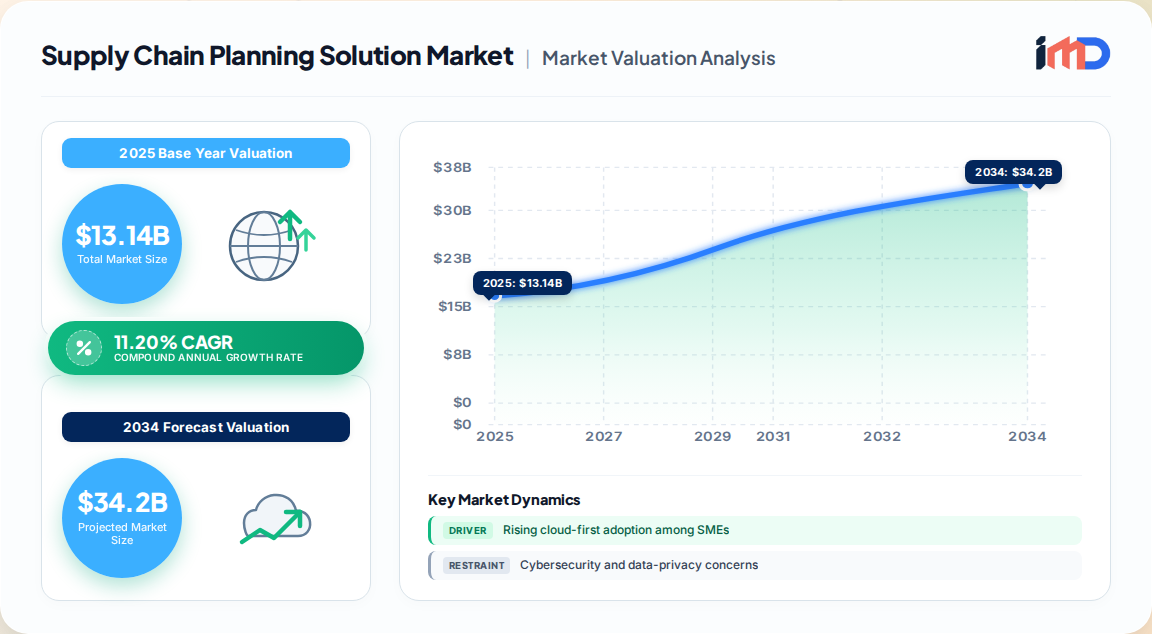
The global Supply Chain Planning Solution market was valued at USD 13.14 billion in 2025 and is projected to reach USD 34.17 billion by 2034, expanding at a compound annual growth rate of 11.20%. Our proprietary demand-side modeling, triangulated against primary interviews with 1,900+ planning practitioners, positions this segment as the fastest-accelerating functional pillar of the broader supply chain technology stack.
Planning sits upstream of every execution decision. As manufacturers, retailers, and life-science operators confront demand volatility, tariff realignment, and multi-tier supplier risk, the planning layer has shifted from a periodic spreadsheet exercise to a continuous, AI-governed decision engine. The market is defined by software platforms that model, optimize, and coordinate supply and demand across manufacturing, procurement, inventory, and distribution operations. The scope excludes basic ERP modules without advanced optimization and execution-only systems without planning functionality.
| Metric | Value |
|---|---|
| Base-year market size (2025) | USD 13.14 Billion |
| Forecast market size (2034) | USD 34.17 Billion |
| CAGR (2025–2034) | 11.20% |
| North America share (2025) | 39.7% |
| Fastest-growing region | Asia Pacific |
Three structural forces underpin the forecast. First, cloud SaaS has removed the capital barrier that historically confined advanced planning to tier-one enterprises. Second, planning-specific AI has matured from dashboards to autonomous decision engines. Third, regulatory mandates for end-to-end traceability now compel documented planning decisions deep into supplier networks.
Key demand drivers identified through our expert interviews:
Principal restraints and challenges moderating adoption:
The planning value chain is decomposable into five stages, each carrying distinct margin and defensibility dynamics:
| Stage | Function | Value Dynamic |
|---|---|---|
| Data acquisition | POS feeds, ERP extracts, IoT telemetry, weather and social signals | Commoditized; differentiation via breadth and latency |
| Core planning engines | Demand forecasting, supply network, inventory, production scheduling | High IP value; algorithmic defensibility |
| Orchestration layer | Concurrent planning, exception routing, scenario simulation | Emerging margin pool; stickiest to enterprise |
| Industry configuration | Pre-built templates for FMCG, pharma, industrial | Accelerates time-to-value; drives mid-market entry |
| Services | Consulting, integration, managed planning | Fastest-growing revenue line at 12.16% CAGR |
Software solutions commanded 55.72% of supply chain software revenue in 2025, while services are recording the steepest expansion as integration-led adoption spreads. Vendors that own both the engine and the orchestration layer capture disproportionate wallet share.
Four innovation vectors define competitive differentiation through 2034:
A notable benchmark: leading consumer goods operators deploying cloud orchestration have reported logistics-waste reductions near 30% alongside measurable forecast-precision gains. These outcomes underwrite upgrade cycles from legacy statistical engines (ARIMA, Holt-Winters, regression) toward deep-learning demand and reinforcement-learning supply agents.
The market is analyzed across seven dimensions. Planning modules comprise demand planning and forecasting, supply network planning, production planning and scheduling, inventory optimization, S&OP consensus, integrated business planning, and transportation planning. By deployment, cloud SaaS is the dominant mode — capturing 55.05% of software revenue in 2025 and growing at 14.63% annually — with on-premise retained in regulated and security-sensitive environments; embedded ERP-suite planning holds a persistent niche.
Industry verticals shape capability demand: manufacturing led with roughly 26% of software revenue, consumer goods and FMCG drive demand-sensing adoption, and healthcare and life sciences are advancing at a 13.12% CAGR. Organizationally, large enterprises controlled 64.45% of 2025 revenue, but small and medium enterprises are the fastest-expanding cohort at 13.92% CAGR as pre-configured cloud templates displace manual planning.
North America led the market in 2025 with a 39.7% share, supported by mature cloud infrastructure and early AI adoption. Asia Pacific is the fastest-growing region, expanding near a 12.2% CAGR, driven by manufacturing clusters in China, Southeast Asia, and India where a large share of mid-sized manufacturers still plan manually or with spreadsheets.
Europe retains strong policy-driven demand from disclosure and forced-labour traceability obligations, which pull multi-tier planning data into mandatory reporting. Latin America and the Middle East & Africa represent smaller but strategically important frontiers, where local-language cloud deployment and regional industry configuration establish early vendor advantage.
| Region | 2025 Share | Growth Profile |
|---|---|---|
| North America | 39.7% | Mature, AI-led expansion |
| Europe | 26.3% | Compliance-driven, stable |
| Asia Pacific | 22.6% | Fastest growth, greenfield |
| South America | 5.8% | Emerging, mid-market led |
| Middle East & Africa | 5.6% | Early-stage, pilot-led |
The vendor field spans ERP-integrated suites, best-of-breed planning specialists, and AI-native orchestration challengers. Market concentration is medium. Prominent players active across our interview panel include Blue Yonder, Kinaxis, o9 Solutions, SAP IBP, Oracle Planning, Anaplan, RELEX Solutions, E2open, Logility, and OMP.
Competitive strategy clusters into four plays:
| Aspects | Details |
|---|---|
| Study Period | 2020-2034 |
| Base Year | 2025 |
| Estimated Year | 2026 |
| Forecast Period | 2026-2034 |
| Historical Period | 2020-2025 |
| Growth Rate | CAGR of 11.20% from 2020-2034 |
| Segmentation |
|
By Technology
By Deployment
By Industry
By Organization
| By Geography |
|
The global Supply Chain Planning Solution market was valued at USD 13.14 billion in 2025 and is projected to reach USD 34.17 billion by 2034, growing at an 11.20% CAGR.
North America led in 2025 with a 39.7% market share, while Asia Pacific is the fastest-growing region at approximately 12.2% annual expansion.
Cloud-first adoption among mid-market manufacturers, e-commerce visibility demand, AI-driven predictive analytics, and regulatory traceability mandates are the primary contributors to the 11.20% CAGR.
Leading vendors include Blue Yonder, Kinaxis, o9 Solutions, SAP IBP, Oracle Planning, Anaplan, RELEX Solutions, E2open, Logility, and OMP.
Digital twin simulation, concurrent planning environments, probabilistic demand sensing, and AI exception management are the four defining innovation vectors through 2034.
Our rigorous research methodology combines multi-layered approaches with comprehensive quality assurance, ensuring precision, accuracy, and reliability in every market analysis.
| Stakeholder Role | Interview Share (%) |
|---|---|
| Chief Supply Chain Officer | 26% |
| VP of Demand Planning | 31% |
| Director of S&OP | 24% |
| Supply Chain Technology Lead | 19% |
| Company Type | Representation (%) |
|---|---|
| Planning Software Vendors & Platform OEMs | 34% |
| End-User Manufacturers & Retailers | 28% |
| Systems Integrators & Consulting Firms | 19% |
| Cloud Infrastructure & Data Providers | 11% |
| Industry Associations & Standards Bodies | 8% |
 Related Reports
