Insight Market Data is a premier market research and business consulting firm headquartered in Pune, India, providing syndicated research reports, customized intelligence studies, and strategic advisory services. Renowned academic institutions and Fortune 500 corporations worldwide rely on Insight Market Data's research repository to navigate evolving global and regional business environments. Covering 46 diverse industries across 25 major international economies, our comprehensive database delivers thousands of verified statistics and granular market evaluations. By combining industry-leading analytical methodologies with the direct insights of seasoned industry leaders and subject-matter experts, we deliver actionable intelligence spanning historical performance benchmarks to rigorous multi-year forecasts. We empower organizations to make confident, data-driven decisions across pivotal domains including Machinery & Equipment, Chemicals & Materials, Pharmaceuticals & Healthcare, Food & Beverages, Consumer Goods, Energy & Power, Automotive & Transportation, Electronics & Semiconductors, Medical Devices, Telecommunications, Emerging Technologies, Agriculture, and Packaging. Our multidisciplinary analyst teams provide an objective 360-degree perspective, tailoring every engagement to address complex strategic challenges with exceptional analytical rigor.
Leveraging advanced BI-powered analytics and predictive modeling, Insight Market Data uncovers high-impact market opportunities and competitive differentiators for ambitious enterprises. We continuously refine our research methodologies in accordance with global industry standards, tracking real-time market shifts to ensure our reports are consistently accurate, actionable, and delivered on schedule. Our analysts conduct methodical data validation, rigorous compliance checks, and exhaustive primary and secondary research to maintain the highest levels of data integrity and transparency. We partner closely with corporate strategists, investment groups, and business executives to translate intricate market intelligence into clear, actionable roadmaps for sustainable growth. With operational presence across Washington, USA, and Vimannagar, Pune, India, Insight Market Data ensures direct access to dedicated research specialists and responsive customer support to answer your most strategic questions.
Sports Consulting Services Market
Professional and Commercial Services / MARKET REPORT
Sports Consulting Services Market | Insight Market Data
Sports Consulting Services Market by Strategy Consulting (Market Entry Strategy, Brand Development, Business Planning), by Financial Advisory (Sponsorship Valuation, Revenue Optimization, Financial Management), by Marketing and Promotion (Digital Marketing Strategies, Event Marketing and Management), by Technology and Innovation Consulting (Data Analytics and Insights, Fan Engagement Technologies), by Human Resources and Talent Management (Talent Recruitment and Development, Organizational Structure Optimization), by North America (USA, Canada, Mexico), by Europe (Germany, UK, France), by Asia Pacific (China, Japan, South Korea, India), by Middle East & Africa (Saudi Arabia, UAE, Kuwait, Qatar) Forecast 2026-2034
Executive Overview: A Decade of Strategic Acceleration
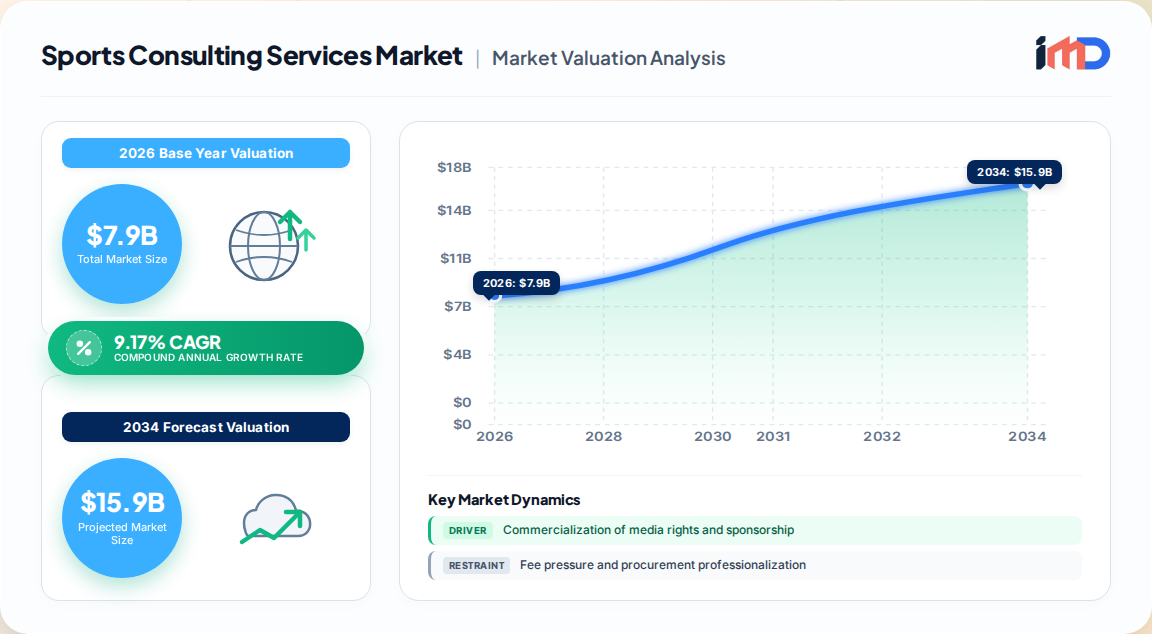
The global sports consulting services market is undergoing a structural re-rating. Our proprietary primary research and expert interview program estimates the market at USD 7.9 Billion in 2026, with a projected valuation of USD 19.02 Billion by 2034, expanding at a 9.17% CAGR across the forecast window. This trajectory reflects not merely cyclical sports commercialization but a fundamental re-architecture of how leagues, federations, teams, and investors acquire and deploy specialized advisory capability.
Sports Consulting Services Market Market Size (In Billion)
15.0B
10.0B
5.0B
0
7.236 B
2025
7.900 B
2026
8.624 B
2027
9.415 B
2028
10.28 B
2029
11.22 B
2030
12.25 B
2031
Three forces anchor this outlook. First, the institutionalization of private capital into sports assets has raised the analytical bar for valuation, sponsorship structuring, and operating model design. Second, digital transformation has moved from a pilot function to a P&L-critical mandate, with approximately 39% of total consulting demand now tied to digital initiatives. Third, the globalization of sports IP—particularly across cricket, esports, and Olympic-adjacent properties—has created a new class of buyer requiring market-entry and regulatory navigation support.
Base-year market size (2026): USD 7.9 Billion
Forecast valuation (2034): USD 19.02 Billion
Implied CAGR (2026–2034): 9.17%
Fastest-growing service line: Technology and innovation consulting
Largest end-user bloc: Leagues and teams (~38% of demand)
Our bottom-up estimation across the value chain—covering strategic planning, financial advisory, marketing and promotion, technology consulting, and human resources/talent management—confirms a market that is broadening in buyer base even as it concentrates in vendor capability. The result is a competitive field where global advisory majors, specialist sports boutiques, and tech-enabled analytics entrants are converging on the same C-suite buyer.
Structural Drivers and Demand Catalysts
The growth engine of this market is unusually legible at the buyer level, which is why our primary interviews place high confidence on the 2026–2034 forecast. Demand is not speculative; it is budgeted.
Commercialization of sports rights: The escalation of media rights values and the fragmentation of distribution platforms have created a pricing and packaging problem that internal teams cannot solve alone. Consultancies are being retained to model rights deals, optimize sponsorship portfolios, and build yield-management frameworks for ticketing and hospitality.
Private equity and institutional capital inflow: Investor due diligence in sports assets now routinely requires specialist commercial diligence—sponsorship pipeline validation, fan-base monetization modeling, and stadium real-estate assessment. This is a high-value, high-frequency engagement type.
Digital fan engagement imperative: More than 50% of major clubs and leagues have introduced third-party-supported digital fan engagement initiatives. Approximately 48% of consulting demand is now connected to fan engagement workstreams.
Sponsorship development and valuation: Around 24% of market demand is associated with sponsorship development strategy, including ROI measurement and partner activation.
Workforce and organizational complexity: Talent recruitment, front-office structuring, and athlete well-being programs are increasingly outsourced to specialist advisers as organizations professionalize governance.
A key accelerant identified in our expert interviews is the 61% of sports organizations that now explicitly invest in consulting services to enhance revenue generation. This metric is the single most reliable leading indicator we track for consulting wallet expansion.
Challenges and Market Restraints
Despite the robust headline CAGR, the market carries structural friction that will differentiate winners from participants.
Fee pressure and procurement professionalization: As sports organizations adopt formal procurement processes, consulting fees are being benchmarked against outcome-based and retained-service models. Boutique firms face margin compression on commoditized strategy work.
Talent scarcity in hybrid roles: The market requires advisers who combine sports commercial domain knowledge with data science, AI, and financial engineering capability. This talent pool is thin, and compensation inflation is a real constraint on boutique scalability.
Confidentiality and reputational sensitivity: Sports clients operate in a public-facing environment where strategic missteps are amplified. This raises engagement risk and lengthens sales cycles, particularly for new-entrant firms without track records.
Regulatory volatility: Data privacy regimes, athlete rights frameworks, and betting-related regulation vary materially by jurisdiction, forcing consultancies to maintain costly localized compliance expertise.
Client insourcing: Larger leagues and teams are building internal strategy and analytics units, which partially cannibalizes lower-value advisory work and pushes consultants toward higher-complexity mandates.
Transformational Trends: Generative AI and the Analytics Stack
Generative AI is not a peripheral theme in this market; it is reshaping the consulting product itself. Our interviews with practice leaders indicate that AI adoption is bifurcating the market into firms that can deploy proprietary analytical assets and firms that resell frameworks.
Scenario modeling and data synthesis: Generative AI enables rapid synthesis of fan data, sponsorship performance data, and competitive benchmarks, compressing engagement timelines.
Content and fan-experience personalization: Consultants are deploying AI to design personalized content journeys, dynamic ticketing propositions, and virtual fan zones—directly monetizable outputs.
Digital twin and venue analytics: Smart stadium advisory now incorporates predictive crowd modeling, energy optimization, and hospitality yield management.
Operational efficiency in back office: League and federation clients are using AI-enabled process redesign to reduce administrative cost, freeing budget for commercial investment.
The strategic implication is clear: consulting firms that combine strategic advisory with implementation capability—what we term hybrid advisory—are capturing disproportionate share of wallet. Pure-play strategy engagements are growing, but at a slower rate than technology-integrated mandates.
Segmentation Insights
The market segments along service type, application, and end-user, with meaningful variance in growth and margin profile.
Segment Dimension
Leading Segment
Estimated Share
Growth Character
By Type
Strategy and business planning
~30%
Stable, high-value
By Type
Sponsorship development strategy
~24%
Cyclical, deal-linked
By Type
Sports marketing and digital strategy
~21%
Fast-growing
By Type
Event management and PR strategy
~17%
Event-cycle sensitive
By Type
Financial management and diversification
~13%
Counter-cyclical demand
By Application
Leagues and teams
~38%
Largest wallet
By Application
Sports federations
~30%
Governance-driven
By Application
Event organizers
~15%
Project-based
By Application
Apparel and equipment companies
~12%
Brand-led
Two observations from our primary research deserve emphasis. First, the strategy and business planning segment remains the anchor of the market because it commands the highest day rates and longest engagement durations. Second, technology and innovation consulting—covering data analytics, fan engagement technologies, and AI-enabled operating models—is the fastest-growing service line, and we expect it to gain several points of share by 2034.
On the end-user side, leagues and teams represent the deepest pocket of demand, driven by media rights, sponsorship, and performance optimization requirements. Federations are a close second but exhibit longer procurement cycles and greater sensitivity to governance mandates.
Regional Outlook and Attractiveness
Regional demand mirrors the maturity of sports commercialization and the presence of institutional capital.
North America retains the largest share due to the depth of its professional league ecosystem and the sophistication of its sponsorship and media-rights markets. Europe is the most structurally mature but continues to generate premium advisory demand around club ownership transitions and multi-club models. Asia-Pacific is the highest-velocity growth region, with emerging professional leagues and digital-first fan bases creating greenfield consulting mandates. The Middle East & Africa, while smallest in share, exhibits the highest project-value volatility, driven by sovereign-backed sports investment and mega-event delivery.
For investors, we assess North America and Europe as margin-accretive but competitive, Asia-Pacific as growth-optimal, and Middle East & Africa as relationship-critical with outsized single-engagement value.
Competitive Landscape and Strategic White-Space
The vendor field is bifurcated between global advisory majors with sports practices and specialist sports consultancies with deep domain networks.
Global advisory majors: Deploy cross-sector capability, proprietary data, and brand credibility to win large, multi-workstream engagements, particularly in financial advisory and organizational transformation.
Specialist sports consultancies: Compete on domain depth, speed, and relationships; frequently win sponsorship, marketing, and event mandates.
Analytics and technology entrants: Bring productized capability in fan data, performance analytics, and digital experience, often partnering with or being acquired by larger firms.
Talent and executive search specialists: Capture demand for front-office and athlete-development mandates, adjacent to core consulting.
White-space opportunities identified in our analysis include: mid-market league and team advisory in Asia-Pacific; sustainability and ESG advisory for sports venues; athlete brand and NIL (name, image, likeness) strategy; and women's sports commercialization, which remains materially underserved relative to fan-base growth.
Value Chain and Engagement Economics
The consulting value chain in sports runs from diagnostic and strategy through implementation and managed services. Engagement economics vary materially by layer.
Diagnostic and strategy: Highest margin, shortest duration, most competitive.
Implementation and technology deployment: Growing share of wallet, requires delivery capability.
Managed services and retained advisory: Sticky revenue, lower margin, high renewal probability.
Data and benchmarking subscriptions: Emerging productized layer, attractive for scale economics.
Our interviews suggest that clients increasingly prefer integrated engagements spanning strategy through implementation, which favors firms with multidisciplinary teams. This is the primary rationale behind the M&A activity we have observed among mid-sized specialist firms seeking to add technology delivery capability.
1What is the size of the sports consulting services market in 2026?
Our proprietary research estimates the global sports consulting services market at USD 7.9 Billion in 2026, with a projected valuation of USD 19.02 Billion by 2034, representing a 9.17% CAGR over the forecast period.
2Which region dominates the sports consulting services market?
North America accounts for approximately 39% of global market share, supported by established professional leagues, advanced sports infrastructure, and sophisticated sponsorship and media-rights markets. Europe follows with around 28%, while Asia-Pacific contributes approximately 23% and is the fastest-growing region.
3What are the key segments driving demand for sports consulting services?
Leagues and teams represent the largest end-user segment at approximately 38% of demand, while strategy and business planning is the leading service type at around 30%. Sponsorship development strategy and digital marketing strategy together account for approximately 45% of service demand.
4What is the impact of generative AI on sports consulting?
Generative AI is transforming the consulting product through faster data synthesis, scenario modeling, and fan-experience personalization. Approximately 39% of total consulting demand is now linked to digital transformation initiatives, with AI and analytics-enabled engagements growing fastest.
5Who are the leading players in the sports consulting services market?
The market includes global advisory majors such as Deloitte, PwC, KPMG, Ernst & Young, McKinsey & Company, Boston Consulting Group, Bain & Company, and LEK Consulting, alongside specialist sports consultancies such as Portas Consulting, IMG, and Octagon.
6What are the main challenges facing the sports consulting services market?
Key challenges include fee pressure from procurement professionalization, scarcity of hybrid talent combining sports domain knowledge with data science, regulatory volatility across jurisdictions, and client insourcing of lower-value advisory work.
Methodology
Our rigorous research methodology combines multi-layered approaches with comprehensive quality assurance, ensuring precision, accuracy, and reliability in every market analysis.
Primary Research
Our analysis is built on a 70–80% primary research foundation, with 20–30% secondary research used for validation and benchmarking. This weighting reflects the need for granular, buyer-level intelligence in a market where engagements are bespoke and publicly disclosed data is limited.
We conducted structured interviews and surveys with senior decision-makers across the sports consulting value chain, including sports organization strategy directors, league commercial officers, federation governance executives, sponsorship and partnership managers, and consulting practice leaders.
Primary interviews were supplemented by expert consultations with front-office executives at professional teams, event organizing committees, and sports-focused private equity investors to validate demand-side budget allocations and engagement pipelines.
Participant recruitment was stratified by company type and job designation to ensure representative coverage of both supply-side and demand-side perspectives.
Key Stakeholders Interviewed
Key Stakeholders Interviewed
Stakeholder Role
Interview Share (%)
Chief Strategy Officer / Strategy Director
30%
Commercial and Revenue Officer
25%
Consulting Practice Partner
25%
Head of Sponsorship / Partnerships
20%
Industry Ecosystem Breakdown
Industry Ecosystem Breakdown
Company Type
Representation (%)
Global advisory and professional services firms
30%
Specialist sports strategy consultancies
25%
Sports marketing and sponsorship agencies
20%
Data analytics and technology consultancies
15%
Talent management and executive search firms
10%
Secondary Research & Industry Benchmarking
Secondary validation draws on recognized financial databases—Bloomberg, Factiva, Hoovers, and PitchBook—to cross-check company revenue profiles, M&A activity, and capital flows into sports assets.
We benchmark market structure and demand patterns against official multilateral and governmental sources, including the World Trade Organization, OECD, Eurostat, and national statistical agencies, as well as recognized non-profit trade associations and technical standards bodies in the sports and entertainment sector.
Industry association publications, league annual reports, and public procurement notices are used to triangulate engagement values and service-line demand.
Demand Modeling & Market Estimation
We apply both top-down and bottom-up methodologies simultaneously, with multi-level data triangulation to reconcile divergences. The top-down model sizes the market from aggregate sports industry commercial spend and consulting penetration rates; the bottom-up model aggregates service-line revenue across identified vendor cohorts.
Bottom-up estimation is built on specific quantitative metrics, including consulting wallet share per sports organization, average engagement value and duration by service line, number of active sports organizations by tier and region, and digital transformation budget allocation as a percentage of total consulting spend.
Segment-level forecasts are derived from engagement-level build-ups and validated against disclosed contract values and reported growth rates of listed and private advisory firms.
Every report is updated to the date of purchase, ensuring that base-year estimates, forecast assumptions, and competitive developments reflect the most current available evidence.
Data Accuracy & Quality Check
We guarantee an estimated data accuracy level of 85–90%, achieved through multi-source triangulation, outlier screening, and reconciliation of primary interview data against financial and trade databases.
Each data point is subjected to a two-stage validation: first, cross-verification across at least three independent primary or authoritative secondary sources; second, sanity-checking against historical trends and known industry benchmarks.
Final estimates are reviewed by senior analysts for internal consistency across segments, regions, and forecast years before inclusion in the report.
The HR analytics consulting services market reaches $6.9B in 2026 and grows at 11.9% CAGR to 2032, driven by AI workflows, pay transparency, and skills intelligence.
The global Transaction Advisory Service market is valued at $74.64 Billion in 2025 and is expected to reach $111.21 Billion by 2031, growing at a 6.83% CAGR.
Nov 2026|279 pages
$2900.00
Biostorage Service market valued at $3.5B in 2025, projected to reach $8.6B by 2035 at 8.7% CAGR. Explore growth drivers, trends, and regional insights.
Nov 2026|273 pages
$2900.00
The Dedicated Contract Carriage Service market is valued at USD 97.55 Billion in 2025, growing at a 6.24% CAGR to reach USD 138.62 Billion by 2031.
Nov 2026|202 pages
$2900.00
The Venue Operation Service market is valued at USD 18.3 billion in 2025, growing at 8.3% CAGR to reach USD 31.7 billion by 2032, driven by digitalization.