1What is the current market size of the Seed Low Humidity Storage Cabinet Market?
Our proprietary research estimates the global market at 487 Million in 2025, projected to reach 878 Million by 2033 with a CAGR of 8.1%.
Insight Market Data is a premier market research and business consulting firm headquartered in Pune, India, providing syndicated research reports, customized intelligence studies, and strategic advisory services. Renowned academic institutions and Fortune 500 corporations worldwide rely on Insight Market Data's research repository to navigate evolving global and regional business environments. Covering 46 diverse industries across 25 major international economies, our comprehensive database delivers thousands of verified statistics and granular market evaluations. By combining industry-leading analytical methodologies with the direct insights of seasoned industry leaders and subject-matter experts, we deliver actionable intelligence spanning historical performance benchmarks to rigorous multi-year forecasts. We empower organizations to make confident, data-driven decisions across pivotal domains including Machinery & Equipment, Chemicals & Materials, Pharmaceuticals & Healthcare, Food & Beverages, Consumer Goods, Energy & Power, Automotive & Transportation, Electronics & Semiconductors, Medical Devices, Telecommunications, Emerging Technologies, Agriculture, and Packaging. Our multidisciplinary analyst teams provide an objective 360-degree perspective, tailoring every engagement to address complex strategic challenges with exceptional analytical rigor.
Leveraging advanced BI-powered analytics and predictive modeling, Insight Market Data uncovers high-impact market opportunities and competitive differentiators for ambitious enterprises. We continuously refine our research methodologies in accordance with global industry standards, tracking real-time market shifts to ensure our reports are consistently accurate, actionable, and delivered on schedule. Our analysts conduct methodical data validation, rigorous compliance checks, and exhaustive primary and secondary research to maintain the highest levels of data integrity and transparency. We partner closely with corporate strategists, investment groups, and business executives to translate intricate market intelligence into clear, actionable roadmaps for sustainable growth. With operational presence across Washington, USA, and Vimannagar, Pune, India, Insight Market Data ensures direct access to dedicated research specialists and responsive customer support to answer your most strategic questions.
 Seed Low Humidity Storage Cabinet Market
 by Type (Large, Small), by Application (University Laboratory, Business Research Institute, Others), by North America (USA, Canada, Mexico), by Europe (Germany, UK, France, Italy, Spain, Russia), by Asia Pacific (China, Japan, India, South Korea, Australia), by South America (Brazil, Argentina), by Middle East & Africa (South Africa, GCC Countries, Israel) Forecast 2026-2034

Research Associate


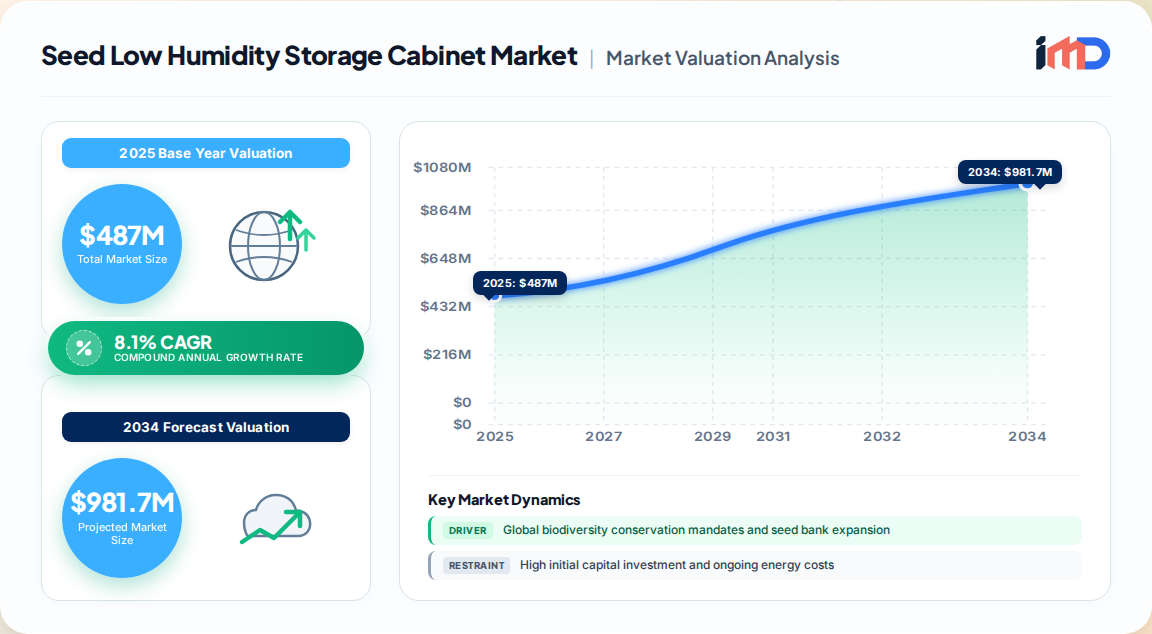
The global Seed Low Humidity Storage Cabinet Market is a critical, specialized segment within the broader agricultural and laboratory equipment landscape. Our proprietary primary research estimates the market at 487 Million in 2025, with a projected compound annual growth rate (CAGR) of 8.1% from 2026 to 2033. This growth is fundamentally anchored in the escalating global imperative for food security, biodiversity conservation, and advanced agricultural research. The market's core value proposition lies in its ability to create precisely controlled low-temperature and low-humidity microenvironments that drastically reduce seed metabolism, thereby extending viability from months to decades. This capability is indispensable for germplasm banks, university laboratories, and commercial seed research institutes that are racing to preserve genetic diversity against the backdrop of climate change and agricultural intensification.
Drivers:
Restraints:
The value chain is characterized by specialized component suppliers, system integrators (OEMs), channel partners, and end-users.
The market exhibits a clear pattern of trade, with advanced manufacturing concentrated in Europe, North America, and parts of East Asia. Official trade statistics from UN Comtrade and ITC's Trade Map indicate that Europe (particularly Germany, the Netherlands, and Switzerland) is a net exporter of high-precision environmental chambers, while Asia-Pacific and North America are major importers for institutional research infrastructure. China has rapidly expanded its manufacturing base, becoming a significant exporter of cost-competitive small and medium-sized cabinets, particularly to emerging markets in Southeast Asia, Africa, and Latin America. This dynamic creates a tiered market: premium, technology-rich cabinets from European and North American OEMs are sold at a significant price premium, while Chinese and Indian manufacturers compete aggressively on cost and local service.
The market is productively segmented by type and application, reflecting distinct user requirements.
| Segment | Key Characteristics | Primary Applications | Typical End-Users |
|---|---|---|---|
| Large Cabinets | Capacity >500 liters, redundant climate control, advanced data logging, energy-intensive | Long-term base collections, high-volume seed processing | National genebanks, large research institutes, commercial seed companies |
| Small Cabinets | Capacity <500 liters, single climate control unit, compact footprint, lower cost | Short-to-medium term storage, experimental controls, teaching | University laboratories, small business R&D units, botanical gardens |
The competitive landscape is moderately fragmented, with a mix of specialized niche players and diversified instrumentation conglomerates. Conviron and Weiss-Technik lead the high-end global market through technological leadership, brand equity, and extensive service networks. Aralab and Kelviron hold strong positions in Europe and North America, while Meditech and Acmas Technologies compete effectively in Asia with a focus on value engineering.
Strategic White-Space:
For buyers, the procurement of seed low humidity storage cabinets is a strategic decision balancing capital outlay against long-term reliability and operational risk.
| Aspects | Details |
|---|---|
| Study Period | 2020-2034 |
| Base Year | 2025 |
| Estimated Year | 2026 |
| Forecast Period | 2026-2034 |
| Historical Period | 2020-2025 |
| Growth Rate | CAGR of 8.1% from 2020-2034 |
| Segmentation |
|
| By Geography |
|
Our proprietary research estimates the global market at 487 Million in 2025, projected to reach 878 Million by 2033 with a CAGR of 8.1%.
Asia-Pacific is the fastest-growing region, driven by government seed industry revitalization programs in China and expanding agricultural research in India, holding a 42% market share.
Major drivers include global biodiversity conservation mandates, the need for climate-resilient crop breeding, and technological advancements in energy-efficient dehumidification and remote monitoring systems.
Leading players include Conviron, Weiss-Technik, Aralab, Kelviron, Meditech, Acmas Technologies, Labec, Bry-Air, Seed Processing Holland, BOXUN, and Zhejiang Top Cloud-agri Technology Co., Ltd.
The primary applications are university laboratories (45% of sales), business research institutes, and others such as government genebanks and botanical gardens.
High initial capital costs and continuous energy consumption for 24/7 operation are significant barriers, particularly for budget-constrained institutions and in regions with volatile energy prices.
Our rigorous research methodology combines multi-layered approaches with comprehensive quality assurance, ensuring precision, accuracy, and reliability in every market analysis.
| Stakeholder Role | Interview Share (%) |
|---|---|
| Procurement Director | 30% |
| Lab Manager | 25% |
| R&D Head | 22% |
| Operations Manager | 15% |
| Quality Assurance | 8% |
| Company Type | Representation (%) |
|---|---|
| Cabinet OEMs | 45% |
| Component Suppliers | 20% |
| Distributors & Channel Partners | 18% |
| End-Users | 12% |
| Regulatory & Standards Bodies | 5% |
 Related Reports
