1What is the size of the probiotic cosmetics market?
The global probiotic cosmetics market is estimated at USD 435.22 million in 2026 and is projected to reach USD 912.57 million by 2035, growing at a CAGR of 8.59%.
Insight Market Data is a premier market research and business consulting firm headquartered in Pune, India, providing syndicated research reports, customized intelligence studies, and strategic advisory services. Renowned academic institutions and Fortune 500 corporations worldwide rely on Insight Market Data's research repository to navigate evolving global and regional business environments. Covering 46 diverse industries across 25 major international economies, our comprehensive database delivers thousands of verified statistics and granular market evaluations. By combining industry-leading analytical methodologies with the direct insights of seasoned industry leaders and subject-matter experts, we deliver actionable intelligence spanning historical performance benchmarks to rigorous multi-year forecasts. We empower organizations to make confident, data-driven decisions across pivotal domains including Machinery & Equipment, Chemicals & Materials, Pharmaceuticals & Healthcare, Food & Beverages, Consumer Goods, Energy & Power, Automotive & Transportation, Electronics & Semiconductors, Medical Devices, Telecommunications, Emerging Technologies, Agriculture, and Packaging. Our multidisciplinary analyst teams provide an objective 360-degree perspective, tailoring every engagement to address complex strategic challenges with exceptional analytical rigor.
Leveraging advanced BI-powered analytics and predictive modeling, Insight Market Data uncovers high-impact market opportunities and competitive differentiators for ambitious enterprises. We continuously refine our research methodologies in accordance with global industry standards, tracking real-time market shifts to ensure our reports are consistently accurate, actionable, and delivered on schedule. Our analysts conduct methodical data validation, rigorous compliance checks, and exhaustive primary and secondary research to maintain the highest levels of data integrity and transparency. We partner closely with corporate strategists, investment groups, and business executives to translate intricate market intelligence into clear, actionable roadmaps for sustainable growth. With operational presence across Washington, USA, and Vimannagar, Pune, India, Insight Market Data ensures direct access to dedicated research specialists and responsive customer support to answer your most strategic questions.
 Probiotic Cosmetics Market
 by Product (Skin Care, Hair Care, Other Cosmetics), by Application (Anti-aging, Acne Treatment, Skin Hydration, Sensitive Skin Care, Other Applications), by Formulation Type (Creams, Serums), by Distribution Channel (E-commerce, Pharmacy & Drug Stores, Hypermarkets/Supermarkets, Specialty Stores), by Consumer Demographics (Age Group, Lifestyle), by North America (USA, Canada, Mexico), by Europe (Germany, UK, France, Italy, Spain), by Asia Pacific (China, Japan, South Korea, India, Australia), by Latin America (Brazil, Argentina), by Middle East & Africa (UAE, Saudi Arabia, South Africa) Forecast 2026-2034

Research Analyst

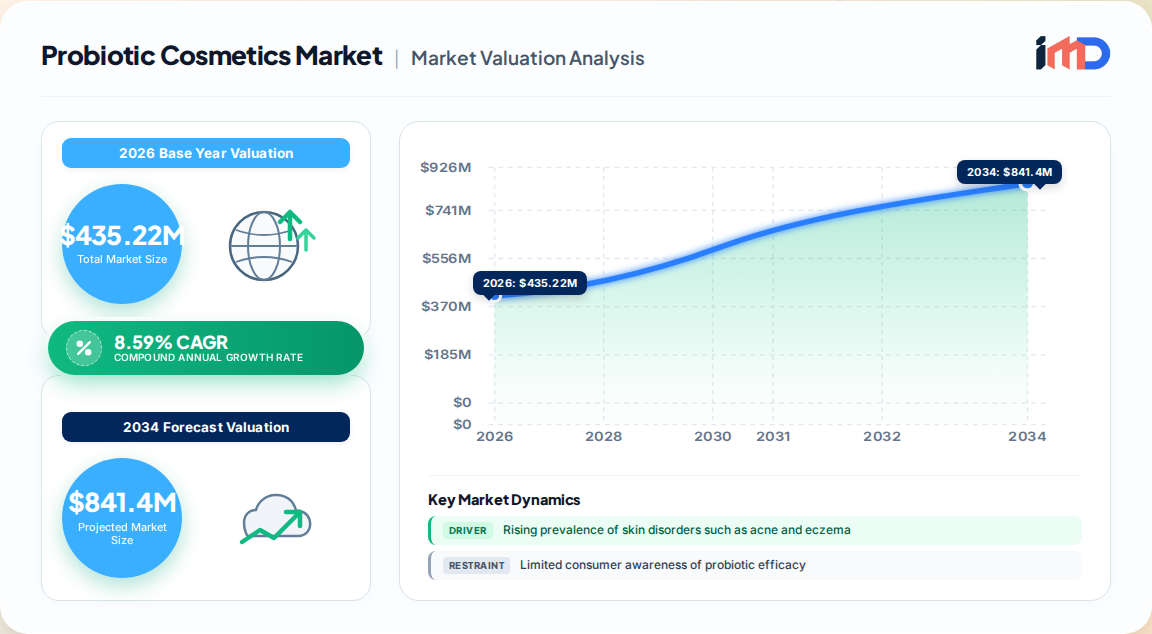
The global probiotic cosmetics market is estimated at USD 435.22 million in 2026 and is projected to reach USD 912.57 million by 2035, expanding at a CAGR of 8.59% over the forecast period. This growth is underpinned by a structural shift in consumer beauty routines toward microbiome-friendly, science-backed formulations that address skin barrier health, sensitivity, and premature aging.
Probiotic cosmetics—topical products incorporating live microorganisms, lysates, ferments, or prebiotic/postbiotic actives—have moved from niche wellness positioning into mainstream premium skincare. The category's expansion is fueled by rising consumer literacy regarding the skin microbiome, increasing prevalence of inflammatory skin conditions, and the commercial momentum of clean beauty.
North America remains the largest regional market, while Asia Pacific is the fastest-growing, registering double-digit momentum in key innovation hubs. E-commerce is the dominant distribution channel, though pharmacy and drug store channels are gaining ground as clinical validation improves.
The probiotic cosmetics value chain comprises five principal stages, each with distinct technical and commercial requirements.
| Stage | Key Activities | Value-Addition Focus |
|---|---|---|
| Strain Discovery & Fermentation | Identification of beneficial bacterial strains; fermentation optimization | Strain efficacy, stability, and intellectual property |
| Ingredient Supply & Biotech Processing | Production of lysates, ferments, prebiotics, postbiotics | Purity, concentration, and formulation compatibility |
| Formulation & Contract Manufacturing | Creams, serums, cleansers, and hair care development | Preservation of probiotic viability; texture and sensory performance |
| Branding & Marketing | Clinical validation, educational content, influencer engagement | Trust, claim substantiation, and premium positioning |
| Distribution & Retail | E-commerce, pharmacy, specialty, and mass retail | Access, education, and conversion |
A critical value-chain tension exists between probiotic viability and cosmetic preservation. Brands that resolve this through postbiotic and lysate technologies can achieve broader distribution and longer shelf life without cold-chain dependence.
| Region | Market Position | Growth Profile |
|---|---|---|
| North America | Largest market, ~34% revenue share | Mature, premium-led, high consumer awareness |
| Europe | Established, regulation-driven | Clean-beauty leadership; strong pharmacy channel |
| Asia Pacific | Fastest-growing region | Innovation hubs, digital-first adoption, rising disposable income |
| Latin America | Emerging | Growing middle class; clean-beauty interest accelerating |
| Middle East & Africa | Early-stage | Premium niche and wellness-led demand |
The U.S. accounts for the largest country-level share globally, supported by high consumer awareness and premium product adoption. South Korea remains a pivotal innovation and export hub, with skincare accounting for a substantial share of cosmetic imports. In Europe, regulatory rigor and sustainability expectations shape formulation and packaging decisions, creating a premium, compliance-oriented market. Asia Pacific's growth is driven by digital-native consumers, fast-moving beauty trends, and expanding e-commerce infrastructure.
The market features a mix of specialized microbiome-first brands, legacy beauty majors, and biotechnology ingredient suppliers. Key players include Tula Life, Inc., The Clorox Co., L'Oréal S.A., LaFlore Probiotic Skincare, Mother Dirt, Aurelia London, ProbioFerm, Burt's Bees, Estée Lauder, Kiehl's, and Dr. Organic.
Competitive positioning hinges on three axes:
Legacy brands leverage distribution scale and R&D budgets, while specialized brands benefit from authenticity and agility. Strategic partnerships between biotechnology firms and cosmetic brands are accelerating the translation of microbiome science into commercial products.
The long-term outlook remains strongly positive, with consumer interest in clean, natural, and microbiome-friendly beauty expected to sustain innovation and adoption through 2035.
| Aspects | Details |
|---|---|
| Study Period | 2020-2034 |
| Base Year | 2026 |
| Estimated Year | 2026 |
| Forecast Period | 2026-2034 |
| Historical Period | 2020-2025 |
| Growth Rate | CAGR of 8.59% from 2020-2034 |
| Segmentation |
|
By Formulation Type
By Distribution Channel
By Consumer Demographics
| By Geography |
|
The global probiotic cosmetics market is estimated at USD 435.22 million in 2026 and is projected to reach USD 912.57 million by 2035, growing at a CAGR of 8.59%.
North America holds the largest revenue share at approximately 34%, supported by high consumer awareness and premium product adoption, while Asia Pacific is the fastest-growing region.
Key drivers include rising prevalence of skin disorders such as acne and eczema, growing awareness of skin microbiome health, demand for clean beauty, and expanding e-commerce access.
Skin care dominates with over 90% revenue share, led by anti-aging applications, while hair care is the fastest-growing product segment.
Leading players include Tula Life, Inc., The Clorox Co., L'Oréal S.A., LaFlore Probiotic Skincare, Mother Dirt, Aurelia London, and Burt's Bees, among others.
Our rigorous research methodology combines multi-layered approaches with comprehensive quality assurance, ensuring precision, accuracy, and reliability in every market analysis.
| Stakeholder Role | Interview Share (%) |
|---|---|
| R&D and Formulation Scientists | 32% |
| Brand and Product Marketing Directors | 28% |
| Supply Chain and Procurement Managers | 22% |
| Regulatory Affairs Specialists | 18% |
| Company Type | Representation (%) |
|---|---|
| Probiotic Strain & Biotech Suppliers | 22% |
| Contract Manufacturers & Formulators | 26% |
| Microbiome-First Skincare Brands | 28% |
| Legacy Beauty & Personal Care Multinationals | 16% |
| E-commerce & Specialty Retail Distributors | 8% |

 Related Reports
