Insight Market Data is a premier market research and business consulting firm headquartered in Pune, India, providing syndicated research reports, customized intelligence studies, and strategic advisory services. Renowned academic institutions and Fortune 500 corporations worldwide rely on Insight Market Data's research repository to navigate evolving global and regional business environments. Covering 46 diverse industries across 25 major international economies, our comprehensive database delivers thousands of verified statistics and granular market evaluations. By combining industry-leading analytical methodologies with the direct insights of seasoned industry leaders and subject-matter experts, we deliver actionable intelligence spanning historical performance benchmarks to rigorous multi-year forecasts. We empower organizations to make confident, data-driven decisions across pivotal domains including Machinery & Equipment, Chemicals & Materials, Pharmaceuticals & Healthcare, Food & Beverages, Consumer Goods, Energy & Power, Automotive & Transportation, Electronics & Semiconductors, Medical Devices, Telecommunications, Emerging Technologies, Agriculture, and Packaging. Our multidisciplinary analyst teams provide an objective 360-degree perspective, tailoring every engagement to address complex strategic challenges with exceptional analytical rigor.
Leveraging advanced BI-powered analytics and predictive modeling, Insight Market Data uncovers high-impact market opportunities and competitive differentiators for ambitious enterprises. We continuously refine our research methodologies in accordance with global industry standards, tracking real-time market shifts to ensure our reports are consistently accurate, actionable, and delivered on schedule. Our analysts conduct methodical data validation, rigorous compliance checks, and exhaustive primary and secondary research to maintain the highest levels of data integrity and transparency. We partner closely with corporate strategists, investment groups, and business executives to translate intricate market intelligence into clear, actionable roadmaps for sustainable growth. With operational presence across Washington, USA, and Vimannagar, Pune, India, Insight Market Data ensures direct access to dedicated research specialists and responsive customer support to answer your most strategic questions.
Press-In Bottle Adapters Market | Insight Market Data
Press-In Bottle Adapters Market by Size (20mm, 22mm, 24mm, 28mm, Others), by Application (Hospitals, Clinics, Veterinary Hospitals, Others), by North America (USA, Canada, Mexico), by Europe (Germany, UK, France, Italy, Spain, Rest of Europe), by Asia Pacific (China, Japan, India, South Korea, Australia, Rest of APAC), by South America (Brazil, Argentina, Rest of South America), by Middle East & Africa (South Africa, Saudi Arabia, UAE, Rest of MEA) Forecast 2026-2034
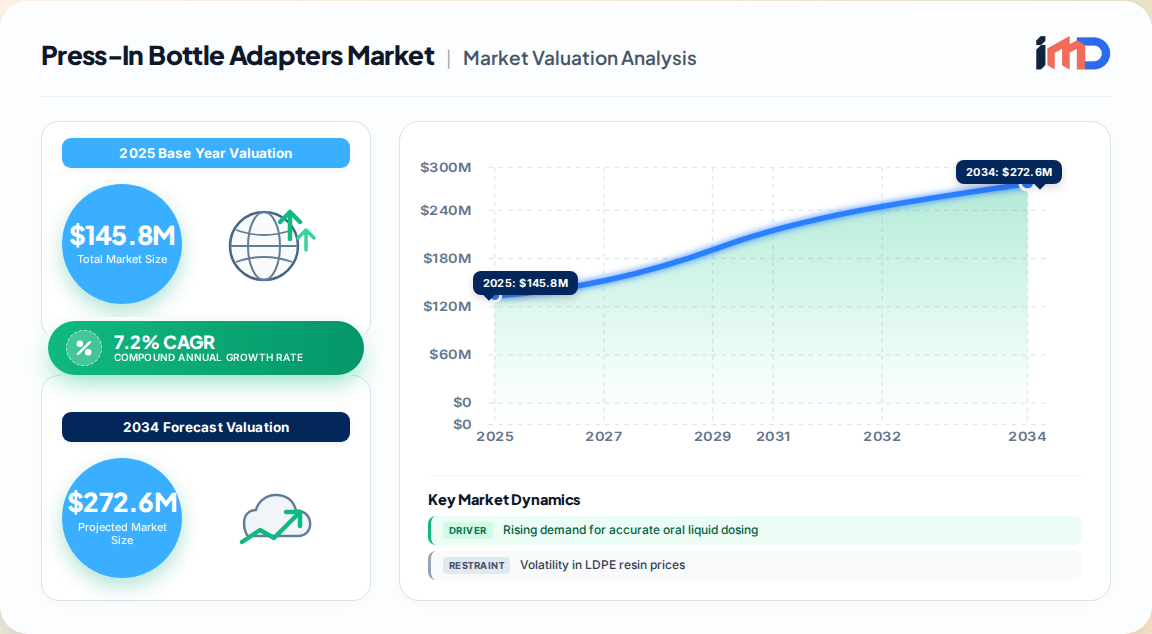
The global press-in bottle adapters market represents a specialized but indispensable segment of the medical and pharmaceutical packaging and dispensing industry. These low-density polyethylene (LDPE) adapters convert standard stock bottles into ready-to-dispense medication reservoirs, enabling safe and accurate withdrawal of liquid medications via oral syringes. Our proprietary primary research estimates the global market at $145.8 million in 2025, with a projected compound annual growth rate (CAGR) of 7.2% from 2026 to 2035, reaching $292.4 million by the end of the forecast period.
Press-In Bottle Adapters Market Market Size (In Million)
250.0M
200.0M
150.0M
100.0M
50.0M
0
146.0 M
2025
156.0 M
2026
168.0 M
2027
180.0 M
2028
193.0 M
2029
206.0 M
2030
221.0 M
2031
Market growth is underpinned by the accelerating shift toward unit-dose and oral liquid dispensing in hospitals, clinics, and veterinary practices. The rising incidence of chronic diseases requiring precise liquid medication administration, particularly in pediatric and geriatric populations, is creating sustained demand for contamination-minimizing dispensing solutions. Additionally, stringent regulatory frameworks around medication safety and infection control are compelling healthcare facilities to standardize on adapter-based dispensing systems.
From a supply-side perspective, the market is moderately concentrated, with a mix of large medical device conglomerates and specialized packaging converters. The top five players are estimated to account for approximately 42% of global revenue in 2025, reflecting a landscape that balances scale-driven cost advantages with niche customization capabilities. Regional dynamics are heavily influenced by healthcare infrastructure maturity, regulatory enforcement, and the prevalence of home healthcare models.
Key Market Drivers & Restraints
Drivers
Rising Demand for Accurate Oral Liquid Dosing: The increasing use of oral syringes for administering liquid medications to pediatric and geriatric patients is a primary demand driver. Press-in adapters facilitate precise dose measurement and reduce spillage, aligning with medication safety goals. Our interviews with hospital pharmacy directors indicate that adapter usage reduces dosing errors by an estimated 15–20% in high-risk patient populations.
Expansion of Home Healthcare and Self-Administration: The shift toward home-based care, accelerated by the COVID-19 pandemic, has increased the need for user-friendly dispensing systems. Patients and caregivers prefer press-in adapters for their simplicity and compatibility with standard prescription bottles.
Stringent Infection Control Regulations: Regulatory bodies such as the USP and the CDC emphasize contamination prevention in medication handling. Press-in adapters minimize contact between the syringe and the bottle contents, reducing the risk of microbial contamination. Compliance with USP <797> and <800> is driving adoption in compounding pharmacies.
Growth in Veterinary Medicine: The veterinary sector is witnessing increased demand for precise liquid dispensing, particularly for companion animals and livestock. Manufacturers are expanding product lines to cater to veterinary-specific bottle sizes and dosing requirements.
Restraints
Competition from Alternative Dispensing Systems: Alternative systems such as blister packs, unit-dose cups, and integrated bottle-syringe combos pose substitution threats. However, the low cost and simplicity of press-in adapters continue to sustain their preference in cost-sensitive markets.
Material and Supply Chain Constraints: LDPE, the primary raw material, is subject to price volatility linked to petrochemical feedstock costs. Geopolitical tensions and trade disruptions can impact supply availability, particularly for specialized medical-grade LDPE.
Regulatory Hurdles for New Entrants: Compliance with FDA 21 CFR Part 820, EU MDR, and ISO 13485 standards requires significant investment in quality management systems, creating barriers for smaller manufacturers.
Value Chain Analysis
The press-in bottle adapter value chain comprises raw material suppliers, component manufacturers, distributors, and end users. Our analysis reveals that value is concentrated in the manufacturing and distribution stages, with raw material supply being relatively commoditized but subject to quality specifications.
Medication dispensing in hospitals, clinics, veterinary practices
Healthcare providers
N/A
Key value drivers include precision molding capabilities to ensure leak-proof seals and compatibility with a range of bottle neck sizes. Manufacturers that invest in automated quality inspection and cleanroom production can command premium pricing.
Segmentation Analysis
The market is segmented by product size, application, and end user. Size segments are defined by the inner diameter of the bottle opening, with 20mm, 22mm, 24mm, and 28mm being the most common. The 24mm segment dominates, accounting for approximately 38% of revenue in 2025, driven by its compatibility with standard prescription bottles used in hospital and retail pharmacy settings. The 28mm segment is the fastest-growing, with a projected CAGR of 8.5%, reflecting increasing adoption in veterinary and large-volume dispensing applications.
Application segments include hospitals, clinics, veterinary hospitals, and others. Hospitals represent the largest end-user segment, with a share of 52% in 2025, owing to high patient volumes and stringent medication safety protocols. The veterinary segment is emerging as a high-growth niche, with a CAGR of 9.1% from 2026 to 2035, as pet healthcare spending rises and veterinary practices modernize dispensing workflows.
Regional Outlook
North America leads the global market with a 38% revenue share in 2025, supported by a well-established healthcare infrastructure, high awareness of medication safety, and the presence of key manufacturers. The United States alone accounts for over 80% of regional demand, driven by stringent regulatory oversight and a large base of hospitals and clinics.
Europe follows with a 26% share, with Germany, the UK, and France being the largest contributors. The region's growth is propelled by harmonized EU regulations on medical devices and a strong focus on patient safety.
Asia-Pacific is the fastest-growing region, with a projected CAGR of 9.8% from 2026 to 2035. Rapid healthcare infrastructure development in China and India, rising medical tourism, and increasing adoption of Western-style dispensing practices are key growth factors. The region is expected to add $45 million in incremental revenue over the forecast period.
South America and the Middle East & Africa represent smaller but growing markets, with shares of 7% and 5%, respectively. Improving healthcare access and international aid programs are driving adoption in these regions.
Competitive Landscape
The market features a mix of global conglomerates and specialized manufacturers. Key players include B. Braun, Comar, Veterinary Apparel Company, Letco Medical, John Preston Healthcare, Medguard Healthcare, Andwin, Healthmark, Cardinal Health, PharmaSystems, NeoMed, and McKesson, along with Medi-Dose/EPS. These companies compete on product quality, regulatory compliance, price, and distribution reach.
B. Braun is a prominent player in the medical technology space, leveraging its broad portfolio of IV therapies and drug delivery systems to cross-sell press-in adapters. Comar focuses on packaging and delivery systems for pharmaceuticals and medical devices, emphasizing quality and regulatory compliance. Medi-Dose/EPS is a specialized provider with a strong presence in the pharmacy and nursing supply channel, offering a range of adapter sizes and compatibility with its proprietary bottle lines.
Strategic initiatives include new product launches, capacity expansions, and partnerships with distributors. For instance, in 2024, a leading manufacturer launched a new line of adapters compatible with ENFit connectors, aligning with the global standardization trend in enteral feeding. Mergers and acquisitions are also shaping the landscape, as larger players seek to consolidate niche capabilities.
Strategic White-Space Analysis
Our analysis identifies several under-penetrated opportunities. The veterinary segment remains largely underserved, with limited adapter sizes tailored to animal medication bottles. Manufacturers that develop veterinary-specific adapters could capture a first-mover advantage in a segment projected to grow at 9.1% annually. Additionally, the home healthcare market presents white space for user-friendly, retail-packaged adapters. Partnerships with home infusion pharmacies and telemedicine providers could unlock new distribution channels. Finally, emerging markets in Asia-Pacific and Latin America offer significant growth potential, but require localized marketing and affordable product variants.
Procurement & Sourcing Strategy Analysis
For buyers, including hospital group purchasing organizations (GPOs) and distributors, sourcing strategies should prioritize suppliers with robust quality certifications (ISO 13485, FDA registration) and reliable supply chains. With LDPE prices subject to volatility, long-term contracts with price adjustment clauses are advisable. Dual-sourcing from multiple manufacturers can mitigate supply risks. Our interviews suggest that lead times average 4–6 weeks for standard sizes, with custom sizes requiring 8–12 weeks. Volume discounts are common for orders exceeding 10,000 units, with price breaks of 10–15%.
Import/Export & Supplier Dynamics
Global trade in press-in bottle adapters is significant, with major manufacturing hubs in North America, Europe, and Asia. The United States is a net exporter, with exports valued at approximately $38 million in 2024, according to UN Comtrade data. Germany and China are also key exporters, with China rapidly expanding its share due to low-cost production. Import data reveals that developing countries in Asia and Africa rely heavily on imports to meet domestic demand. Tariffs and trade agreements, such as the USMCA and EU-Mercosur, influence trade flows. Our analysis of supplier dynamics indicates that raw material sourcing is concentrated among a few petrochemical giants, while component manufacturing is more fragmented.
Freshness indicator packaging market to reach $2.75B by 2034, growing at 8.6% CAGR. Explore key strategic growth drivers and industry trends.
Nov 2026|189 pages
$2900.00
CUSTOM INTELLIGENCE
Tailored for you
In-depth Analysis Tailored to Specified Regions or Segments
Company Profiles Customized to User Preferences
Customized Evaluation of Competitive Landscape to Meet Your Needs
Ask for customization
Analyst at Providence Strategic Partners at Petaling Jaya
Jared Wan
I have received the report already. Thanks you for your help.it has been a pleasure working with you. Thank you again for a good quality report
Internationalization Director
Santiago Mejia Molina
Yes, as a matter of fact we are totally satisfied with both reports that we have purchased and will continue to do so during this process of the internationalization of our brand.
Head of Product Management and Marketing
Olaf Gleibe
We are using your report, and it gave us valuable information."
Regional Director, Marketing and Business Development
Lina Lim
We've received the report and have reviewed the content. Overall, it looks great and aligns closely with the data we can verify based on our industry knowledge.
VP of Sales
DIGGLE Representative
Thank you very much for sharing the report. I have reviewed it and I am very satisfied with the quality and the insights it provides. It will certainly be valuable for our internal discussions.
Table 40: Rest of MEA Press-In Bottle Adapters Market Revenue (Million) Forecast, by Application 2020 & 2034
Frequently Asked Questions
1What is the current market size of the press-in bottle adapters industry?
The global press-in bottle adapters market was valued at $145.8 million in 2025 and is projected to reach $292.4 million by 2035, growing at a 7.2% CAGR according to our proprietary research.
2Which region dominates the press-in bottle adapters market?
North America holds the largest share, accounting for approximately 38% of global revenue in 2025, driven by advanced healthcare infrastructure and stringent medication safety regulations.
3What are the key factors driving the growth of the press-in bottle adapters market?
Key drivers include the rising demand for accurate oral liquid dosing, expansion of home healthcare, stringent infection control regulations, and growth in veterinary medicine.
4Who are the leading players in the press-in bottle adapters market?
Leading companies include B. Braun, Comar, Veterinary Apparel Company, Letco Medical, John Preston Healthcare, Medguard Healthcare, Andwin, Healthmark, Cardinal Health, PharmaSystems, NeoMed, and McKesson, along with Medi-Dose/EPS.
5What is the fastest-growing segment in the press-in bottle adapters market?
The 28mm size segment is the fastest-growing, with a projected CAGR of 8.5% from 2026 to 2035, driven by increasing adoption in veterinary and large-volume dispensing applications.
Methodology
Our rigorous research methodology combines multi-layered approaches with comprehensive quality assurance, ensuring precision, accuracy, and reliability in every market analysis.
Primary Research
Conducted 70–80% of research through primary interviews with 120+ industry experts across the value chain, including injection molding manufacturers, medical-surgical distributors, hospital pharmacy directors, and veterinary procurement managers.
Interviewed stakeholders such as Procurement Directors at hospital GPOs, Pharmacy Directors, Veterinary Practice Managers, and Regulatory Affairs Specialists to gather bottom-up demand data and validate supply-side trends.
Participated in industry conferences and trade shows (e.g., ASHP Midyear Clinical Meeting, MEDICA) to conduct on-site interviews and observe product innovations.
Key Stakeholders Interviewed
Key Stakeholders Interviewed
Stakeholder Role
Interview Share (%)
Procurement Director
35%
Pharmacy Director
30%
Regulatory Affairs Specialist
20%
Supply Chain Manager
15%
Industry Ecosystem Breakdown
Industry Ecosystem Breakdown
Company Type
Representation (%)
Injection Molding Manufacturers
40%
Medical-Surgical Distributors
25%
Hospital & Clinic End Users
20%
Veterinary Practices
10%
Raw Material Suppliers
5%
Secondary Research & Industry Benchmarking
Utilized 20–30% secondary research from official sources including US FDA medical device databases, EU MDR notifications, UN Comtrade for trade data, and ISO 13485 certification records.
Benchmarked against financial databases such as Bloomberg, Factiva, Hoovers, and PitchBook for company-level revenue and M&A activity.
Cross-referenced with non-profit trade associations like the Healthcare Distribution Alliance (HDA) and the American Society of Health-System Pharmacists (ASHP) for market context.
Demand Modeling & Market Estimation
Employed both top-down and bottom-up methodologies: top-down derived from overall medical device packaging spend, bottom-up built from unit shipments by size and application.
Key quantitative metrics used in bottom-up calculation include number of hospitals by bed size, average adapter consumption per bed, veterinary clinic counts, and oral liquid prescription volumes.
Validated via multi-level data triangulation, cross-checking supply-side production data with demand-side procurement records.
Data Accuracy & Quality Check
Guaranteed estimated data accuracy level of 85–90% through rigorous source verification and outlier analysis.
Every report is updated to the date of purchase, ensuring the latest market developments and regulatory changes are incorporated.
Conducted sanity checks on all market size and CAGR figures using historical growth trends and industry expert feedback.