1What is the current size of the Oral Dose Packaging Market?
Our proprietary research values the market at USD 171.3 billion in 2026, with a projected CAGR of 16.9% to reach USD 816.97 billion by 2036.
Insight Market Data is a premier market research and business consulting firm headquartered in Pune, India, providing syndicated research reports, customized intelligence studies, and strategic advisory services. Renowned academic institutions and Fortune 500 corporations worldwide rely on Insight Market Data's research repository to navigate evolving global and regional business environments. Covering 46 diverse industries across 25 major international economies, our comprehensive database delivers thousands of verified statistics and granular market evaluations. By combining industry-leading analytical methodologies with the direct insights of seasoned industry leaders and subject-matter experts, we deliver actionable intelligence spanning historical performance benchmarks to rigorous multi-year forecasts. We empower organizations to make confident, data-driven decisions across pivotal domains including Machinery & Equipment, Chemicals & Materials, Pharmaceuticals & Healthcare, Food & Beverages, Consumer Goods, Energy & Power, Automotive & Transportation, Electronics & Semiconductors, Medical Devices, Telecommunications, Emerging Technologies, Agriculture, and Packaging. Our multidisciplinary analyst teams provide an objective 360-degree perspective, tailoring every engagement to address complex strategic challenges with exceptional analytical rigor.
Leveraging advanced BI-powered analytics and predictive modeling, Insight Market Data uncovers high-impact market opportunities and competitive differentiators for ambitious enterprises. We continuously refine our research methodologies in accordance with global industry standards, tracking real-time market shifts to ensure our reports are consistently accurate, actionable, and delivered on schedule. Our analysts conduct methodical data validation, rigorous compliance checks, and exhaustive primary and secondary research to maintain the highest levels of data integrity and transparency. We partner closely with corporate strategists, investment groups, and business executives to translate intricate market intelligence into clear, actionable roadmaps for sustainable growth. With operational presence across Washington, USA, and Vimannagar, Pune, India, Insight Market Data ensures direct access to dedicated research specialists and responsive customer support to answer your most strategic questions.

 Oral Dose Packaging Market
 by Material (Glass, Plastics, Paper & Paperboards, Metal, Others), by Dose Type (Reusable, Disposable), by End User (Clinics, Hospitals, Homecare Settings, Others), by Technology (Unit Dose Dispensing Systems, Child-Resistant Packaging, Tamper-Evident Packaging, Moisture Barrier Technology, Blister Sealing Technology, Serialization and Track-and-Trace Systems), by Distribution Channel (Direct Sales, Distributors, E-commerce Platforms, Institutional Supply Chains), by North America (USA, Canada), by Europe (Germany, UK, France), by Asia Pacific (China, Japan, South Korea), by Latin America (Brazil, Mexico), by Middle East & Africa (South Africa, GCC) Forecast 2026-2034

Research Associate

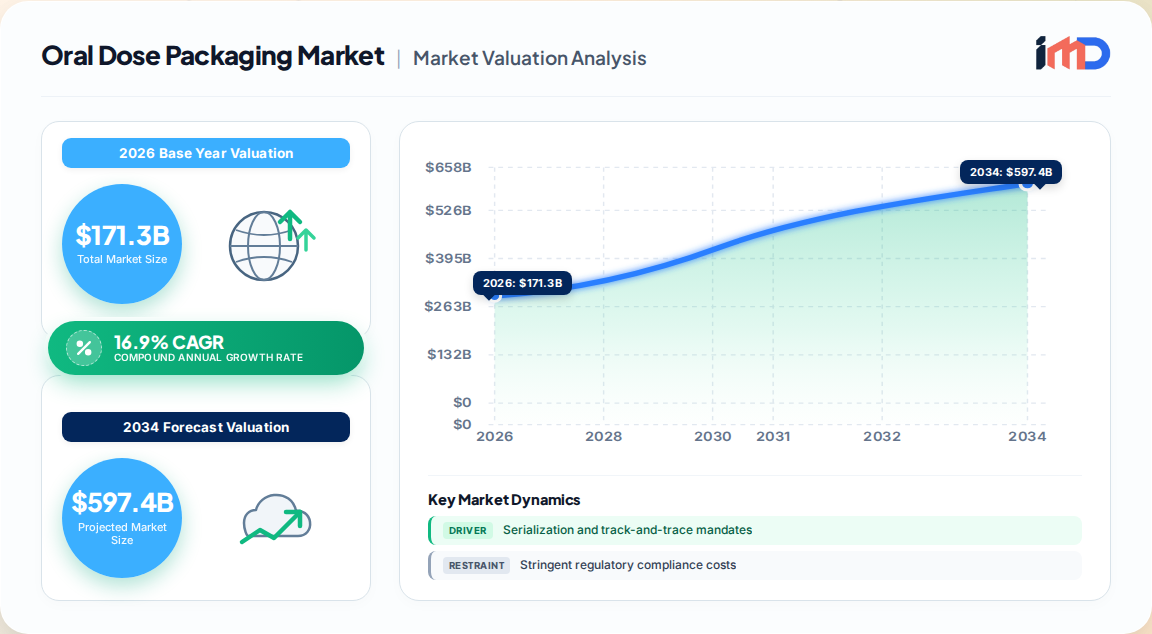
The global Oral Dose Packaging Market stands at a pivotal inflection point. Our first-party primary research estimates the market at USD 171.3 billion in 2026, projected to expand to USD 816.97 billion by 2036, representing a robust CAGR of 16.9% over the forecast decade. This growth is not merely a function of volume expansion in pharmaceutical output; it is driven by a structural redefinition of the package from a passive container to an active compliance, safety, and data node within the healthcare supply chain.
The market's evolution is underpinned by three converging forces: the global proliferation of chronic disease management requiring adherence-enhancing formats, the tightening regulatory noose around serialization and child-resistance, and the decentralization of care toward homecare settings. Plastics dominate the material landscape at 57.8% of the 2026 segment, while disposable dose formats command 64.3%, reflecting the hospital sector's preference for standardized, single-use, and tamper-evident packaging. Hospitals remain the largest end-user, accounting for 52.0% of procurement, driven by the need for automated dispensing compatibility and error reduction.
The market's upward trajectory is propelled by a confluence of regulatory and demographic factors.
A granular understanding of the value chain reveals critical control points and margin pools.
| Stage | Key Activities | Dominant Player Types | Value-Added Focus |
|---|---|---|---|
| Raw Material Supply | Polymer resin, aluminum foil, specialty paper, glass production | Chemical and material suppliers | Barrier properties, recyclability, food-grade compliance |
| Conversion & Packaging | Blister forming, filling, sealing, cartoning, labeling | Pharmaceutical packaging converters and CPOs | Multi-format flexibility, serialization integration, lean manufacturing |
| Technology Integration | Printing (serialization, QR codes), sensor embedding, child-resistant closure mechanisms | Technology solution providers | Interoperability, data security, regulatory compliance |
| Distribution & Logistics | Warehousing, cold chain (if applicable), direct-to-pharmacy, institutional supply chains | Distributors and logistics providers | Supply chain visibility, temperature control |
| End-Use Application | Dispensing, patient use | Hospitals, retail pharmacies, homecare settings | Medication adherence, safety, error reduction |
The conversion stage captures the highest value, where companies that integrate technology and compliance features command premium pricing. Raw material supply is increasingly strategic with the push for sustainable materials.
Asia-Pacific leads global growth, projected to account for 41% of regional market share, spearheaded by South Korea (16.9% CAGR) and USA (16.7% CAGR). South Korea's growth is anchored by a robust pharmaceutical manufacturing base and stringent packaging regulations, while the USA market is driven by FDA modernization and high per-capita drug consumption.
Europe follows closely, with 24% share, where the EU Green Deal and packaging waste directives are forcing a rapid shift toward mono-material and recyclable formats. North America (27% share) remains a mature but high-value market, with significant import activity for generic drugs from India and China, both of which are major exporters of oral solid dosage forms. Trade data from UN Comtrade indicates that global trade in pharmaceutical packaging materials grew by 8.3% year-over-year in 2025, reflecting robust cross-border supply chains.
Key trade flows: The EU is a net exporter of high-value barrier films and specialized packaging machinery, while Asia Pacific is a net exporter of finished blister packs and generic drug packaging. Import/export regulations for pharmaceutical goods are stringent, with the EU's Access2Markets portal serving as a critical resource for compliance with destination-country packaging and labeling requirements.
The market segmentation reveals distinct procurement patterns that shape competitive strategies.
The market is intensely competitive, with Amcor plc, Constantia Flexibles, WestRock Company, and Huhtamaki Oyj leading the global stage. Competition is anchored in four pillars: regulatory compliance, product breadth, regional distribution access, and technological integration.
Strategic imperatives include:
Ansoff Matrix analysis indicates that market leaders are pursuing market penetration in emerging markets (e.g., South Korea) while diversifying into smart packaging and sustainable materials for product development.
The next decade presents attractive white spaces:
By 2036, the oral dose packaging market will be defined by compliance-integrated, patient-centric, and sustainable formats. Suppliers that invest in digital track-and-trace and multi-format flexibility will be best positioned to capture the projected USD 645.7 billion incremental opportunity between 2026 and 2036.
| Aspects | Details |
|---|---|
| Study Period | 2020-2034 |
| Base Year | 2026 |
| Estimated Year | 2026 |
| Forecast Period | 2026-2034 |
| Historical Period | 2020-2025 |
| Growth Rate | CAGR of 16.9% from 2020-2034 |
| Segmentation |
|
By End User
By Technology
By Distribution Channel
| By Geography |
|
Our proprietary research values the market at USD 171.3 billion in 2026, with a projected CAGR of 16.9% to reach USD 816.97 billion by 2036.
Asia-Pacific is the fastest-growing region, led by South Korea at 16.9% CAGR, supported by strong pharmaceutical manufacturing and regulatory modernization.
Key drivers include expanding chronic disease management, regulatory mandates for serialization and child-resistant packaging, and the growth of homecare medication delivery.
Leading companies include Amcor plc, Constantia Flexibles, WestRock Company, and Huhtamaki Oyj, who compete on compliance integration and regional distribution.
Plastics account for 57.8% of the material segment due to cost efficiency, excellent barrier properties, and compatibility with child-resistant and tamper-evident closure systems.
Our rigorous research methodology combines multi-layered approaches with comprehensive quality assurance, ensuring precision, accuracy, and reliability in every market analysis.
| Stakeholder Role | Interview Share (%) |
|---|---|
| Procurement Director | 30% |
| Head of Packaging Development | 25% |
| Regulatory Affairs Manager | 25% |
| Operations Director | 20% |
| Company Type | Representation (%) |
|---|---|
| Pharmaceutical Packaging Converters | 35% |
| Contract Packaging Organizations (CPOs) | 25% |
| Pharmaceutical Manufacturers | 20% |
| Raw Material Suppliers | 12% |
| Hospital Procurement Departments | 8% |

Analyst at Providence Strategic Partners at Petaling Jaya
I have received the report already. Thanks you for your help.it has been a pleasure working with you. Thank you again for a good quality report

Internationalization Director
Yes, as a matter of fact we are totally satisfied with both reports that we have purchased and will continue to do so during this process of the internationalization of our brand.

Head of Product Management and Marketing
We are using your report, and it gave us valuable information."

Regional Director, Marketing and Business Development
We've received the report and have reviewed the content. Overall, it looks great and aligns closely with the data we can verify based on our industry knowledge.

VP of Sales
Thank you very much for sharing the report. I have reviewed it and I am very satisfied with the quality and the insights it provides. It will certainly be valuable for our internal discussions.
 Related Reports
