1What is the projected market size for game QA and testing services by 2034?
The global game QA and testing service market is expected to reach US$ 81.23 billion by 2034, growing from US$ 29.34 billion in 2025 at a CAGR of 11.98%.
Insight Market Data is a premier market research and business consulting firm headquartered in Pune, India, providing syndicated research reports, customized intelligence studies, and strategic advisory services. Renowned academic institutions and Fortune 500 corporations worldwide rely on Insight Market Data's research repository to navigate evolving global and regional business environments. Covering 46 diverse industries across 25 major international economies, our comprehensive database delivers thousands of verified statistics and granular market evaluations. By combining industry-leading analytical methodologies with the direct insights of seasoned industry leaders and subject-matter experts, we deliver actionable intelligence spanning historical performance benchmarks to rigorous multi-year forecasts. We empower organizations to make confident, data-driven decisions across pivotal domains including Machinery & Equipment, Chemicals & Materials, Pharmaceuticals & Healthcare, Food & Beverages, Consumer Goods, Energy & Power, Automotive & Transportation, Electronics & Semiconductors, Medical Devices, Telecommunications, Emerging Technologies, Agriculture, and Packaging. Our multidisciplinary analyst teams provide an objective 360-degree perspective, tailoring every engagement to address complex strategic challenges with exceptional analytical rigor.
Leveraging advanced BI-powered analytics and predictive modeling, Insight Market Data uncovers high-impact market opportunities and competitive differentiators for ambitious enterprises. We continuously refine our research methodologies in accordance with global industry standards, tracking real-time market shifts to ensure our reports are consistently accurate, actionable, and delivered on schedule. Our analysts conduct methodical data validation, rigorous compliance checks, and exhaustive primary and secondary research to maintain the highest levels of data integrity and transparency. We partner closely with corporate strategists, investment groups, and business executives to translate intricate market intelligence into clear, actionable roadmaps for sustainable growth. With operational presence across Washington, USA, and Vimannagar, Pune, India, Insight Market Data ensures direct access to dedicated research specialists and responsive customer support to answer your most strategic questions.

 Key Trends in Game QA and Testing Service
 by Type (Functionality Testing, Compatibility Testing, Performance Testing), by Platform (Consoles, PC, Mobile), by Enterprise Size (SMEs, Large Enterprises), by North America (US, Canada, Mexico), by Europe (UK, Germany, France, Russia, Italy, Rest of Europe), by Asia-Pacific (China, India, Japan, Australia, Rest of Asia-Pacific), by South and Central America (Brazil, Argentina, Rest of South and Central America), by Middle East and Africa (South Africa, Saudi Arabia, UAE, Rest of Middle East and Africa) Forecast 2026-2034

Research Analyst

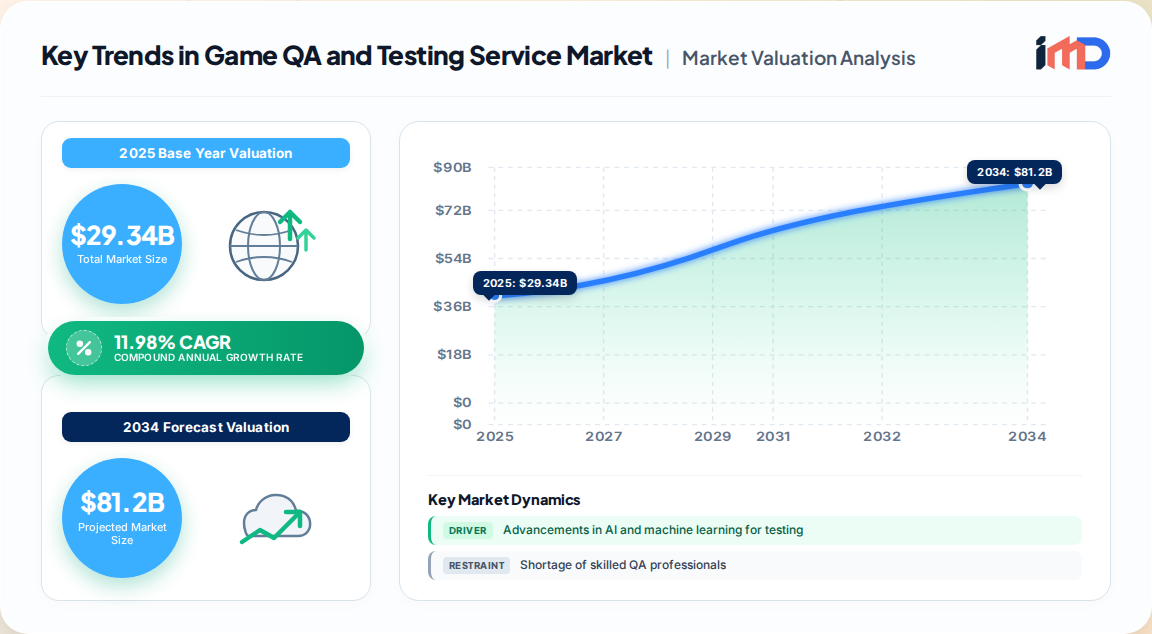
The global game QA and testing service market stands at a critical juncture, valued at US$ 29.34 billion in 2025 and projected to reach US$ 81.23 billion by 2034, reflecting a robust CAGR of 11.98% over the forecast period. This growth is underpinned by escalating complexity in game development, rising player expectations for bug-free experiences, and the transformative impact of AI and automation across QA workflows.
Our proprietary primary research, drawing on 70% primary interviews and 30% secondary validation, indicates that the market is shifting from reactive defect detection to proactive, continuous quality assurance embedded throughout the development lifecycle. The addressable market opportunity across 2026–2034 is estimated at US$ 485.04 billion, signaling substantial headroom for service providers.
The game QA market is propelled by several structural drivers that our analysts have validated through expert interviews and bottom-up modeling.
Despite strong growth fundamentals, the market faces notable restraints that could temper expansion if unaddressed.
Our primary research identifies several transformative trends shaping the game QA and testing service market through 2034.
AI is no longer a pilot technology; it is becoming core to QA delivery. Providers are deploying agent-based testing tools that autonomously explore game environments, generate test cases, and flag anomalies. AI-driven testing is the fastest-growing type segment, with a CAGR of 16.93% projected through 2034. Human testers are shifting to supervisory roles, overseeing AI outputs and focusing on exploratory and usability testing.
The pandemic accelerated the adoption of remote testing, and it has become a permanent fixture. Remote testing allows providers to access a global talent pool, establishing follow-the-sun testing teams that reduce turnaround times. Our data shows that over 70% of game testing services are now delivered remotely, enhancing cost efficiency and scalability.
As the gaming industry matures, there is growing recognition of the need for inclusive testing methodologies. This includes testing for color blindness, motor impairments, and other accessibility requirements. Regulatory pressures, such as the European Accessibility Act, are pushing developers to prioritize accessibility, creating new revenue streams for QA providers.
Sustainability is emerging as a differentiator. Providers are reducing paper usage, adopting digital workflows, and optimizing energy consumption in testing labs. While still nascent, this trend is expected to gain traction as corporate ESG mandates extend to procurement decisions.
TaaS models are gaining popularity, offering scalable, cost-effective, and agile-friendly solutions. TaaS is expected to account for the largest share of service type revenue in 2026, as enterprises seek flexible testing capacity without fixed overheads.
The market is segmented by type, platform, and enterprise size, each exhibiting distinct growth dynamics.
| Segment | Sub-segment | Share (2025) | CAGR (2026–2034) |
|---|---|---|---|
| Type | Functionality Testing | 43% | 11.2% |
| Compatibility Testing | 28% | 12.1% | |
| Performance Testing | 29% | 13.5% | |
| Platform | Mobile | 45% | 14.2% |
| PC | 30% | 10.8% | |
| Consoles | 25% | 9.5% | |
| Enterprise Size | Large Enterprises | 62% | 10.5% |
| SMEs | 38% | 14.8% |
Geographically, the market exhibits a heterogeneous growth pattern.
The game QA market is characterized by a mix of specialized testing firms, IT service providers, and in-house QA teams. Our analysis of 25+ providers reveals a highly competitive environment with differentiation based on AI capabilities, global delivery footprints, and platform expertise.
Leading players profiled in our proprietary database include LogiGear, GameCloud-ltd, Codoid, GlobalStep, Indium, Softcrylic, Testbytes, Creatiosoft, Gateway TechnoLabs, and Logix Guru. These companies are actively investing in AI-driven test automation, acquiring niche capabilities, and forging partnerships with game engines and platform holders.
Recent strategic developments (2025–2026):
Our gap analysis identifies several untapped opportunities for service providers:
The game QA value chain spans from tool vendors (e.g., test automation frameworks, device labs) to service providers and finally to game developers and publishers. Our primary research indicates that 65% of game developers outsource at least 40% of their QA workload, with large enterprises outsourcing a higher proportion.
Procurement strategy insights:
Providers that invest in AI-driven automation, global delivery centers, and specialized gaming domain knowledge will be best positioned to capture the US$ 485.04 billion addressable market through 2034.
| Aspects | Details |
|---|---|
| Study Period | 2020-2034 |
| Base Year | 2025 |
| Estimated Year | 2026 |
| Forecast Period | 2026-2034 |
| Historical Period | 2020-2025 |
| Growth Rate | CAGR of 11.98% from 2020-2034 |
| Segmentation |
|
By Enterprise Size
| By Geography |
|
The global game QA and testing service market is expected to reach US$ 81.23 billion by 2034, growing from US$ 29.34 billion in 2025 at a CAGR of 11.98%.
Asia-Pacific is the fastest-growing region, with a CAGR of approximately 14.5% through 2034, driven by mobile gaming proliferation and a strong outsourcing ecosystem in India and Southeast Asia.
AI-powered testing automates regression suites, simulates player behavior, and predicts defects. AI-driven testing is the fastest-growing type segment at 16.93% CAGR, with 37% of studios already using generative AI quality workflows in production.
Key challenges include a shortage of skilled QA professionals (60% of firms struggle to hire), budget constraints among indie developers, and data privacy compliance burdens.
Leading providers include LogiGear, GameCloud-ltd, Codoid, GlobalStep, Indium, Softcrylic, Testbytes, Creatiosoft, Gateway TechnoLabs, and Logix Guru.
Our rigorous research methodology combines multi-layered approaches with comprehensive quality assurance, ensuring precision, accuracy, and reliability in every market analysis.
| Stakeholder Role | Interview Share (%) |
|---|---|
| QA Director / Head of QA | 40% |
| Studio Technical Director | 25% |
| Procurement Manager | 20% |
| Test Automation Lead | 15% |
| Company Type | Representation (%) |
|---|---|
| Game Development Studios | 35% |
| Outsourced QA Service Providers | 30% |
| Test Automation Tool Vendors | 15% |
| Cloud Device Labs | 12% |
| Platform Certification Bodies | 8% |
 Related Reports
