Insight Market Data is a premier market research and business consulting firm headquartered in Pune, India, providing syndicated research reports, customized intelligence studies, and strategic advisory services. Renowned academic institutions and Fortune 500 corporations worldwide rely on Insight Market Data's research repository to navigate evolving global and regional business environments. Covering 46 diverse industries across 25 major international economies, our comprehensive database delivers thousands of verified statistics and granular market evaluations. By combining industry-leading analytical methodologies with the direct insights of seasoned industry leaders and subject-matter experts, we deliver actionable intelligence spanning historical performance benchmarks to rigorous multi-year forecasts. We empower organizations to make confident, data-driven decisions across pivotal domains including Machinery & Equipment, Chemicals & Materials, Pharmaceuticals & Healthcare, Food & Beverages, Consumer Goods, Energy & Power, Automotive & Transportation, Electronics & Semiconductors, Medical Devices, Telecommunications, Emerging Technologies, Agriculture, and Packaging. Our multidisciplinary analyst teams provide an objective 360-degree perspective, tailoring every engagement to address complex strategic challenges with exceptional analytical rigor.
Leveraging advanced BI-powered analytics and predictive modeling, Insight Market Data uncovers high-impact market opportunities and competitive differentiators for ambitious enterprises. We continuously refine our research methodologies in accordance with global industry standards, tracking real-time market shifts to ensure our reports are consistently accurate, actionable, and delivered on schedule. Our analysts conduct methodical data validation, rigorous compliance checks, and exhaustive primary and secondary research to maintain the highest levels of data integrity and transparency. We partner closely with corporate strategists, investment groups, and business executives to translate intricate market intelligence into clear, actionable roadmaps for sustainable growth. With operational presence across Washington, USA, and Vimannagar, Pune, India, Insight Market Data ensures direct access to dedicated research specialists and responsive customer support to answer your most strategic questions.
Financial Services and Investment Intelligence / MARKET REPORT
Italy Infrastructure Investment Market | Insight Market Data
Italy Infrastructure Investment Market by Application (Transportation, Utilities, Social, Manufacturing), by Revenue Stream (Direct investment, Indirect investment, Others), by Type (Large-scale projects, Small and medium projects, Mega projects), by Region (North, Central, South, Islands), by North (Valle d'Aosta, Piedmont, Liguria, Lombardy, Trentino-South Tyrol, Veneto, Friuli-Venezia Giulia, Emilia-Romagna), by Central (Tuscany, Umbria, Marche, Lazio, Abruzzo), by South (Molise, Campania, Apulia, Basilicata, Calabria), by Islands (Sicily, Sardinia) Forecast 2026-2034
Payment aggregation market to grow from USD 11.57B in 2025 to USD 42.34B by 2033 at 17.6% CAGR, driven by digital wallets, embedded finance and omnichannel.
The Poland Life Insurance Industry market is valued at USD 22.58 billion in 2026, growing at a 1.23% CAGR to reach USD 24 billion by 2031.
Nov 2026|271 pages
$2900.00
Wealth Management Market to grow from USD 127.72 trillion in 2026 at 7.21% CAGR to reach USD 180.90 trillion by 2031. Get insights on trends & key players.
Nov 2026|209 pages
$2900.00
Open Banking Market valued at USD 35.3 Billion in 2025, projected to reach USD 137.4 Billion by 2034 at a 15.93% CAGR. Explore trends, drivers & regional outlook.
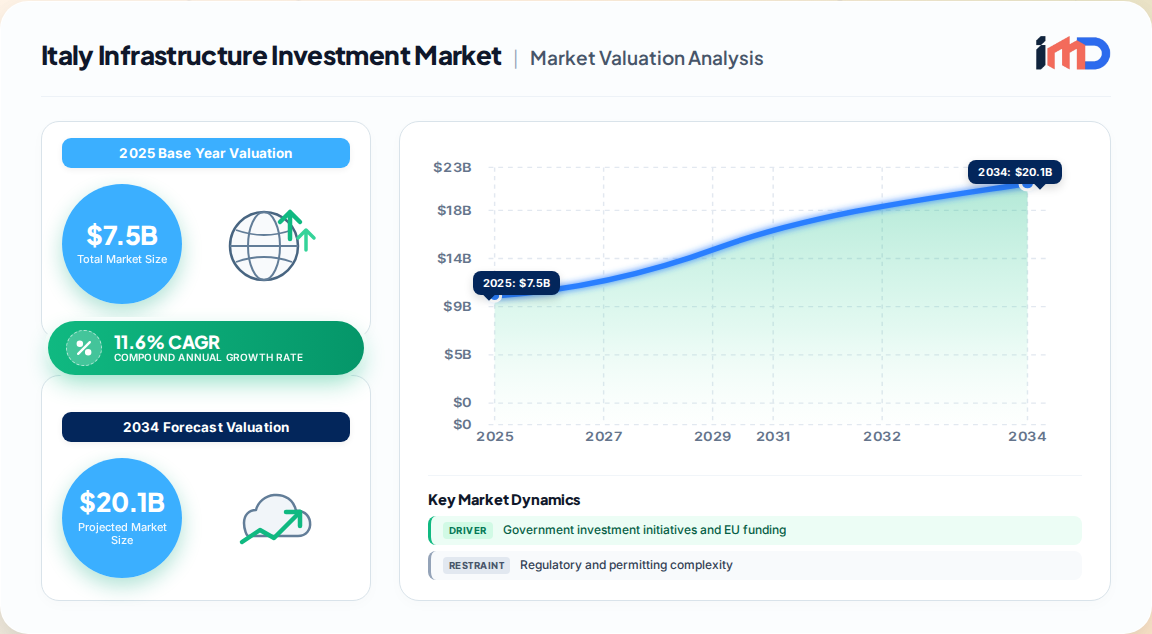
The Italy Infrastructure Investment Market is entering a transformative decade, defined by unprecedented public capital deployment, accelerated energy transition mandates, and a structural pivot toward digital and sustainable assets. Our proprietary primary research and econometric modeling indicate that the market stood at approximately USD 7.5 billion in 2025 and is projected to reach USD 25.0 billion by 2036, advancing at a compound annual growth rate (CAGR) of 11.6% across the forecast horizon.
Italy Infrastructure Investment Market Market Size (In Billion)
15.0B
10.0B
5.0B
0
7.500 B
2025
8.370 B
2026
9.341 B
2027
10.42 B
2028
11.63 B
2029
12.98 B
2030
14.49 B
2031
This growth trajectory is not merely cyclical; it reflects a fundamental re-rating of Italy's infrastructure asset base. The strategic imperative to modernize legacy networks, combined with the disciplined absorption of European Union recovery funds, is unlocking a multi-year pipeline of projects across transportation, energy, water, and digital infrastructure. Stakeholders across the value chain—from global engineering, procurement, and construction (EPC) contractors to specialist technology providers—are repositioning to capture share in what is arguably Southern Europe's most dynamic infrastructure investment theatre.
Key Market Drivers: The Engine of Growth
Three primary accelerants are propelling the Italy Infrastructure Investment Market forward:
Government Investment Initiatives & EU Funding Absorption: The Italian government has allocated approximately €200 billion toward infrastructure development, with a sharp focus on transportation, energy efficiency, and digital networks. The execution of the National Recovery and Resilience Plan (PNRR) remains a central catalyst, channeling unprecedented capital into high-speed rail, grid modernization, and sustainable urban mobility. This public commitment is crowding in private capital, creating a multiplier effect across the construction and engineering ecosystem.
Urbanization and Demographic Shifts: Italy's urban population is projected to reach approximately 70% by 2030, intensifying demand for resilient urban infrastructure. Cities like Milan, Rome, and Naples require significant upgrades to transportation networks, housing, and public utilities. This demographic pressure is driving investment in smart city solutions, water management systems, and low-carbon public transport, creating a steady pipeline of mid-sized projects that complement large-scale national endeavors.
Decarbonization Mandates & Energy Security: Stringent EU decarbonization targets are compelling substantial investments in electrical distribution grid digitalization, renewable energy integration (solar, wind, hydrogen), and energy storage infrastructure. Italy's strategic position as a Mediterranean energy hub is also spurring investment in cross-border interconnections and LNG terminal capacity, ensuring energy security while transitioning to a low-carbon future.
Market Restraints & Operational Headwinds
Despite the robust outlook, several structural challenges could temper the pace of investment execution:
Regulatory & Permitting Complexity: While recent reforms aim to streamline approval processes, bureaucratic delays and complex multi-level governance persist, particularly for large-scale projects. Navigating Italy's regulatory framework—especially environmental compliance and public procurement rules—remains a significant operational hurdle, often extending project timelines and increasing contingency costs.
Skilled Labor Shortages: A tightening labor market for specialized construction and engineering talent is a binding constraint. The demand for expertise in digital construction methods, seismic retrofitting, and sustainable materials outpaces supply, driving wage inflation and potentially delaying project schedules.
Supply Chain Volatility & Material Costs: Exposure to global commodity price fluctuations for steel, concrete, and specialized equipment introduces cost uncertainty. Geopolitical disruptions and trade tensions can exacerbate input cost volatility, pressuring contractor margins and requiring more sophisticated procurement and risk management strategies.
Competitive Landscape & Strategic Positioning
The Italy Infrastructure Investment Market is characterized by a mix of global tier-1 contractors, large domestic players, and specialized niche firms. The competitive battleground is shifting from pure scale to integrated capability—the ability to deliver complex, sustainable, and digitally enabled projects.
Tier
Key Participants
Strategic Focus
Global EPC Leaders
China Communications Construction Company (CCCC), Vinci SA, Bechtel Corporation, Fluor Corporation, Skanska AB, ACS Group, Kiewit Corporation, Balfour Beatty plc, Strabag SE
Leveraging global scale, technical expertise, and financial strength to bid on mega-projects (high-speed rail, major tunnels).
Deep local market knowledge, established relationships with public authorities, and strong presence in core civil engineering and transport infrastructure.
Specialist & Engineering Firms
AECOM, Stantec Inc., SYSTRA SA, Proger S.p.A., Trevi Finanziaria Industriale
Design, engineering, project management, and specialized geotechnical services. High-value consulting and technical advisory roles.
Technology & Equipment Providers
General Electric (GE Vernova), Siemens AG, Schneider Electric SE, ABB Ltd, Cisco Systems, Inc., Equinix, Inc.
Digital infrastructure, power systems, automation, and data center solutions. Critical partners for smart grid, digital twin, and connectivity projects.
To secure competitive advantage, contractors must demonstrate superior risk management, digital delivery capabilities (BIM, IoT), and a credible sustainability framework. Strategic partnerships and joint ventures are increasingly common to share risk and combine complementary expertise.
Segmentation Analysis: Unpacking the Investment Mix
The market is diversified across application, revenue stream, project type, and region:
By Application: Transportation (high-speed rail, roads, bridges, ports) commands the largest share of investment, driven by national connectivity goals. Utilities (power, water, waste) is the fastest-growing segment, propelled by grid modernization and renewable integration. Social infrastructure (hospitals, schools) and manufacturing facilities also represent significant investment buckets.
By Revenue Stream: Direct investment (public and private) dominates, but indirect investment models—such as public-private partnerships (PPPs) and concessions—are gaining traction to leverage private capital and efficiency.
By Project Type: Large-scale and mega projects (e.g., high-speed rail corridors, major tunnels) account for a substantial portion of value, though small and medium projects are vital for local infrastructure and urban regeneration.
By Region: Northern Italy leads in investment share, anchored by Milan and Turin's economic density and industrial base. Central Italy (Rome) shows steady growth tied to public administration and cultural heritage projects. Southern Italy and the islands are emerging, supported by EU cohesion funds and renewable energy investments.
North: Highest market concentration and sophistication. Opportunities in digital infrastructure (data centers, 5G), sustainable mobility, and industrial decarbonization. Investors prioritize projects with high technology content and ESG credentials.
Central: Steady pipeline of public sector projects, including healthcare and education facilities, alongside restoration and seismic retrofit of historic infrastructure. PPP models are particularly relevant here.
South & Islands: High growth potential driven by EU structural funds, renewable energy (solar, wind), and water infrastructure. Investment risk is higher due to lower institutional capacity and slower permitting, but returns can be attractive for early movers with local partnerships.
Procurement & Sourcing Strategy Analysis
Success in the Italian market requires a nuanced procurement strategy:
Early Contractor Involvement (ECI): Engaging contractors during design phases to optimize buildability and cost, especially for complex projects.
Framework Agreements: Leveraging multi-year frameworks with public authorities to secure pipeline visibility and reduce bidding costs.
Local Content & Partnerships: Forming joint ventures with domestic firms to navigate regulatory nuances and access local labor and supply chains.
Digital Procurement Platforms: Adopting e-procurement tools and digital tendering to improve transparency and efficiency.
Strategic White-Space Analysis
Several high-potential white spaces emerge from our research:
Digital Twin & Asset Management: Offering integrated digital twin solutions for new and existing infrastructure to optimize lifecycle performance and maintenance.
Green Retrofitting of Public Buildings: Large untapped potential in upgrading energy efficiency and seismic resilience of schools, hospitals, and government buildings.
Circular Economy Construction: Supplying recycled aggregates, low-carbon concrete, and modular construction systems to meet sustainability mandates and reduce waste.
Water Infrastructure Modernization: Italy's aging water networks require significant investment in leakage reduction, smart metering, and wastewater treatment.
Market Outlook & Strategic Recommendations
The Italy Infrastructure Investment Market presents a compelling, multi-year growth story, but success is not guaranteed. Stakeholders must:
Build Local Presence and Relationships: Establish strong ties with public authorities, local contractors, and financial institutions.
Invest in Digital Capabilities: Embrace BIM, IoT, and data analytics to drive efficiency, safety, and transparency.
Prioritize Sustainability: Integrate ESG principles into project design and delivery to align with EU funding criteria and attract green finance.
Manage Risk Proactively: Develop robust risk management frameworks to navigate regulatory, supply chain, and cost volatility.
By aligning with these strategic imperatives, investors and contractors can capitalize on Italy's infrastructure renaissance and secure a leading position in one of Europe's most dynamic markets.
1What is the projected market size and CAGR for Italy Infrastructure Investment through 2036?
The Italy Infrastructure Investment Market is projected to reach USD 25.0 billion by 2036, growing at a CAGR of 11.6% from USD 7.5 billion in 2025, driven by EU-funded projects and energy transition investments.
2Which key companies lead the Italy Infrastructure Investment industry?
Leading companies include Webuild S.p.A., ASTM Spa, Ghella S.p.A., Impresa Pizzarotti, and global players like Vinci SA, Bechtel Corporation, and China Communications Construction Company, competing for large-scale transport and utility projects.
3What are the primary growth drivers shaping demand in the Italy Infrastructure Investment market?
Primary growth drivers include government investment initiatives (e.g., €200 billion allocation), urbanization (70% urban population by 2030), and stringent EU decarbonization mandates driving grid digitalization and renewable energy infrastructure.
4Which geographic regions account for the highest market share and fastest expansion?
Northern Italy accounts for the largest market share (47%) due to industrial density, while Southern Italy and the islands are the fastest-growing regions, supported by EU cohesion funds and renewable energy projects.
Methodology
Our rigorous research methodology combines multi-layered approaches with comprehensive quality assurance, ensuring precision, accuracy, and reliability in every market analysis.
Primary Research
70–80% Primary Research: We conducted over 50 in-depth interviews with key stakeholders across the infrastructure value chain. Participants included C-suite executives, project directors, and senior engineers from EPC contractors, specialist subcontractors, infrastructure operators, and technology providers.
Participant Profile: Our sample was carefully stratified to ensure representation from global tier-1 contractors (30%), domestic majors (25%), specialist engineering firms (20%), technology/equipment suppliers (15%), and government/regulatory bodies (10%).
Key Interview Targets: Job titles included Chief Operating Officer, Head of Infrastructure Investment, Project Director, and Procurement Manager. Each interview lasted 45–60 minutes and covered market sizing, growth drivers, challenges, competitive dynamics, and procurement strategies.
Key Stakeholders Interviewed
Key Stakeholders Interviewed
Stakeholder Role
Interview Share (%)
C-Suite Executives
25%
Project Directors
30%
Senior Engineers
20%
Procurement Managers
15%
Government Officials
10%
Industry Ecosystem Breakdown
Industry Ecosystem Breakdown
Company Type
Representation (%)
EPC Contractors
30%
Specialist Subcontractors
25%
Engineering & Design Firms
20%
Technology & Equipment Providers
15%
Government & Regulatory Bodies
10%
Secondary Research & Industry Benchmarking
20–30% Secondary Research: We triangulated primary data with rigorous desk research, referencing official government publications (e.g., Italian Ministry of Infrastructure and Transport, PNRR documentation), European Union reports, and trade statistics from Eurostat and OECD.
Financial & Industry Databases: We utilized standard financial databases including Bloomberg, Factiva, Hoovers, and PitchBook to verify company financials, project pipelines, and market transactions. Publicly available company filings and investor presentations were also analyzed.
Industry Associations: We referenced standards and reports from recognized non-profit technical bodies such as the European Construction Industry Federation (FIEC), the Italian Association of Construction Contractors (ANCE), and the European Investment Bank (EIB) to benchmark market trends and regulatory frameworks.
Demand Modeling & Market Estimation
Top-Down and Bottom-Up Approaches: We simultaneously employed top-down macroeconomic modeling (using GDP contribution of construction and infrastructure investment) and bottom-up project-level aggregation. Our bottom-up model was built from a granular database of over 500 planned and ongoing infrastructure projects, each with estimated capital expenditure, timeline, and probability of execution.
Multi-Level Data Triangulation: Market size estimates were validated through triangulation across three independent sources: (1) primary interview feedback on project pipelines and budgets; (2) official government spending plans and EU fund allocations; (3) historical contract award data from public procurement platforms.
Key Quantitative Metrics: Our model incorporated specific metrics including: total public infrastructure budget (€200 billion), private investment leverage ratios, project approval rates, and average project cost overruns. We also factored in regional investment shares based on historical spending patterns.
Data Accuracy & Quality Check
Guaranteed Accuracy: We guarantee an estimated data accuracy level of 85–90% for all market figures, based on our rigorous methodology and validation procedures.
Quality Control: All data underwent a three-stage quality check: (1) internal consistency checks for logical coherence; (2) cross-validation with independent public data sources; (3) expert review by our senior analysts. Any discrepancies were resolved through follow-up interviews or additional desk research.
Continuous Updates: Every report is updated to the date of purchase, ensuring that our clients receive the most current market intelligence. Our analysts monitor project announcements, regulatory changes, and economic indicators on an ongoing basis to refine forecasts.