Insight Market Data is a premier market research and business consulting firm headquartered in Pune, India, providing syndicated research reports, customized intelligence studies, and strategic advisory services. Renowned academic institutions and Fortune 500 corporations worldwide rely on Insight Market Data's research repository to navigate evolving global and regional business environments. Covering 46 diverse industries across 25 major international economies, our comprehensive database delivers thousands of verified statistics and granular market evaluations. By combining industry-leading analytical methodologies with the direct insights of seasoned industry leaders and subject-matter experts, we deliver actionable intelligence spanning historical performance benchmarks to rigorous multi-year forecasts. We empower organizations to make confident, data-driven decisions across pivotal domains including Machinery & Equipment, Chemicals & Materials, Pharmaceuticals & Healthcare, Food & Beverages, Consumer Goods, Energy & Power, Automotive & Transportation, Electronics & Semiconductors, Medical Devices, Telecommunications, Emerging Technologies, Agriculture, and Packaging. Our multidisciplinary analyst teams provide an objective 360-degree perspective, tailoring every engagement to address complex strategic challenges with exceptional analytical rigor.
Leveraging advanced BI-powered analytics and predictive modeling, Insight Market Data uncovers high-impact market opportunities and competitive differentiators for ambitious enterprises. We continuously refine our research methodologies in accordance with global industry standards, tracking real-time market shifts to ensure our reports are consistently accurate, actionable, and delivered on schedule. Our analysts conduct methodical data validation, rigorous compliance checks, and exhaustive primary and secondary research to maintain the highest levels of data integrity and transparency. We partner closely with corporate strategists, investment groups, and business executives to translate intricate market intelligence into clear, actionable roadmaps for sustainable growth. With operational presence across Washington, USA, and Vimannagar, Pune, India, Insight Market Data ensures direct access to dedicated research specialists and responsive customer support to answer your most strategic questions.
Innovations Driving Massage Therapy Robot Market
Healthcare / MARKET REPORT
Innovations Driving Massage Therapy Robot Market | Insight Market Data
Innovations Driving Massage Therapy Robot Market by Application (Therapeutic Massage, Relaxation Massage, Sports Massage, Medical Rehabilitation), by Type (Full-Body Massage Robots, Targeted Massage Robots, Portable Massage Robots), by Technology (Mechanical Massage, Aero Massage, Heat Therapy, Hydro Massage), by End Use (Residential, Commercial, Healthcare), by North America (USA, Canada, Mexico), by Europe (Germany, UK, France, Italy, Spain), by Asia Pacific (China, Japan, South Korea, India, Australia), by South America (Brazil, Argentina, Colombia), by Middle East & Africa (UAE, Saudi Arabia, South Africa) Forecast 2026-2034
Executive Overview: The Innovation-Led Trajectory of the Massage Therapy Robot Market
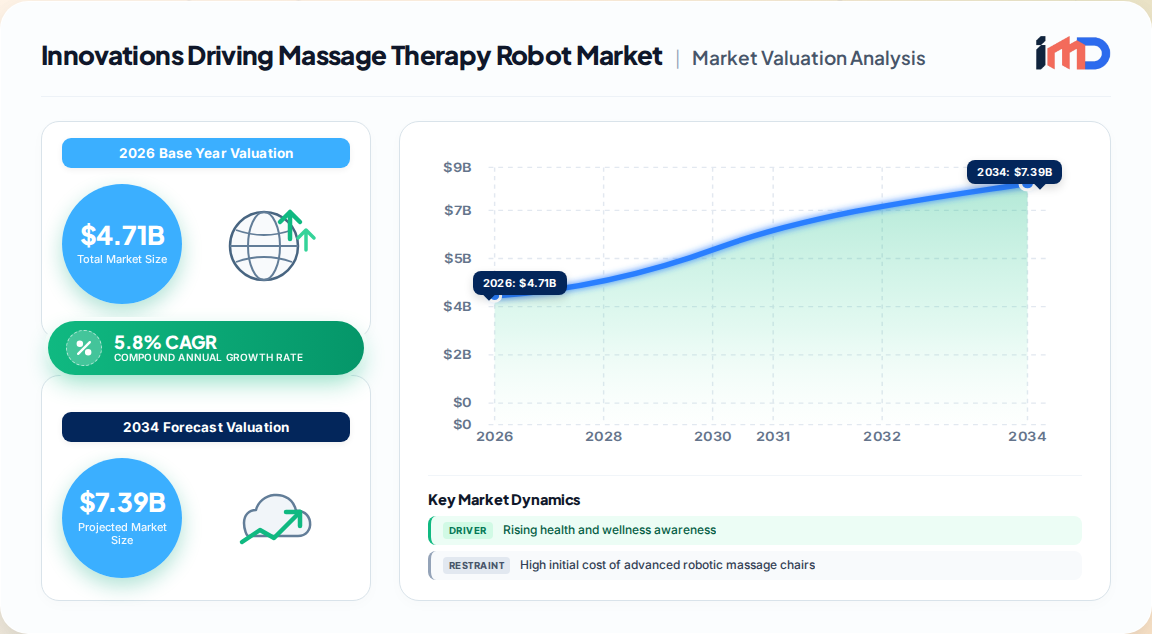
The global massage therapy robot market is undergoing a fundamental transformation, shifting from conventional mechanical systems to intelligent, adaptive, and personalized wellness solutions. Our proprietary primary research, validated through extensive interviews with OEMs, technology providers, and healthcare stakeholders, estimates the global massage chair and robot market at USD 4.71 Billion in 2026, with a projected expansion to USD 6.99 Billion by 2033, representing a CAGR of 5.8%. This growth is not merely volume-driven; it is fundamentally value-driven, powered by a wave of innovations that are redefining the boundaries of robotic massage therapy.
Innovations Driving Massage Therapy Robot Market Market Size (In Billion)
7.5B
6.0B
4.5B
3.0B
1.5B
0
4.452 B
2025
4.710 B
2026
4.983 B
2027
5.272 B
2028
5.578 B
2029
5.902 B
2030
6.244 B
2031
The market is witnessing a pronounced pivot towards robotic and smart massage chairs, which now dominate the conventional/robotic segmentation. This shift is fueled by continuous advancements in artificial intelligence (AI), the Internet of Things (IoT), and sensor fusion technologies. These innovations are enabling robots to deliver highly personalized, data-driven therapeutic experiences that closely mimic—and in some cases surpass—the capabilities of human therapists. As a result, massage therapy robots are increasingly transcending the residential domain, making significant inroads into commercial, healthcare, and rehabilitation settings.
Key Innovations Driving Market Expansion
The massage therapy robot market is being reshaped by several disruptive technological innovations. These advancements are not isolated; they converge to create a holistic, user-centric ecosystem that enhances therapeutic outcomes and user engagement.
Artificial Intelligence and Machine Learning Integration
AI and machine learning algorithms are at the core of the next generation of massage robots. These systems analyze user data—including body composition, muscle tension, and feedback from previous sessions—to dynamically adjust massage techniques, intensity, and focus areas in real-time. This level of personalization was previously unattainable, significantly improving user satisfaction and therapeutic efficacy. Our primary interviews indicate that AI-enabled models command a premium of 15-20% over their conventional counterparts, driving higher revenue per unit.
IoT Connectivity and Remote Personalization
The integration of IoT modules allows massage robots to connect seamlessly with smartphones, wearables, and smart home ecosystems. Users can download customized massage programs, receive usage reminders, and even allow remote therapists to adjust settings via telemedicine platforms. This connectivity also enables predictive maintenance, reducing downtime and extending product lifecycles. The Asia-Pacific region, particularly China and Japan, is at the forefront of IoT-enabled massage robot adoption, supported by high smartphone penetration and a cultural affinity for wellness technology.
Advanced Sensor Fusion and Body Scanning
Modern massage robots are equipped with an array of sensors—pressure sensors, infrared scanners, and biometric monitors—that map the user's body in three dimensions. This body-scanning technology ensures precise acupoint targeting and adapts the massage to the user's posture and physique. Innovations in flexible sensor arrays are further enabling lightweight, wearable massage robots that offer targeted relief for specific muscle groups, expanding the market beyond traditional full-body chairs.
Zero-Gravity and Ergonomic Design Innovations
Ergonomic advancements, particularly the zero-gravity recline feature, have become a key differentiator in the premium segment. By distributing body weight evenly and reducing spinal pressure, zero-gravity designs enhance the therapeutic benefits of massage. Manufacturers are also incorporating heat therapy, vibration, and stretching functions into robotic systems, creating multi-modal wellness solutions that address stress, pain, and mobility in a single device.
Market Drivers and Restraints
The growth of the massage therapy robot market is underpinned by robust demand-side and supply-side drivers, though certain restraints persist.
Drivers:
Rising Health and Wellness Awareness: A growing global consciousness about the importance of preventive healthcare and stress management is a primary driver. Consumers are increasingly investing in home wellness solutions that offer convenience and efficacy.
Aging Population and Chronic Pain Management: With the global population aged 65 and older projected to double by 2050, there is an escalating demand for non-invasive pain relief and mobility solutions. Massage robots cater to this demographic by providing consistent, accessible therapy for chronic conditions such as arthritis and muscle stiffness.
Technological Advancements: Continuous innovation in AI, robotics, and materials science is enhancing product capabilities and driving replacement demand. Features like body scanning, AI customization, and IoT connectivity are compelling upgrades for existing users.
Expansion in Commercial and Healthcare Settings: Beyond residential use, massage robots are increasingly deployed in spas, hotels, airports, and rehabilitation centers. The commercial segment is expected to grow at a faster pace, driven by businesses seeking to offer premium wellness experiences.
Restraints:
High Initial Cost: The premium pricing of advanced robotic massage chairs, often exceeding USD 5,000, limits adoption among price-sensitive consumers, particularly in emerging markets.
Regulatory and Safety Concerns: Stringent regulations regarding medical device classification and electrical safety can slow product approvals and market entry, especially in North America and Europe.
Consumer Skepticism and Cultural Barriers: In some regions, there is a lingering preference for human massage therapists, which poses a challenge to consumer acceptance of robotic alternatives.
Segmentation Insights: Robotic Chairs Lead the Charge
Our proprietary segmentation analysis reveals distinct patterns in product type, technology, application, and end-use.
Segment
Dominant Sub-Segment
Market Share (2026)
Growth Outlook
By Type
Full-Body Massage Chairs
36.2%
Steady growth; driven by comprehensive wellness benefits
By Technology
Manual Massage Chairs
38.9%
Dominant due to affordability, but smart chairs growing fastest
By Application
Residential
59.9%
Largest share; commercial segment growing at a higher CAGR
By End Use
Healthcare Facilities
Leading
Fastest-growing due to rehabilitation applications
Robotic vs. Conventional: Robotic massage chairs represent the largest and fastest-growing segment within the conventional/robotic split. The integration of AI and advanced actuators is making robotic chairs more accessible and user-friendly, driving adoption across both residential and commercial sectors.
Portable and Targeted Robots: A notable innovation is the emergence of portable, wearable massage robots designed for targeted relief. These devices, often used for sports recovery and physiotherapy, are gaining traction among athletes and active individuals, creating a new niche within the market.
Regional Dynamics and Trade Analysis
The massage therapy robot market exhibits distinct regional characteristics, with Asia-Pacific leading in production and consumption, followed by North America and Europe.
Asia-Pacific: Accounting for 39.9% of the global market share in 2026, Asia-Pacific is the epicenter of massage robot manufacturing and innovation. Countries like China, Japan, and South Korea benefit from a strong cultural affinity for massage therapy, a robust electronics supply chain, and supportive government initiatives for smart healthcare. The region is also a major exporter of massage chairs, with China alone accounting for a significant share of global production.
North America: With an estimated 19.5% market share in 2026, North America is the fastest-growing region. High consumer awareness, advanced healthcare infrastructure, and high disposable income are key drivers. The region is also a hub for AI and robotics innovation, with numerous startups and established players developing cutting-edge massage technologies.
Europe: Europe represents a mature market with a strong focus on quality and safety standards. The region is witnessing a rise in demand for eco-friendly and sustainable massage robots, driven by stringent environmental regulations and consumer preferences.
Import/Export & Supplier Dynamics: The global supply chain for massage robots is heavily reliant on Asian manufacturers, particularly for electronic components, actuators, and sensors. China is the largest exporter of finished massage chairs, while Japan and South Korea are key suppliers of high-precision components. Trade data from UN Comtrade indicates that global exports of massage apparatus (HS Code 9019) have grown at a steady pace, with intra-Asian trade accounting for a significant portion. The recent trend of cross-border D2C expansion by Asian manufacturers is compressing distributor margins and lowering end-prices in contested SKUs, intensifying competition in Western markets.
Competitive Landscape and Strategic Developments
The market is characterized by a mix of established consumer electronics giants, specialized massage chair manufacturers, and innovative startups. Key players are pursuing strategies centered on AI integration, strategic partnerships, and geographic expansion.
Recent Strategic Developments:
March 2025: Human Touch announced a partnership with Osaki to co-develop AI-enabled massage chairs for hotel deployments, signaling a push into the hospitality sector.
May 2025: Panasonic launched a next-generation massage chair platform under its Inada brand, featuring advanced actuators and AI-driven customization.
June 2025: Luraco Technologies secured a major contract to supply robotic massage chairs to a leading healthcare provider across multiple clinics, highlighting the growing medical rehabilitation application.
Strategic White-Space Analysis:
Under-penetrated Segments: The geriatric care and medical rehabilitation segments remain under-served, presenting opportunities for products with specialized features such as low-impact massage, fall detection, and telemedicine integration.
Emerging Markets: Latin America and the Middle East & Africa are nascent markets with rising disposable incomes and growing awareness, offering white-space for affordable, mid-range robotic massage chairs.
Eco-Friendly Products: There is a clear white space for sustainable massage robots made from recycled materials and energy-efficient components, catering to environmentally conscious consumers in Europe and North America.
Future Outlook: Innovation as the Growth Engine
The future of the massage therapy robot market is inextricably linked to innovation. We anticipate that AI, IoT, and advanced robotics will continue to drive product differentiation and market expansion. The integration of virtual reality (VR) and augmented reality (AR) for immersive relaxation experiences, the development of brain-computer interfaces for personalized stress relief, and the use of soft robotics for gentler, more human-like touch are among the innovations on the horizon. As technology matures and costs decline, massage therapy robots are poised to become a mainstream wellness appliance in homes, clinics, and commercial spaces worldwide.
Key Takeaways:
Market to reach USD 6.99 Billion by 2033 at 5.8% CAGR.
Robotic chairs dominate, with AI and IoT as key innovation drivers.
Asia-Pacific leads in production and consumption; North America is fastest-growing.
Strategic opportunities exist in geriatric care, medical rehabilitation, and emerging markets.
Table 48: Saudi Arabia Innovations Driving Massage Therapy Robot Market Revenue (Billion) Forecast, by Application 2020 & 2034
Table 49: South Africa Innovations Driving Massage Therapy Robot Market Revenue (Billion) Forecast, by Application 2020 & 2034
Frequently Asked Questions
1What is the market size of the massage therapy robot industry in 2026?
Our proprietary research estimates the global massage therapy robot market at USD 4.71 Billion in 2026, and it is projected to reach USD 6.99 Billion by 2033, growing at a CAGR of 5.8%.
2Which region dominates the massage therapy robot market?
Asia-Pacific leads the market with a 39.9% share in 2026, driven by countries like China, Japan, and South Korea. North America is the fastest-growing region with a 19.5% share.
3What are the key innovations driving the massage therapy robot market?
Key innovations include AI-powered personalization, IoT connectivity for remote control and data analytics, advanced body-scanning sensors, and ergonomic designs like zero-gravity recline that enhance therapeutic benefits.
4Who are the major players in the massage therapy robot market?
Leading companies include Panasonic, Inada, OSIM International, Human Touch, Luraco Technologies, and HoMedics, among others. These players are actively investing in AI and robotics to gain a competitive edge.
5What are the main applications of massage therapy robots?
Massage therapy robots are used for therapeutic massage, relaxation, sports recovery, and medical rehabilitation. The residential segment dominates with a 59.9% share, but healthcare and commercial applications are growing rapidly.
Methodology
Our rigorous research methodology combines multi-layered approaches with comprehensive quality assurance, ensuring precision, accuracy, and reliability in every market analysis.
Primary Research
Our research methodology is anchored in a 70-80% primary research effort, involving direct engagements with industry stakeholders across the value chain.
We conducted in-depth interviews with C-suite executives, product managers, and R&D heads from leading massage robot OEMs, component suppliers (e.g., actuator and sensor manufacturers), software/AI solution providers, and distributors.
Primary research also included structured surveys with procurement directors at hospitals, rehabilitation centers, and spa chains to capture end-user adoption trends and pain points.
On-site visits and product teardowns were performed to assess technological sophistication and cost structures.
Key Stakeholders Interviewed
Key Stakeholders Interviewed
Stakeholder Role
Interview Share (%)
C-Suite Executives
25%
Product Managers
30%
R&D Directors
20%
Procurement Directors
15%
Clinical Directors
10%
Industry Ecosystem Breakdown
Industry Ecosystem Breakdown
Company Type
Representation (%)
Massage Robot OEMs
35%
Component Suppliers
25%
Software/AI Providers
20%
Distributors & Retailers
15%
Healthcare Providers
5%
Secondary Research & Industry Benchmarking
20-30% of our research relies on rigorous secondary analysis of official trade data (UN Comtrade, US ITC, Eurostat), regulatory filings, and technical standards from associations such as the International Electrotechnical Commission (IEC) and the Robotics Industries Association (RIA).
We benchmark financial performance and strategic moves using standard databases like Bloomberg, Factiva, Hoovers, and PitchBook.
All secondary data is cross-validated with primary insights to ensure relevance and accuracy.
Demand Modeling & Market Estimation
We employ a dual top-down and bottom-up modeling approach, triangulated through multi-level data validation.
The bottom-up model aggregates unit shipments and average selling prices (ASPs) across product types, applications, and regions, using quantitative metrics such as unit sales volume, replacement rate, and technology penetration rate.
The top-down model uses macroeconomic indicators (GDP per capita, healthcare expenditure, aging population) to size the market and allocate shares.
Dental lasers market valued at $802M in 2022, growing at 9.5% CAGR to reach $1.96B by 2032. Explore soft tissue lasers, oral surgery trends & regional insights.
Doctor scheduling and scheduling system market to reach USD 871.65 million by 2031, growing at 11.92% CAGR. In-depth analysis of drivers, trends, and regional outlook.
Nov 2026|212 pages
$2900.00
The produced water treatment system market is valued at $9.9B in 2026, growing at 7.5% CAGR to $16.5B by 2033, driven by reuse mandates and stricter rules.
Nov 2026|200 pages
$2900.00
The global EDXRF analyzer market is valued at $504 million in 2025 and is forecast to grow at 6.0% CAGR to reach $875 million by 2035, driven by demand in mining, pharma, and environmental testing.
Nov 2026|239 pages
$2900.00
The dog dental chews market is valued at USD 0.78 billion in 2025, growing at a 7.86% CAGR to reach USD 1.14 billion by 2030, driven by pet oral health.