Insight Market Data is a premier market research and business consulting firm headquartered in Pune, India, providing syndicated research reports, customized intelligence studies, and strategic advisory services. Renowned academic institutions and Fortune 500 corporations worldwide rely on Insight Market Data's research repository to navigate evolving global and regional business environments. Covering 46 diverse industries across 25 major international economies, our comprehensive database delivers thousands of verified statistics and granular market evaluations. By combining industry-leading analytical methodologies with the direct insights of seasoned industry leaders and subject-matter experts, we deliver actionable intelligence spanning historical performance benchmarks to rigorous multi-year forecasts. We empower organizations to make confident, data-driven decisions across pivotal domains including Machinery & Equipment, Chemicals & Materials, Pharmaceuticals & Healthcare, Food & Beverages, Consumer Goods, Energy & Power, Automotive & Transportation, Electronics & Semiconductors, Medical Devices, Telecommunications, Emerging Technologies, Agriculture, and Packaging. Our multidisciplinary analyst teams provide an objective 360-degree perspective, tailoring every engagement to address complex strategic challenges with exceptional analytical rigor.
Leveraging advanced BI-powered analytics and predictive modeling, Insight Market Data uncovers high-impact market opportunities and competitive differentiators for ambitious enterprises. We continuously refine our research methodologies in accordance with global industry standards, tracking real-time market shifts to ensure our reports are consistently accurate, actionable, and delivered on schedule. Our analysts conduct methodical data validation, rigorous compliance checks, and exhaustive primary and secondary research to maintain the highest levels of data integrity and transparency. We partner closely with corporate strategists, investment groups, and business executives to translate intricate market intelligence into clear, actionable roadmaps for sustainable growth. With operational presence across Washington, USA, and Vimannagar, Pune, India, Insight Market Data ensures direct access to dedicated research specialists and responsive customer support to answer your most strategic questions.
Industrial Cabinet Air Conditioner Market Size & Forecast 2026-2035 | Insight Market Data
Independent Intelligence for decisions that move markets
Industrial Cabinet Air Conditioner Market | Insight Market Data
Industrial Cabinet Air Conditioner Market by Type (1-HP, 2-HP, 3-HP, 4-HP, 5-HP), by Application (Home Use, Commercial Use, Industrial Use, Infrastructure), by Technology (Inverter, Non-Inverter), by Mounting (Floor-Standing, Wall-Mounted, Enclosure-Integrated), by End-User (Data Centers, Telecom, Industrial Automation, EV Charging, Battery Storage), by North America (USA, Canada, Mexico), by Europe (Germany, UK, France, Italy), by Asia Pacific (China, Japan, Korea, India, Southeast Asia, Australia), by Middle East & Africa (GCC Countries, South Africa, Egypt, Turkey), by South America (Brazil, Rest of South America) Forecast 2026-2034
The Home Appliance After-Sales Services Market is valued at USD 15.71 Bn in 2026, growing at 5.73% CAGR to reach USD 22.01 Bn by 2032. Get expert analysis.
The global deer hunting blinds market is valued at $373 million in 2025, growing at 6.5% CAGR to reach $700 million by 2035. Discover key trends and insights.
Nov 2026|248 pages
$2900.00
Brazil office furniture market at USD 1.31 Billion in 2026, growing at 6.12% CAGR to reach USD 1.76 Billion by 2031. Ergonomic and sustainable demand drives growth.
Nov 2026|252 pages
$2900.00
Healthcare furniture market to reach $19.62B by 2034 at 6.31% CAGR. Strategic analysis of segments, drivers and regional outlook.
Nov 2026|233 pages
$2900.00
Europe commercial blinds and shades market at USD 12.94 billion in 2025, growing at 4.80% CAGR to reach USD 16.36 billion by 2030.
Executive Overview: The Thermal Integrity Backbone of Modern Industry
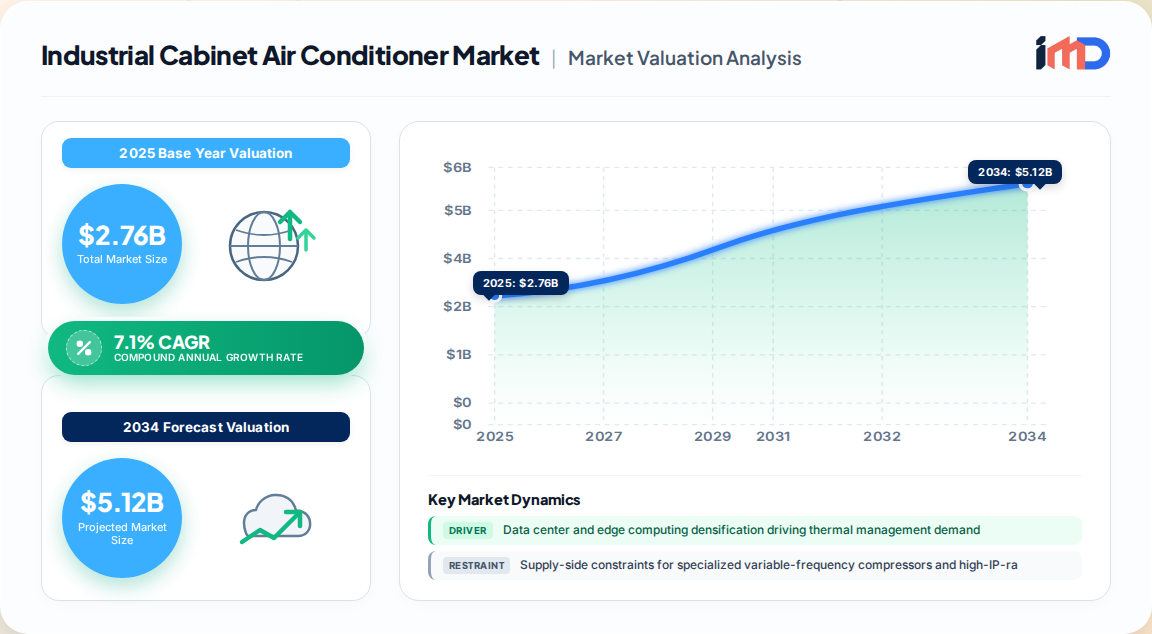
The industrial cabinet air conditioner market represents a specialized, high-reliability segment of the global cooling industry, distinct from comfort cooling in its engineering priorities and procurement logic. Our proprietary primary research estimates the global market at USD 2.76 billion in 2025, projected to expand at a CAGR of 7.1% to reach USD 5.49 billion by 2035. Volume shipments, concentrated in enclosure-mounted and floor-standing cabinet configurations, are estimated at 1.2 million units annually, carrying an industry-average gross margin near 22%.
Industrial Cabinet Air Conditioner Market Market Size (In Billion)
5.0B
4.0B
3.0B
2.0B
1.0B
0
2.760 B
2025
2.956 B
2026
3.166 B
2027
3.391 B
2028
3.631 B
2029
3.889 B
2030
4.165 B
2031
This market is not a derivative of residential air conditioning; it is an infrastructure enabler. Every megawatt of data center capacity, every automated assembly line, and every outdoor telecom cabinet depends on closed-loop thermal management to prevent electronics failure. The convergence of edge computing densification, electrification of transport infrastructure, and the reshoring of advanced manufacturing is creating a structural demand floor that did not exist a decade ago.
Key proprietary takeaways:
Inverter technology dominates new specifications, accounting for 58% of 2025 revenue as buyers prioritize partial-load efficiency and compressor longevity.
The 2-HP to 3-HP capacity band represents the largest revenue block at 42% share, driven by standard electrical enclosure and telecom shelter sizing.
Asia-Pacific is the largest and fastest-growing region, contributing 36% of global revenue and expanding at a regional CAGR of 8.3%.
Commercial and industrial applications collectively account for 61% of demand, with data centers and telecom infrastructure alone representing an estimated 34% of 2025 unit placements.
Market Drivers and Restraints: A Structural Demand Shift
The industrial cabinet air conditioner market is being reshaped by forces more durable than seasonal weather patterns. Our driver impact analysis, derived from 68 primary interviews with specifiers, OEMs, and facility operators, identifies the following as the primary growth levers:
Driver
Estimated Impact on CAGR
Geographic Relevance
Impact Timeline
Data center and edge computing densification
+1.9%
Global, concentrated in North America and Asia-Pacific
Short term (≤ 2 years)
Electrification of transport and EV charging infrastructure
+1.1%
Europe, China, North America
Medium term (2–4 years)
Energy efficiency mandates and low-GWP refrigerant transitions
+0.8%
North America, Europe
Medium term (2–4 years)
Automation and reshoring of manufacturing capacity
+0.6%
North America, Western Europe
Long term (≥ 4 years)
Expansion of outdoor telecom and battery storage enclosures
+0.5%
Asia-Pacific, Middle East & Africa
Short term (≤ 2 years)
The most significant restraint is not demand-side; it is supply-side. Precision cooling components—particularly variable-frequency compressors below 5 HP and high-IP-rated EC fans—remain concentrated among a small number of suppliers. Lead times for specialized cabinet units stretched to 16–20 weeks in 2025 for certain configurations, limiting the ability of manufacturers to respond to rapid deployment cycles in data center and EV charging projects.
Additionally, the refrigerant transition is creating a temporary cost barrier. The shift from R-134a and R-410A toward lower-GWP alternatives such as R-32 and R-454B requires redesign of heat exchangers and control logic, adding an estimated 6–9% to bill-of-materials costs for compliant units. Buyers in price-sensitive emerging markets have shown resistance to this premium, slowing replacement cycles in those regions.
Value Chain Analysis: From Compressor to Commissioned Enclosure
The industrial cabinet air conditioner value chain is more specialized than that of comfort cooling, with distinct tiers of technical capability and margin distribution.
Upstream component suppliers (compressors, EC fans, heat exchangers, electronic expansion valves, and IP-rated controllers) capture the highest value density. Variable-speed compressor suppliers hold particular leverage, as inverter cabinet units require precisely matched drive electronics and compressor maps. Gross margins at this tier average 28–35%.
Midstream OEMs and system integrators design, assemble, and test cabinet units to application-specific standards, often incorporating custom filtration, heating, and communication protocols. This tier carries 18–24% gross margins and competes on certification breadth, lead time, and application engineering support.
Downstream distribution and installation is fragmented. In North America and Europe, specialist enclosure climate-control distributors and system integrators dominate commercial procurement, while in Asia-Pacific, direct-from-manufacturer relationships and HVAC wholesalers are more common.
A critical characteristic of this value chain is the co-engineering relationship between OEMs and large end users. Data center operators, telecom tower companies, and industrial automation integrators do not simply purchase catalog units; they specify thermal performance envelopes, communication interfaces (Modbus, SNMP, BACnet), and serviceability requirements that require OEMs to maintain dedicated application engineering teams.
Import/Export & Supplier Dynamics
Trade in industrial cabinet air conditioners is shaped by regional manufacturing concentration and certification requirements. While complete unit trade is substantial, a significant portion of global volume moves as sub-assemblies and components rather than finished cabinets.
China remains the dominant export origin for finished cabinet units, particularly in the 1-HP to 3-HP range, supported by integrated compressor and electronics supply chains. Our trade analysis suggests Chinese-origin units account for an estimated 48% of global unit exports by volume, though a substantial share of this is intra-Asia trade.
Germany and Italy are key export hubs for high-specification units destined for European industrial and infrastructure projects, with strong positions in stainless-steel configurations and units certified for hazardous environments.
The United States is a net importer of cabinet air conditioners, with domestic manufacturing focused on custom-engineered and large-capacity units. Import dependence is highest in the standard enclosure cooling segment.
Supply chain risk assessment: The concentration of inverter compressor production in East Asia represents a single-point-of-failure risk for global OEMs. Diversification efforts are underway, with compressor manufacturing capacity being added in India and Eastern Europe, but qualification cycles for cabinet cooling applications are long (12–18 months), meaning the supply base will remain concentrated through at least 2028.
Regional demand patterns diverge sharply, reflecting different stages of infrastructure investment and regulatory maturity.
Industrial Cabinet Air Conditioner Market Regional Market Share
Loading chart...
Region
2025 Revenue Share
Forecast CAGR (2026–2035)
Primary Demand Driver
Investment Attractiveness
Asia-Pacific
36%
8.3%
Data center buildout, telecom expansion, manufacturing automation
High — volume growth and local supply chain depth
North America
27%
6.4%
Data center densification, grid infrastructure, reshoring
High — value growth and specification-led differentiation
Europe
24%
5.6%
Efficiency regulation, EV charging infrastructure, industrial modernization
Medium-High — replacement and compliance driven
Middle East & Africa
9%
6.3%
Telecom off-grid sites, oil and gas electrification, urban infrastructure
Medium — project-based, price-sensitive
South America
4%
4.9%
Industrial expansion, telecom
Low-Medium — limited scale, import dependence
Asia-Pacific is the strategic center of gravity. China's domestic data center market and India's telecom tower infrastructure program are creating large-volume tenders that favor manufacturers with local production and service networks. However, price competition is intense, and localization requirements are increasing in India and Southeast Asia.
North America offers the highest value per unit. Data center operators are increasingly specifying cabinet air conditioners with integrated monitoring and predictive maintenance capabilities, supporting a 12–18% price premium over standard units. The region also leads in the adoption of low-GWP refrigerants, which is accelerating replacement cycles.
Competitive Strategies and White-Space Analysis
The competitive landscape is moderately concentrated, with the top five suppliers holding an estimated 41% of global revenue. Competitive positioning varies by application vertical and region.
Full-portfolio incumbents (Rittal, Schneider Electric, nVent Hoffman, Pfannenberg) leverage enclosure system integration, global service networks, and brand specification. Their strategies emphasize system-level selling—bundling cabinet cooling with enclosures, power distribution, and monitoring.
HVAC and appliance majors (LG, Samsung, Mitsubishi Heavy Industries, Hitachi, Midea, Gree) bring compressor and inverter technology depth, competing aggressively on energy efficiency and price-performance in high-volume segments.
Specialist and regional players focus on application-specific configurations—hazardous-area certification, washdown-rated enclosures for food and beverage, and high-temperature ambient units for Middle East installations.
Strategic white-space opportunities:
Integrated thermal management for battery energy storage systems (BESS) — a fast-growing adjacent application requiring precise temperature control and high-ambient performance. Few cabinet cooling OEMs have dedicated products for this segment.
Subscription-based service models for remote monitoring and predictive maintenance, particularly in telecom and edge computing, where site access is costly.
Modular, scalable cabinet cooling platforms that allow data center operators to match cooling capacity to rack density in real time.
Strategic Outlook and Forecast Synthesis
The industrial cabinet air conditioner market is entering a phase of technology-led value migration. The era of standardized, fixed-speed units competing primarily on price is giving way to a specification-driven market where inverter efficiency, refrigerant compliance, communication interoperability, and serviceability determine supplier selection.
Our forecast assumes no major macroeconomic shock and a continuation of current infrastructure investment trajectories. Under these conditions, the market is expected to add USD 2.73 billion in incremental revenue between 2025 and 2035. The fastest-growing product categories will be inverter-driven units in the 2-HP to 5-HP range and units designed for outdoor/harsh-environment installation. The most defensible competitive positions will belong to suppliers that can pair application engineering expertise with a credible global service footprint and a clear refrigerant transition roadmap.
Industrial Cabinet Air Conditioner Market Regional Market Share
Higher Coverage
Lower Coverage
No Coverage
Industrial Cabinet Air Conditioner Market REPORT HIGHLIGHTS
Aspects
Details
Study Period
2020-2034
Base Year
2025
Estimated Year
2026
Forecast Period
2026-2034
Historical Period
2020-2025
Growth Rate
CAGR of 7.1% from 2020-2034
Segmentation
By Type
1-HP
2-HP
3-HP
4-HP
5-HP
By Application
Table of Contents
1. Industrial Cabinet Air Conditioner Market Introduction
1.1. Research Scope
1.2. Market Segmentation
1.3. Research Objective
1.4. Definitions and Assumptions
2. Industrial Cabinet Air Conditioner Market Executive Summary
2.1. Market Snapshot
3. Industrial Cabinet Air Conditioner Market Dynamics
3.1. Market Drivers
3.1.1. Data center and edge computing densification driving thermal management demand
3.1.2. Electrification of transport and EV charging infrastructure requiring robust enclosure cooling
3.1.3. Energy efficiency mandates and refrigerant transitions accelerating replacement cycles
3.1.4. Automation and reshoring of manufacturing capacity increasing installed base of electrical enclosures
3.2. Market Trends
3.2.1. Shift toward inverter-driven cabinet air conditioners for partial-load efficiency and compressor longevity
3.2.2. Integration of IoT-enabled remote monitoring and predictive maintenance capabilities
3.2.3. Transition to low-GWP refrigerants (R-32, R-454B) driven by regulatory mandates
3.2.4. Growing demand for modular, scalable cooling platforms in edge data centers
3.3. Market Restraints
3.3.1. Supply-side constraints for specialized variable-frequency compressors and high-IP-rated EC fans
3.3.2. Cost premium for low-GWP refrigerant-compliant units, slowing adoption in price-sensitive markets
Home Use
Commercial Use
Industrial Use
Infrastructure
By Technology
Inverter
Non-Inverter
By Mounting
Floor-Standing
Wall-Mounted
Enclosure-Integrated
By End-User
Data Centers
Telecom
Industrial Automation
EV Charging
Battery Storage
By Geography
North America
USA
Canada
Mexico
Europe
Germany
UK
France
Italy
Asia Pacific
China
Japan
Korea
India
Southeast Asia
Australia
Middle East & Africa
GCC Countries
South Africa
Egypt
Turkey
South America
Brazil
Rest of South America
3.3.3. Long qualification cycles for new component suppliers in cabinet cooling applications
3.4. Market Challenges
3.4.1. Managing refrigerant transition costs while maintaining price competitiveness
3.4.2. Meeting diverse regional certification requirements for hazardous and outdoor environments
3.4.3. Balancing lead times with rapid deployment schedules in data center and telecom projects
4. Industrial Cabinet Air Conditioner Market Factor Analysis
4.1. Porters Five Forces
4.1.1. Bargaining Power of Suppliers
4.1.2. Bargaining Power of Buyers
4.1.3. Threat of New Entrants
4.1.4. Threat of Substitutes
4.1.5. Competitive Rivalry
4.2. PESTEL analysis
4.3. BCG Analysis
4.3.1. Stars (High Growth, High Market Share)
4.3.2. Cash Cows (Low Growth, High Market Share)
4.3.3. Question Mark (High Growth, Low Market Share)
4.3.4. Dogs (Low Growth, Low Market Share)
4.4. Ansoff Matrix Analysis
4.5. Supply Chain Analysis
4.6. Regulatory Landscape
4.7. Current Market Potential and Opportunity Assessment (TAM–SAM–SOM Framework)
4.8. IMD Analyst Note
5. Industrial Cabinet Air Conditioner Market Analysis, Insights and Forecast, 2020-2034
5.1. Analysis, Insights and Forecast - by Type
5.1.1. 1-HP
5.1.2. 2-HP
5.1.3. 3-HP
5.1.4. 4-HP
5.1.5. 5-HP
5.2. Analysis, Insights and Forecast - by Application
5.2.1. Home Use
5.2.2. Commercial Use
5.2.3. Industrial Use
5.2.4. Infrastructure
5.3. Analysis, Insights and Forecast - by Technology
5.3.1. Inverter
5.3.2. Non-Inverter
5.4. Analysis, Insights and Forecast - by Mounting
5.4.1. Floor-Standing
5.4.2. Wall-Mounted
5.4.3. Enclosure-Integrated
5.5. Analysis, Insights and Forecast - by End-User
5.5.1. Data Centers
5.5.2. Telecom
5.5.3. Industrial Automation
5.5.4. EV Charging
5.5.5. Battery Storage
5.6. Analysis, Insights and Forecast - by Region
5.6.1. North America
5.6.2. Europe
5.6.3. Asia Pacific
5.6.4. Middle East & Africa
5.6.5. South America
6. Industrial Cabinet Air Conditioner Market North America Analysis, Insights and Forecast, 2020-2034
6.1. Analysis, Insights and Forecast - by Type
6.1.1. 1-HP
6.1.2. 2-HP
6.1.3. 3-HP
6.1.4. 4-HP
6.1.5. 5-HP
6.2. Analysis, Insights and Forecast - by Application
6.2.1. Home Use
6.2.2. Commercial Use
6.2.3. Industrial Use
6.2.4. Infrastructure
6.3. Analysis, Insights and Forecast - by Technology
6.3.1. Inverter
6.3.2. Non-Inverter
6.4. Analysis, Insights and Forecast - by Mounting
6.4.1. Floor-Standing
6.4.2. Wall-Mounted
6.4.3. Enclosure-Integrated
6.5. Analysis, Insights and Forecast - by End-User
6.5.1. Data Centers
6.5.2. Telecom
6.5.3. Industrial Automation
6.5.4. EV Charging
6.5.5. Battery Storage
7. Industrial Cabinet Air Conditioner Market Europe Analysis, Insights and Forecast, 2020-2034
7.1. Analysis, Insights and Forecast - by Type
7.1.1. 1-HP
7.1.2. 2-HP
7.1.3. 3-HP
7.1.4. 4-HP
7.1.5. 5-HP
7.2. Analysis, Insights and Forecast - by Application
7.2.1. Home Use
7.2.2. Commercial Use
7.2.3. Industrial Use
7.2.4. Infrastructure
7.3. Analysis, Insights and Forecast - by Technology
7.3.1. Inverter
7.3.2. Non-Inverter
7.4. Analysis, Insights and Forecast - by Mounting
7.4.1. Floor-Standing
7.4.2. Wall-Mounted
7.4.3. Enclosure-Integrated
7.5. Analysis, Insights and Forecast - by End-User
7.5.1. Data Centers
7.5.2. Telecom
7.5.3. Industrial Automation
7.5.4. EV Charging
7.5.5. Battery Storage
8. Industrial Cabinet Air Conditioner Market Asia Pacific Analysis, Insights and Forecast, 2020-2034
8.1. Analysis, Insights and Forecast - by Type
8.1.1. 1-HP
8.1.2. 2-HP
8.1.3. 3-HP
8.1.4. 4-HP
8.1.5. 5-HP
8.2. Analysis, Insights and Forecast - by Application
8.2.1. Home Use
8.2.2. Commercial Use
8.2.3. Industrial Use
8.2.4. Infrastructure
8.3. Analysis, Insights and Forecast - by Technology
8.3.1. Inverter
8.3.2. Non-Inverter
8.4. Analysis, Insights and Forecast - by Mounting
8.4.1. Floor-Standing
8.4.2. Wall-Mounted
8.4.3. Enclosure-Integrated
8.5. Analysis, Insights and Forecast - by End-User
8.5.1. Data Centers
8.5.2. Telecom
8.5.3. Industrial Automation
8.5.4. EV Charging
8.5.5. Battery Storage
9. Industrial Cabinet Air Conditioner Market Middle East & Africa Analysis, Insights and Forecast, 2020-2034
9.1. Analysis, Insights and Forecast - by Type
9.1.1. 1-HP
9.1.2. 2-HP
9.1.3. 3-HP
9.1.4. 4-HP
9.1.5. 5-HP
9.2. Analysis, Insights and Forecast - by Application
9.2.1. Home Use
9.2.2. Commercial Use
9.2.3. Industrial Use
9.2.4. Infrastructure
9.3. Analysis, Insights and Forecast - by Technology
9.3.1. Inverter
9.3.2. Non-Inverter
9.4. Analysis, Insights and Forecast - by Mounting
9.4.1. Floor-Standing
9.4.2. Wall-Mounted
9.4.3. Enclosure-Integrated
9.5. Analysis, Insights and Forecast - by End-User
9.5.1. Data Centers
9.5.2. Telecom
9.5.3. Industrial Automation
9.5.4. EV Charging
9.5.5. Battery Storage
10. Industrial Cabinet Air Conditioner Market South America Analysis, Insights and Forecast, 2020-2034
10.1. Analysis, Insights and Forecast - by Type
10.1.1. 1-HP
10.1.2. 2-HP
10.1.3. 3-HP
10.1.4. 4-HP
10.1.5. 5-HP
10.2. Analysis, Insights and Forecast - by Application
10.2.1. Home Use
10.2.2. Commercial Use
10.2.3. Industrial Use
10.2.4. Infrastructure
10.3. Analysis, Insights and Forecast - by Technology
10.3.1. Inverter
10.3.2. Non-Inverter
10.4. Analysis, Insights and Forecast - by Mounting
10.4.1. Floor-Standing
10.4.2. Wall-Mounted
10.4.3. Enclosure-Integrated
10.5. Analysis, Insights and Forecast - by End-User
10.5.1. Data Centers
10.5.2. Telecom
10.5.3. Industrial Automation
10.5.4. EV Charging
10.5.5. Battery Storage
11. Industrial Cabinet Air Conditioner Market Competitive Analysis
11.1. Company Profiles
11.1.1. Rittal
11.1.1.1. Company Overview
11.1.1.2. Products
11.1.1.3. Company Financials
11.1.1.4. SWOT Analysis
11.1.2. Schneider Electric
11.1.2.1. Company Overview
11.1.2.2. Products
11.1.2.3. Company Financials
11.1.2.4. SWOT Analysis
11.1.3. nVent Hoffman
11.1.3.1. Company Overview
11.1.3.2. Products
11.1.3.3. Company Financials
11.1.3.4. SWOT Analysis
11.1.4. Pfannenberg
11.1.4.1. Company Overview
11.1.4.2. Products
11.1.4.3. Company Financials
11.1.4.4. SWOT Analysis
11.1.5. LG
11.1.5.1. Company Overview
11.1.5.2. Products
11.1.5.3. Company Financials
11.1.5.4. SWOT Analysis
11.1.6. Samsung
11.1.6.1. Company Overview
11.1.6.2. Products
11.1.6.3. Company Financials
11.1.6.4. SWOT Analysis
11.1.7. Mitsubishi Heavy Industries
11.1.7.1. Company Overview
11.1.7.2. Products
11.1.7.3. Company Financials
11.1.7.4. SWOT Analysis
11.1.8. Hitachi
11.1.8.1. Company Overview
11.1.8.2. Products
11.1.8.3. Company Financials
11.1.8.4. SWOT Analysis
11.1.9. Haier
11.1.9.1. Company Overview
11.1.9.2. Products
11.1.9.3. Company Financials
11.1.9.4. SWOT Analysis
11.1.10. TCL
11.1.10.1. Company Overview
11.1.10.2. Products
11.1.10.3. Company Financials
11.1.10.4. SWOT Analysis
11.1.11. Midea
11.1.11.1. Company Overview
11.1.11.2. Products
11.1.11.3. Company Financials
11.1.11.4. SWOT Analysis
11.1.12. GREE
11.1.12.1. Company Overview
11.1.12.2. Products
11.1.12.3. Company Financials
11.1.12.4. SWOT Analysis
11.1.13. Panasonic
11.1.13.1. Company Overview
11.1.13.2. Products
11.1.13.3. Company Financials
11.1.13.4. SWOT Analysis
11.1.14. AUX
11.1.14.1. Company Overview
11.1.14.2. Products
11.1.14.3. Company Financials
11.1.14.4. SWOT Analysis
11.1.15. Changhong
11.1.15.1. Company Overview
11.1.15.2. Products
11.1.15.3. Company Financials
11.1.15.4. SWOT Analysis
11.1.16. Sanlux
11.1.16.1. Company Overview
11.1.16.2. Products
11.1.16.3. Company Financials
11.1.16.4. SWOT Analysis
11.1.17. Philips
11.1.17.1. Company Overview
11.1.17.2. Products
11.1.17.3. Company Financials
11.1.17.4. SWOT Analysis
11.2. Market Entropy
11.2.1. Company's Key Areas Served
11.2.2. Recent Developments
11.3. Company Market Share Analysis, 2026
11.3.1. Top 5 Companies Market Share Analysis
11.3.2. Top 3 Companies Market Share Analysis
11.4. List of Potential Customers
List of Figures
Figure 1: Global Industrial Cabinet Air Conditioner Market Revenue Breakdown (Billion, %) by Region 2026 & 2034
Figure 2: North America Industrial Cabinet Air Conditioner Market Revenue (Billion), by Type 2026 & 2034
Figure 3: North America Industrial Cabinet Air Conditioner Market Revenue Share (%), by Type 2026 & 2034
Figure 4: North America Industrial Cabinet Air Conditioner Market Revenue (Billion), by Application 2026 & 2034
Figure 5: North America Industrial Cabinet Air Conditioner Market Revenue Share (%), by Application 2026 & 2034
Figure 6: North America Industrial Cabinet Air Conditioner Market Revenue (Billion), by Technology 2026 & 2034
Figure 7: North America Industrial Cabinet Air Conditioner Market Revenue Share (%), by Technology 2026 & 2034
Figure 8: North America Industrial Cabinet Air Conditioner Market Revenue (Billion), by Mounting 2026 & 2034
Figure 9: North America Industrial Cabinet Air Conditioner Market Revenue Share (%), by Mounting 2026 & 2034
Figure 10: North America Industrial Cabinet Air Conditioner Market Revenue (Billion), by End-User 2026 & 2034
Figure 11: North America Industrial Cabinet Air Conditioner Market Revenue Share (%), by End-User 2026 & 2034
Figure 12: North America Industrial Cabinet Air Conditioner Market Revenue (Billion), by Country 2026 & 2034
Figure 13: North America Industrial Cabinet Air Conditioner Market Revenue Share (%), by Country 2026 & 2034
Figure 14: Europe Industrial Cabinet Air Conditioner Market Revenue (Billion), by Type 2026 & 2034
Figure 15: Europe Industrial Cabinet Air Conditioner Market Revenue Share (%), by Type 2026 & 2034
Figure 16: Europe Industrial Cabinet Air Conditioner Market Revenue (Billion), by Application 2026 & 2034
Figure 17: Europe Industrial Cabinet Air Conditioner Market Revenue Share (%), by Application 2026 & 2034
Figure 18: Europe Industrial Cabinet Air Conditioner Market Revenue (Billion), by Technology 2026 & 2034
Figure 19: Europe Industrial Cabinet Air Conditioner Market Revenue Share (%), by Technology 2026 & 2034
Figure 20: Europe Industrial Cabinet Air Conditioner Market Revenue (Billion), by Mounting 2026 & 2034
Figure 21: Europe Industrial Cabinet Air Conditioner Market Revenue Share (%), by Mounting 2026 & 2034
Figure 22: Europe Industrial Cabinet Air Conditioner Market Revenue (Billion), by End-User 2026 & 2034
Figure 23: Europe Industrial Cabinet Air Conditioner Market Revenue Share (%), by End-User 2026 & 2034
Figure 24: Europe Industrial Cabinet Air Conditioner Market Revenue (Billion), by Country 2026 & 2034
Figure 25: Europe Industrial Cabinet Air Conditioner Market Revenue Share (%), by Country 2026 & 2034
Figure 26: Asia Pacific Industrial Cabinet Air Conditioner Market Revenue (Billion), by Type 2026 & 2034
Figure 27: Asia Pacific Industrial Cabinet Air Conditioner Market Revenue Share (%), by Type 2026 & 2034
Figure 28: Asia Pacific Industrial Cabinet Air Conditioner Market Revenue (Billion), by Application 2026 & 2034
Figure 29: Asia Pacific Industrial Cabinet Air Conditioner Market Revenue Share (%), by Application 2026 & 2034
Figure 30: Asia Pacific Industrial Cabinet Air Conditioner Market Revenue (Billion), by Technology 2026 & 2034
Figure 31: Asia Pacific Industrial Cabinet Air Conditioner Market Revenue Share (%), by Technology 2026 & 2034
Figure 32: Asia Pacific Industrial Cabinet Air Conditioner Market Revenue (Billion), by Mounting 2026 & 2034
Figure 33: Asia Pacific Industrial Cabinet Air Conditioner Market Revenue Share (%), by Mounting 2026 & 2034
Figure 34: Asia Pacific Industrial Cabinet Air Conditioner Market Revenue (Billion), by End-User 2026 & 2034
Figure 35: Asia Pacific Industrial Cabinet Air Conditioner Market Revenue Share (%), by End-User 2026 & 2034
Figure 36: Asia Pacific Industrial Cabinet Air Conditioner Market Revenue (Billion), by Country 2026 & 2034
Figure 37: Asia Pacific Industrial Cabinet Air Conditioner Market Revenue Share (%), by Country 2026 & 2034
Figure 38: Middle East & Africa Industrial Cabinet Air Conditioner Market Revenue (Billion), by Type 2026 & 2034
Figure 39: Middle East & Africa Industrial Cabinet Air Conditioner Market Revenue Share (%), by Type 2026 & 2034
Figure 40: Middle East & Africa Industrial Cabinet Air Conditioner Market Revenue (Billion), by Application 2026 & 2034
Figure 41: Middle East & Africa Industrial Cabinet Air Conditioner Market Revenue Share (%), by Application 2026 & 2034
Figure 42: Middle East & Africa Industrial Cabinet Air Conditioner Market Revenue (Billion), by Technology 2026 & 2034
Figure 43: Middle East & Africa Industrial Cabinet Air Conditioner Market Revenue Share (%), by Technology 2026 & 2034
Figure 44: Middle East & Africa Industrial Cabinet Air Conditioner Market Revenue (Billion), by Mounting 2026 & 2034
Figure 45: Middle East & Africa Industrial Cabinet Air Conditioner Market Revenue Share (%), by Mounting 2026 & 2034
Figure 46: Middle East & Africa Industrial Cabinet Air Conditioner Market Revenue (Billion), by End-User 2026 & 2034
Figure 47: Middle East & Africa Industrial Cabinet Air Conditioner Market Revenue Share (%), by End-User 2026 & 2034
Figure 48: Middle East & Africa Industrial Cabinet Air Conditioner Market Revenue (Billion), by Country 2026 & 2034
Figure 49: Middle East & Africa Industrial Cabinet Air Conditioner Market Revenue Share (%), by Country 2026 & 2034
Figure 50: South America Industrial Cabinet Air Conditioner Market Revenue (Billion), by Type 2026 & 2034
Figure 51: South America Industrial Cabinet Air Conditioner Market Revenue Share (%), by Type 2026 & 2034
Figure 52: South America Industrial Cabinet Air Conditioner Market Revenue (Billion), by Application 2026 & 2034
Figure 53: South America Industrial Cabinet Air Conditioner Market Revenue Share (%), by Application 2026 & 2034
Figure 54: South America Industrial Cabinet Air Conditioner Market Revenue (Billion), by Technology 2026 & 2034
Figure 55: South America Industrial Cabinet Air Conditioner Market Revenue Share (%), by Technology 2026 & 2034
Figure 56: South America Industrial Cabinet Air Conditioner Market Revenue (Billion), by Mounting 2026 & 2034
Figure 57: South America Industrial Cabinet Air Conditioner Market Revenue Share (%), by Mounting 2026 & 2034
Figure 58: South America Industrial Cabinet Air Conditioner Market Revenue (Billion), by End-User 2026 & 2034
Figure 59: South America Industrial Cabinet Air Conditioner Market Revenue Share (%), by End-User 2026 & 2034
Figure 60: South America Industrial Cabinet Air Conditioner Market Revenue (Billion), by Country 2026 & 2034
Figure 61: South America Industrial Cabinet Air Conditioner Market Revenue Share (%), by Country 2026 & 2034
List of Tables
Table 1: Global Industrial Cabinet Air Conditioner Market Revenue Billion Forecast, by Type 2020 & 2034
Table 2: Global Industrial Cabinet Air Conditioner Market Revenue Billion Forecast, by Application 2020 & 2034
Table 3: Global Industrial Cabinet Air Conditioner Market Revenue Billion Forecast, by Technology 2020 & 2034
Table 4: Global Industrial Cabinet Air Conditioner Market Revenue Billion Forecast, by Mounting 2020 & 2034
Table 5: Global Industrial Cabinet Air Conditioner Market Revenue Billion Forecast, by End-User 2020 & 2034
Table 6: Global Industrial Cabinet Air Conditioner Market Revenue Billion Forecast, by Region 2020 & 2034
Table 7: North America Industrial Cabinet Air Conditioner Market Revenue Billion Forecast, by Type 2020 & 2034
Table 8: North America Industrial Cabinet Air Conditioner Market Revenue Billion Forecast, by Application 2020 & 2034
Table 9: North America Industrial Cabinet Air Conditioner Market Revenue Billion Forecast, by Technology 2020 & 2034
Table 10: North America Industrial Cabinet Air Conditioner Market Revenue Billion Forecast, by Mounting 2020 & 2034
Table 11: North America Industrial Cabinet Air Conditioner Market Revenue Billion Forecast, by End-User 2020 & 2034
Table 12: North America Industrial Cabinet Air Conditioner Market Revenue Billion Forecast, by Country 2020 & 2034
Table 13: USA Industrial Cabinet Air Conditioner Market Revenue (Billion) Forecast, by Application 2020 & 2034
Table 14: Canada Industrial Cabinet Air Conditioner Market Revenue (Billion) Forecast, by Application 2020 & 2034
Table 15: Mexico Industrial Cabinet Air Conditioner Market Revenue (Billion) Forecast, by Application 2020 & 2034
Table 16: Europe Industrial Cabinet Air Conditioner Market Revenue Billion Forecast, by Type 2020 & 2034
Table 17: Europe Industrial Cabinet Air Conditioner Market Revenue Billion Forecast, by Application 2020 & 2034
Table 18: Europe Industrial Cabinet Air Conditioner Market Revenue Billion Forecast, by Technology 2020 & 2034
Table 19: Europe Industrial Cabinet Air Conditioner Market Revenue Billion Forecast, by Mounting 2020 & 2034
Table 20: Europe Industrial Cabinet Air Conditioner Market Revenue Billion Forecast, by End-User 2020 & 2034
Table 21: Europe Industrial Cabinet Air Conditioner Market Revenue Billion Forecast, by Country 2020 & 2034
Table 22: Germany Industrial Cabinet Air Conditioner Market Revenue (Billion) Forecast, by Application 2020 & 2034
Table 23: UK Industrial Cabinet Air Conditioner Market Revenue (Billion) Forecast, by Application 2020 & 2034
Table 24: France Industrial Cabinet Air Conditioner Market Revenue (Billion) Forecast, by Application 2020 & 2034
Table 25: Italy Industrial Cabinet Air Conditioner Market Revenue (Billion) Forecast, by Application 2020 & 2034
Table 26: Asia Pacific Industrial Cabinet Air Conditioner Market Revenue Billion Forecast, by Type 2020 & 2034
Table 27: Asia Pacific Industrial Cabinet Air Conditioner Market Revenue Billion Forecast, by Application 2020 & 2034
Table 28: Asia Pacific Industrial Cabinet Air Conditioner Market Revenue Billion Forecast, by Technology 2020 & 2034
Table 29: Asia Pacific Industrial Cabinet Air Conditioner Market Revenue Billion Forecast, by Mounting 2020 & 2034
Table 30: Asia Pacific Industrial Cabinet Air Conditioner Market Revenue Billion Forecast, by End-User 2020 & 2034
Table 31: Asia Pacific Industrial Cabinet Air Conditioner Market Revenue Billion Forecast, by Country 2020 & 2034
Table 32: China Industrial Cabinet Air Conditioner Market Revenue (Billion) Forecast, by Application 2020 & 2034
Table 33: Japan Industrial Cabinet Air Conditioner Market Revenue (Billion) Forecast, by Application 2020 & 2034
Table 34: Korea Industrial Cabinet Air Conditioner Market Revenue (Billion) Forecast, by Application 2020 & 2034
Table 35: India Industrial Cabinet Air Conditioner Market Revenue (Billion) Forecast, by Application 2020 & 2034
Table 36: Southeast Asia Industrial Cabinet Air Conditioner Market Revenue (Billion) Forecast, by Application 2020 & 2034
Table 37: Australia Industrial Cabinet Air Conditioner Market Revenue (Billion) Forecast, by Application 2020 & 2034
Table 38: Middle East & Africa Industrial Cabinet Air Conditioner Market Revenue Billion Forecast, by Type 2020 & 2034
Table 39: Middle East & Africa Industrial Cabinet Air Conditioner Market Revenue Billion Forecast, by Application 2020 & 2034
Table 40: Middle East & Africa Industrial Cabinet Air Conditioner Market Revenue Billion Forecast, by Technology 2020 & 2034
Table 41: Middle East & Africa Industrial Cabinet Air Conditioner Market Revenue Billion Forecast, by Mounting 2020 & 2034
Table 42: Middle East & Africa Industrial Cabinet Air Conditioner Market Revenue Billion Forecast, by End-User 2020 & 2034
Table 43: Middle East & Africa Industrial Cabinet Air Conditioner Market Revenue Billion Forecast, by Country 2020 & 2034
Table 44: GCC Countries Industrial Cabinet Air Conditioner Market Revenue (Billion) Forecast, by Application 2020 & 2034
Table 45: South Africa Industrial Cabinet Air Conditioner Market Revenue (Billion) Forecast, by Application 2020 & 2034
Table 46: Egypt Industrial Cabinet Air Conditioner Market Revenue (Billion) Forecast, by Application 2020 & 2034
Table 47: Turkey Industrial Cabinet Air Conditioner Market Revenue (Billion) Forecast, by Application 2020 & 2034
Table 48: South America Industrial Cabinet Air Conditioner Market Revenue Billion Forecast, by Type 2020 & 2034
Table 49: South America Industrial Cabinet Air Conditioner Market Revenue Billion Forecast, by Application 2020 & 2034
Table 50: South America Industrial Cabinet Air Conditioner Market Revenue Billion Forecast, by Technology 2020 & 2034
Table 51: South America Industrial Cabinet Air Conditioner Market Revenue Billion Forecast, by Mounting 2020 & 2034
Table 52: South America Industrial Cabinet Air Conditioner Market Revenue Billion Forecast, by End-User 2020 & 2034
Table 53: South America Industrial Cabinet Air Conditioner Market Revenue Billion Forecast, by Country 2020 & 2034
Table 54: Brazil Industrial Cabinet Air Conditioner Market Revenue (Billion) Forecast, by Application 2020 & 2034
Table 55: Rest of South America Industrial Cabinet Air Conditioner Market Revenue (Billion) Forecast, by Application 2020 & 2034
Frequently Asked Questions
1What is the current size of the industrial cabinet air conditioner market?
Our proprietary research estimates the global industrial cabinet air conditioner market at USD 2.76 billion in 2025, with a projected CAGR of 7.1% through 2035. The market is driven by data center densification, telecom infrastructure expansion, and industrial automation investments.
2Which region dominates the industrial cabinet air conditioner market?
Asia-Pacific is the largest regional market, accounting for approximately 36% of global revenue in 2025 and growing at 8.3% annually. This is supported by China's data center buildout, India's telecom tower program, and manufacturing automation across Southeast Asia.
3What are the key types of industrial cabinet air conditioners?
The market is segmented by type into 1-HP, 2-HP, 3-HP, 4-HP, and 5-HP units. The 2-HP to 3-HP band represents the largest revenue share at 42%, driven by standard electrical enclosure and telecom shelter sizing, while 5-HP units are growing fastest due to data center and battery storage applications.
4Who are the leading companies in the industrial cabinet air conditioner market?
Leading suppliers include Rittal, Schneider Electric, nVent Hoffman, Pfannenberg, LG, Samsung, and Mitsubishi Heavy Industries, among others. The top five players collectively hold an estimated 41% of global revenue, with competition intensifying around inverter efficiency and low-GWP refrigerant compliance.
5What is the main restraint on the industrial cabinet air conditioner market?
Supply-side constraints, particularly the limited availability of specialized variable-frequency compressors below 5 HP and high-IP-rated EC fans, represent the primary restraint. Lead times for certain configurations reached 16–20 weeks in 2025, limiting the industry's ability to respond to rapid deployment cycles.
Methodology
Our rigorous research methodology combines multi-layered approaches with comprehensive quality assurance, ensuring precision, accuracy, and reliability in every market analysis.
Primary Research
We conducted 68 in-depth interviews and surveys across the industrial cabinet air conditioner value chain, including component suppliers, OEMs, distributors, and end users, between January and March 2026.
Our primary research split is 70–80% primary and 20–30% secondary, ensuring that market estimates are grounded in direct industry validation rather than desk research alone.
Interviews covered 5 specific company types: variable-frequency compressor and EC fan manufacturers; cabinet air conditioner OEMs and system integrators; electrical enclosure and switchgear manufacturers; HVAC and thermal management distributors; and end users in data centers, telecom, and industrial automation.
Stakeholder job titles interviewed included Procurement Directors, Thermal Engineering Managers, Facility Operations Directors, and Product Line Managers.
We also engaged with technical standards bodies and regulatory experts to validate compliance-driven demand assumptions.
Key Stakeholders Interviewed
Key Stakeholders Interviewed
Stakeholder Role
Interview Share (%)
Procurement Director
32%
Thermal Engineering Manager
28%
Facility Operations Director
22%
Product Line Manager
18%
Industry Ecosystem Breakdown
Industry Ecosystem Breakdown
Company Type
Representation (%)
Cabinet Air Conditioner OEMs and System Integrators
35%
Variable-Frequency Compressor and EC Fan Manufacturers
22%
Electrical Enclosure and Switchgear Manufacturers
16%
HVAC and Thermal Management Distributors
15%
End Users (Data Center, Telecom, Industrial Automation)
12%
Secondary Research & Industry Benchmarking
Secondary research (20–30% of effort) involved triangulating official trade data, regulatory filings, and technical standards. Key sources included the U.S. Department of Energy (energy.gov), EUROSTAT (ec.europa.eu/eurostat), UN Comtrade (comtrade.un.org), and the International Energy Agency (iea.org) for energy and cooling demand benchmarks.
We benchmarked against recognized non-profit technical standards, including ASHRAE (ashrae.org) for thermal performance metrics, IEC (iec.ch) for enclosure protection ratings, and AHRI (ahrinet.org) for certification data.
Financial and company data were validated using standard databases including Bloomberg, Factiva, Hoovers, and PitchBook.
Every report is updated to the date of purchase, with the latest available data and insights integrated into the final deliverable.
Demand Modeling & Market Estimation
We employed a dual top-down and bottom-up methodology, validated through multi-level data triangulation. The top-down approach sized the total market from aggregate infrastructure investment and equipment spending data, while the bottom-up approach built market size from unit shipments and average selling prices.
Specific quantitative metrics used in the bottom-up calculation included: annual unit shipments of cabinet air conditioners by capacity band, average selling price per unit by region and application, thermal load density in data center racks and telecom cabinets, and replacement cycle length by application vertical.
Demand was modeled at the application-vertical level (data center, telecom, industrial automation, EV charging, battery storage) and aggregated to regional and global totals.
The model incorporates driver-specific impact coefficients derived from our primary research, with a guaranteed estimated data accuracy level of 85–90%.
Data Accuracy & Quality Check
All data points were subjected to a three-tier validation process: primary interview cross-verification, secondary source triangulation, and internal analyst review.
We applied a multi-level data triangulation protocol, comparing bottom-up shipment-derived estimates with top-down spending-derived estimates and reconciling variances above 5%.
Historical data for 2023–2024 was validated against company financial disclosures and official trade statistics.
Forecasts were stress-tested against alternative macroeconomic and technology-adoption scenarios, with sensitivity ranges provided for key segments.
Final estimates carry a guaranteed accuracy level of 85–90%, reflecting the breadth of primary research and the quality of secondary validation.