1What is the size of the India mattress market in 2026?
The India mattress market was valued at USD 2.57 billion in 2026, according to our proprietary research. It is projected to reach USD 4.13 billion by 2032, growing at a CAGR of 8.15%.
Insight Market Data is a premier market research and business consulting firm headquartered in Pune, India, providing syndicated research reports, customized intelligence studies, and strategic advisory services. Renowned academic institutions and Fortune 500 corporations worldwide rely on Insight Market Data's research repository to navigate evolving global and regional business environments. Covering 46 diverse industries across 25 major international economies, our comprehensive database delivers thousands of verified statistics and granular market evaluations. By combining industry-leading analytical methodologies with the direct insights of seasoned industry leaders and subject-matter experts, we deliver actionable intelligence spanning historical performance benchmarks to rigorous multi-year forecasts. We empower organizations to make confident, data-driven decisions across pivotal domains including Machinery & Equipment, Chemicals & Materials, Pharmaceuticals & Healthcare, Food & Beverages, Consumer Goods, Energy & Power, Automotive & Transportation, Electronics & Semiconductors, Medical Devices, Telecommunications, Emerging Technologies, Agriculture, and Packaging. Our multidisciplinary analyst teams provide an objective 360-degree perspective, tailoring every engagement to address complex strategic challenges with exceptional analytical rigor.
Leveraging advanced BI-powered analytics and predictive modeling, Insight Market Data uncovers high-impact market opportunities and competitive differentiators for ambitious enterprises. We continuously refine our research methodologies in accordance with global industry standards, tracking real-time market shifts to ensure our reports are consistently accurate, actionable, and delivered on schedule. Our analysts conduct methodical data validation, rigorous compliance checks, and exhaustive primary and secondary research to maintain the highest levels of data integrity and transparency. We partner closely with corporate strategists, investment groups, and business executives to translate intricate market intelligence into clear, actionable roadmaps for sustainable growth. With operational presence across Washington, USA, and Vimannagar, Pune, India, Insight Market Data ensures direct access to dedicated research specialists and responsive customer support to answer your most strategic questions.
 India Mattress Market
 by Product Type (Foam (Memory Foam, PU Foam), Innerspring/Coil, Hybrid, Others), by Mattress Size (Single, Double, Queen, King), by End User (Residential, Commercial (Hotels, Hospitals, Corporate Housing)), by Distribution Channel (B2C/Retail (Offline Stores, Online/E-commerce), B2B/Project), by North India (Delhi NCR, Punjab, Haryana, Uttar Pradesh), by South India (Tamil Nadu, Telangana, Kerala, Karnataka, Andhra Pradesh), by West India (Maharashtra, Gujarat), by East India (West Bengal, Bihar, Odisha), by Central & North-East India (Madhya Pradesh, Assam) Forecast 2026-2034

Research Associate


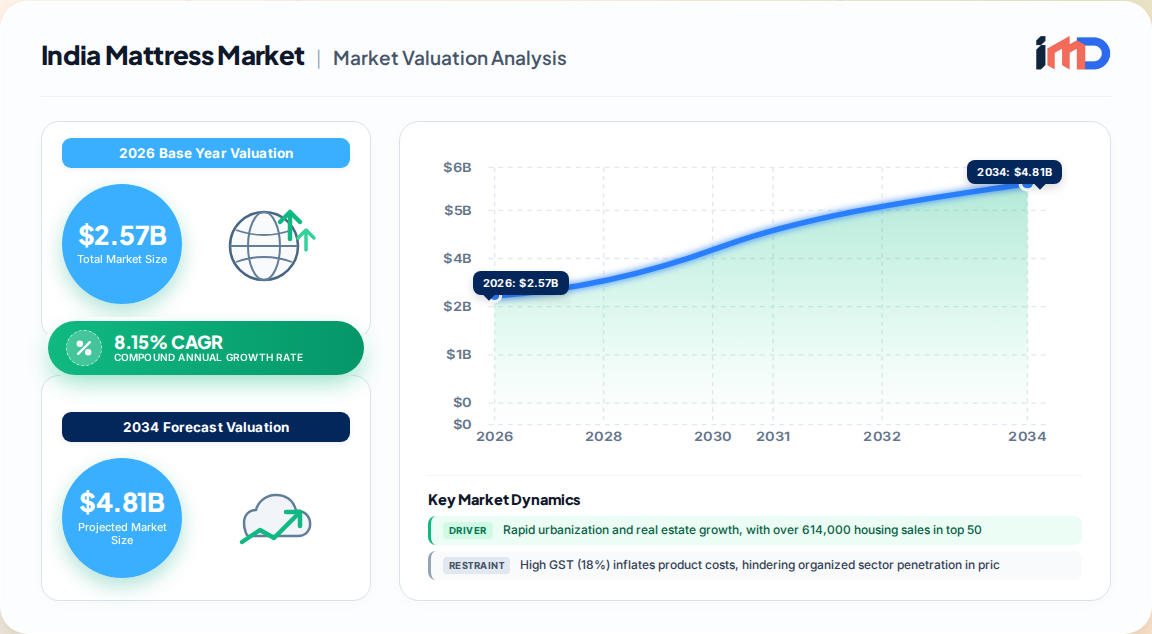
The Indian mattress industry is undergoing a structural transformation, evolving from a fragmented, unorganized trade into a branded, health-conscious consumer market. Our proprietary primary research and expert interviews indicate that the India mattress market was valued at USD 2.57 billion in 2026 and is forecast to expand to USD 4.13 billion by 2032, registering a robust CAGR of 8.15% over the 2027–2032 period. This growth is underpinned by shifts in household spending, rapid urbanization, and a growing recognition of sleep as a critical pillar of wellness.
The expansion of the India mattress market is propelled by a confluence of demographic, economic, and lifestyle factors. Our impact analysis quantifies the influence of each driver on the overall CAGR.
A granular analysis of the India mattress market reveals distinct growth patterns across product types, sizes, end users, and distribution channels.
| Segment | Sub-Segment | 2026 Share / Metric | Forecast CAGR (2027-2032) | Key Insights |
|---|---|---|---|---|
| By Product Type | Foam (incl. Memory Foam) | 52.6% share | 8.15% (overall) | Dominant due to affordability and comfort; hybrid is fastest-growing at 8.65% CAGR. |
| Innerspring / Coil | ~30% share | 7.5% | Losing share to foam but retains a loyal base in premium and hospitality segments. | |
| Hybrid | ~10% share | 8.65% | Fastest-growing, combining support and pressure relief. | |
| By Mattress Size | Queen-size | 33.84% share | 8.2% | The preferred choice for nuclear families in urban apartments. |
| King-size | ~20% share | 8.6% | Fastest-growing size, driven by premiumization and larger homes. | |
| Double/Single/Others | Balance | — | Steady demand from the commercial and budget segments. | |
| By End User | Residential | 77.79% share | 8.0% | Dominated by replacement and new household formation demand. |
| Commercial | 22.21% share | 9.6% | Fastest-growing, fueled by hospitality, healthcare, and corporate housing projects. | |
| By Distribution Channel | B2C/Retail | 73.07% share | 9.0% | Offline stores remain key, but online D2C is surging. |
| B2B/Project | 26.93% share | 7.5% | Steady growth from institutional buyers and real estate developers. |
The India mattress market exhibits significant regional disparities in terms of market maturity, consumer preferences, and growth potential.
The competitive landscape is characterized by a mix of legacy manufacturers, agile direct-to-consumer (D2C) startups, and expanding regional players. The organized sector is intensifying its focus on brand building, technological innovation, and omnichannel distribution.
The mattress value chain in India is evolving, with organized players increasingly integrating manufacturing and distribution to capture margin and ensure quality control.
India’s mattress trade is relatively modest compared to domestic consumption, with the market largely self-sufficient. However, trade flows are influenced by specialty products and raw materials.
Opportunities abound in underserved segments and geographies. Our analysis identifies the following white spaces for strategic investment:
| Existing Products | New Products | |
|---|---|---|
| Existing Markets | Market Penetration: Expand distribution in North and West India; increase replacement cycle frequency via targeted marketing. | Product Development: Launch affordable smart mattresses and orthopedic models for tier-II cities. |
| New Markets | Market Development: Enter East India and rural markets with low-cost foam offerings; target commercial segment (hotels, hospitals). | Diversification: Invest in sustainable materials (e.g., bamboo charcoal foam) and sleep-tech ecosystems (apps, wearables). |
| Aspects | Details |
|---|---|
| Study Period | 2020-2034 |
| Base Year | 2026 |
| Estimated Year | 2026 |
| Forecast Period | 2026-2034 |
| Historical Period | 2020-2025 |
| Growth Rate | CAGR of 8.15% from 2020-2034 |
| Segmentation |
|
By Mattress Size
By End User
By Distribution Channel
| By Geography |
|
The India mattress market was valued at USD 2.57 billion in 2026, according to our proprietary research. It is projected to reach USD 4.13 billion by 2032, growing at a CAGR of 8.15%.
Foam mattresses, including memory foam, held the largest share of 52.6% in 2026. This dominance is attributed to their affordability, comfort, and orthopedic benefits, which align with rising consumer health awareness.
South India is the fastest-growing region, forecast to expand at a CAGR of 8.8% from 2027 to 2032. The region benefits from high literacy, health consciousness, and rapid organized retail expansion.
Key players include Duroflex Ltd., Peps Industries, Wakefit Innovations, Sheela Foam Ltd. (Kurlon and Sleepwell), and The Sleep Company. These companies are expanding their retail footprints and investing in product innovation.
The 18% GST rate elevates product costs, particularly affecting rural and semi-urban price-sensitive consumers. This restrains organized sector growth by about 1.0% on the CAGR, as unbranded alternatives remain cheaper.
Our rigorous research methodology combines multi-layered approaches with comprehensive quality assurance, ensuring precision, accuracy, and reliability in every market analysis.
| Stakeholder Role | Interview Share (%) |
|---|---|
| Procurement Directors | 35% |
| Supply Chain Managers | 30% |
| Category Buyers (Hotels) | 20% |
| Founders/CEOs (D2C) | 15% |
| Company Type | Representation (%) |
|---|---|
| Mattress Manufacturers (Foam, Spring, Hybrid) | 40% |
| Raw Material Suppliers (Polyurethane, Latex, Coir) | 25% |
| D2C Brands | 15% |
| Organized Retail Chains | 12% |
| Hospitality Procurement | 8% |
 Related Reports
