Insight Market Data is a premier market research and business consulting firm headquartered in Pune, India, providing syndicated research reports, customized intelligence studies, and strategic advisory services. Renowned academic institutions and Fortune 500 corporations worldwide rely on Insight Market Data's research repository to navigate evolving global and regional business environments. Covering 46 diverse industries across 25 major international economies, our comprehensive database delivers thousands of verified statistics and granular market evaluations. By combining industry-leading analytical methodologies with the direct insights of seasoned industry leaders and subject-matter experts, we deliver actionable intelligence spanning historical performance benchmarks to rigorous multi-year forecasts. We empower organizations to make confident, data-driven decisions across pivotal domains including Machinery & Equipment, Chemicals & Materials, Pharmaceuticals & Healthcare, Food & Beverages, Consumer Goods, Energy & Power, Automotive & Transportation, Electronics & Semiconductors, Medical Devices, Telecommunications, Emerging Technologies, Agriculture, and Packaging. Our multidisciplinary analyst teams provide an objective 360-degree perspective, tailoring every engagement to address complex strategic challenges with exceptional analytical rigor.
Leveraging advanced BI-powered analytics and predictive modeling, Insight Market Data uncovers high-impact market opportunities and competitive differentiators for ambitious enterprises. We continuously refine our research methodologies in accordance with global industry standards, tracking real-time market shifts to ensure our reports are consistently accurate, actionable, and delivered on schedule. Our analysts conduct methodical data validation, rigorous compliance checks, and exhaustive primary and secondary research to maintain the highest levels of data integrity and transparency. We partner closely with corporate strategists, investment groups, and business executives to translate intricate market intelligence into clear, actionable roadmaps for sustainable growth. With operational presence across Washington, USA, and Vimannagar, Pune, India, Insight Market Data ensures direct access to dedicated research specialists and responsive customer support to answer your most strategic questions.
India Flexible Packaging Market Size, Growth & Forecast 2035 | Insight Market Data
India Flexible Packaging Market
Packaging / MARKET REPORT
India Flexible Packaging Market | Insight Market Data
India Flexible Packaging Market by Material Type (Plastic, Paper, Aluminum Foil), by Product Type (Pouches, Films & Wraps, Bags), by End-Use Industry (Food, Beverage, Pharmaceutical & Healthcare, Personal Care & Cosmetics, Household Care), by West, by South, by North, by East Forecast 2026-2034
Executive Overview: India Flexible Packaging Market
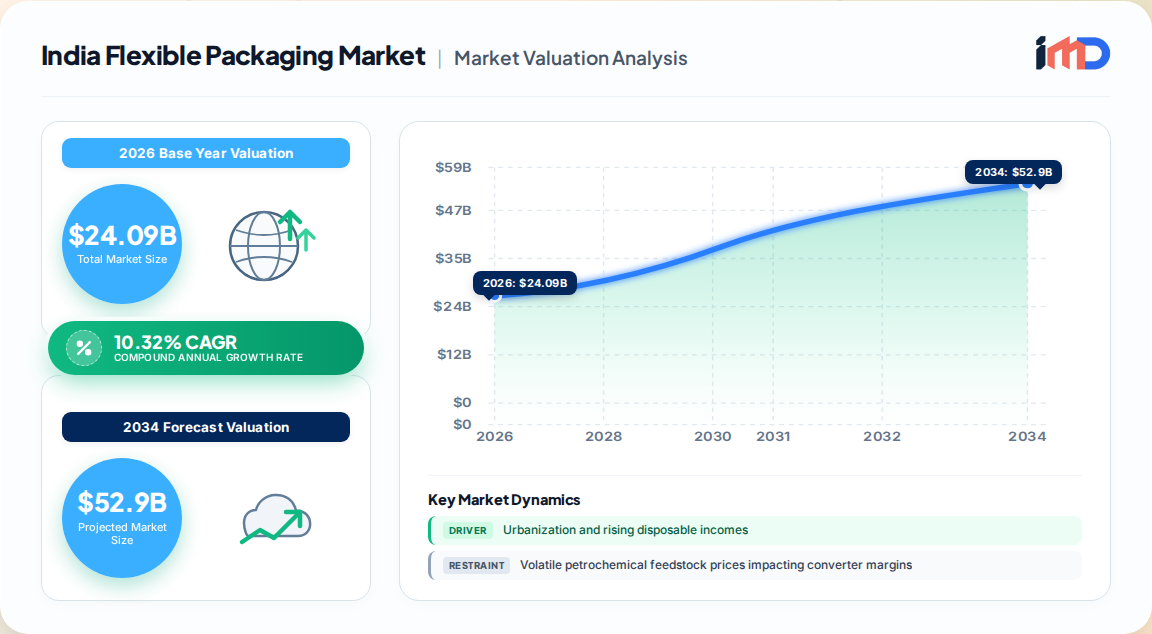
The India flexible packaging market reached USD 21.84 billion in 2025 and is projected to grow from USD 24.09 billion in 2026 to USD 58.29 billion by 2035, registering a CAGR of 10.32% during the forecast period (2026–2035). This robust growth is anchored in India's rapid urbanization—the country added over 130 million urban residents between 2011 and 2024—and rising per capita disposable income, expected to surpass USD 3,200 by 2027, which is channeling consumer spending toward packaged foods and personal care products that depend heavily on flexible formats.
India Flexible Packaging Market Market Size (In Billion)
40.0B
30.0B
20.0B
10.0B
0
21.84 B
2025
24.09 B
2026
26.58 B
2027
29.32 B
2028
32.34 B
2029
35.68 B
2030
39.37 B
2031
A meaningful technology shift is reshaping the market. Legacy rigid containers and metal cans are steadily yielding ground to multi-layer laminated pouches and stand-up formats that offer superior barrier properties at a fraction of the weight. Our proprietary primary research indicates that converters invested over USD 1.2 billion in new extrusion and lamination lines between 2022 and 2024 alone, with gravure-to-digital press conversions accelerating short-run capabilities for regional FMCG brands.
The competitive landscape features both domestic champions and global majors. Key players include Uflex Ltd., Huhtamaki India, Jindal Poly Films Ltd., Cosmo Films Ltd., EPL Limited, and Amcor plc, alongside a fragmented base of regional converters. West India commands approximately 38% of the market, driven by manufacturing concentration across Gujarat and Maharashtra. East India is the fastest-growing region at a projected CAGR of 11.78%, as greenfield FMCG facilities in Odisha and West Bengal attract packaging clusters. South India holds roughly 27% share, anchored by pharmaceutical and personal-care demand hubs in Hyderabad and Bengaluru.
Metric
Value
Base Year (2025) Market Size
USD 21.84 Billion
2026 Market Size
USD 24.09 Billion
2035 Forecast Market Size
USD 58.29 Billion
CAGR (2026–2035)
10.32%
Fastest-Growing Region
East India (11.78% CAGR)
Leading Material
Plastic (68% share)
Leading Product
Pouches (42% share)
Leading End-Use
Food (45% revenue share)
Key Market Drivers and Impact Analysis
The India flexible packaging market is propelled by a confluence of demographic, regulatory, and technological factors. Our driver impact analysis quantifies the contribution of each driver to the overall CAGR.
Urbanization and Income Growth (approx. 2.1% impact on CAGR): India's urban population is projected to reach 600 million by 2031, according to United Nations Department of Economic and Social Affairs projections. Every percentage point increase in urban household penetration translates into roughly 2.5 million new consumers purchasing packaged goods daily. Average per capita packaging consumption in urban India stands at USD 32 compared to USD 9 in rural areas, creating a structural growth runway.
FMCG Penetration in Rural India (approx. 1.8% impact): Hindustan Unilever, ITC, and Dabur jointly invested over INR 4,500 crore in rural distribution infrastructure between 2023 and 2025, with sachet-format goods accounting for over 60% of incremental SKU releases. Sachets costing between INR 1 and INR 10 account for more than 35% of unit volumes and use the largest ratio of packing material to product weight, disproportionately benefiting flexible packaging demand.
EPR Regulations as an Innovation Catalyst (approx. 1.5% impact): The Central Pollution Control Board's 2022 EPR framework requires producers, importers, and brand owners to reach precise recycling and reuse targets. By 2025, compliance must reach 40% of total plastic waste created, driving converters toward mono-material architectures. An estimated USD 280 million was put toward recyclable and compostable laminate development by Indian converters in 2024 alone.
Quick-Commerce Channel Expansion (approx. 1.4% impact): Platforms like Blinkit, Zepto, and Swiggy Instamart processed over 2 million daily orders by early 2025, fundamentally altering pack-size economics. Dark-store fulfillment demands packaging that survives three to four handling touchpoints within 10 minutes—a specification that rigid containers handle poorly.
Pharmaceutical Export Manufacturing Scale-Up (approx. 1.2% impact): India is the world's largest generic drug exporter, driving demand for high-barrier blister films and specialized flexible formats.
Technological Upgrades in Converting Machinery (approx. 1.1% impact): Adoption of high-speed automation, automated die-cutting systems, and advanced rotogravure printing presses reduces changeover times by over 30%.
Premiumization of Personal Care and Household Products (approx. 0.9% impact): Metro cities are witnessing a shift toward premium, aesthetically appealing flexible formats.
Restraints Impact Analysis
Despite strong growth fundamentals, the market faces several headwinds that temper the growth trajectory.
Restraint
Impact on CAGR
Geographic Relevance
Timeline
Volatile petrochemical feedstock prices
approx. -1.3%
Pan-India
Short-term (≤2 yr)
Regulatory complexity around single-use plastic bans
approx. -1.0%
Pan-India
Medium-term (2–4 yr)
Fragmented converter base limiting scale economies
approx. -0.8%
East & North India
Long-term (≥4 yr)
Skilled workforce shortages in advanced converting
approx. -0.5%
Pan-India
Medium-term (2–4 yr)
Petrochemical Price Volatility: Flexible packaging substrates are derivatives of petrochemicals. Fluctuations in crude oil and polymer prices directly impact converter margins and end-user pricing, causing periodic demand softness.
Regulatory Uncertainty on Plastics: India banned specific single-use plastic items in 2022, and evolving EPR mandates create compliance complexity. The industry grapples with the technical difficulty of recycling multilayer plastics and the fiscal pressure of high-cost recycled feedstocks.
Fragmented Converter Base: The presence of numerous small-scale converters, particularly in East and North India, limits economies of scale and adoption of advanced technologies, affecting overall industry efficiency.
Market Segmentation Analysis
By Material Type
Plastic holds approximately 68% share of the India flexible packaging market, propelled by cost advantages in high-volume FMCG applications. Flexible plastic packaging comprises 75% of total plastic packaging usage in India.
Paper-based formats are projected to register the fastest CAGR of 13.15% through 2035, benefiting from EPR-driven material substitution mandates and growing demand for high-barrier paper packaging alternatives, especially in e-commerce.
Aluminum foil segments represent roughly USD 2.84 billion in 2025 value, concentrated in pharmaceutical blister packs and dairy lidding, where superior barrier properties are critical.
By Product Type
Pouches account for an estimated 42% share, led by single-serve sachet demand in rural India. The retail sales value of chocolate pouches and bags in India exceeded USD 250 million in 2023 and is projected to reach approximately USD 458 million by 2028, growing at a CAGR of 12.3%. Stand-up pouches are evolving significantly, driven by sustainability imperatives and printing innovations.
Films & wraps are growing at a CAGR of 10.87%, driven by fresh produce and frozen food distribution modernization. Bags & sacks also hold a significant share, particularly in industrial and e-commerce applications.
By End-Use Industry
Food remains the dominant vertical, contributing approximately 45% of market revenue. The food and beverage segment was valued at USD 10.28 billion in 2024, driven by demand for convenience-oriented and processed products, including ready-to-eat meals and high-barrier pouches.
Pharmaceutical and healthcare applications are expanding at a CAGR of 12.41%, reflecting India's position as the world's largest generic drug exporter. High-barrier blister films with anti-counterfeiting features are increasingly adopted.
Personal care & cosmetics and household care segments benefit from premiumization and the shift toward smaller, transit-optimized formats.
Beverages, including juices, energy drinks, and milk, represent a significant and growing end-use segment.
End-Use Industry
Approx. Revenue Share
Growth Outlook
Food
45%
Dominant, steady growth
Pharmaceutical & Healthcare
18%
Fastest CAGR (12.41%)
Personal Care & Cosmetics
15%
Premiumization-driven
Beverage
12%
Convenience-led
Household Care
10%
Stable
Regional Outlook and Investment Hotspots
West India leads the India flexible packaging market with a 38% regional share, anchored by Gujarat's converter corridor and Maharashtra's manufacturing base. The region benefits from established supply chains, port access, and a concentration of FMCG and pharmaceutical companies.
India Flexible Packaging Market Regional Market Share
Loading chart...
East India is forecast to grow at 11.78% CAGR, the fastest among all regions, as new industrial corridors in Odisha and West Bengal attract packaging investments. Greenfield FMCG facilities are driving demand for locally sourced packaging, reducing logistics costs.
South India holds roughly 27% share, anchored by pharmaceutical and personal-care demand hubs in Hyderabad and Bengaluru. The region's strong pharmaceutical export orientation supports high-value flexible packaging demand.
North India accounts for approximately 21% of the market, with demand concentrated in the National Capital Region's FMCG and e-commerce fulfillment centers.
Region
Market Share
Key Drivers
West
38%
Gujarat converter corridor, FMCG manufacturing
South
27%
Pharma hubs (Hyderabad, Bengaluru)
North
21%
NCR e-commerce and FMCG demand
East
14%
Fastest-growing (11.78% CAGR), new industrial corridors
Competitive Landscape and Strategic Developments
The India flexible packaging market is characterized by a mix of large domestic players and global multinationals, with a fragmented base of regional converters. The market concentration is low, presenting consolidation opportunities.
Key Players:
Uflex Ltd.
Huhtamaki India
Jindal Poly Films Ltd.
Cosmo Films Ltd.
EPL Limited
Amcor plc
Jupiter Laminators Pvt Ltd
Purity Flexipack Pvt Ltd
Recent Industry Developments:
2025: Amcor completed its merger with Berry Global, expanding global scale across consumer and healthcare packaging.
2024: Indian converters invested an estimated USD 280 million in recyclable and compostable laminate development.
2023: SIG opened its second production plant in Palghar, India, manufacturing bag-in-box and spouted pouch packaging.
2023: Ferrero Rocher Moments revamped its packaging in India with pouches in factory-packed hangsells and shelf-ready dispensers.
2026: Amcor partnered with DCM to introduce recycle-ready mono-PE fertilizer packaging with 35% post-consumer recycled content.
Companies are increasing production capabilities in response to growing demand for pouches, bags, and films. Strategic priorities include sustainability (mono-material structures), digitalization (QR codes, anti-counterfeiting), and automation to reduce changeover times.
Value Chain and Supply Chain Dynamics
The flexible packaging value chain in India spans raw material suppliers, converters, brand owners, and end-consumers.
Raw Material Suppliers: Petrochemical companies supply polymers (PE, PP, PET), while aluminum foil and paper are sourced domestically and through imports. Volatility in feedstock prices is a key risk.
Converters: The converting segment includes large players and numerous small-scale manufacturers. Investment in extrusion and lamination lines is accelerating. Over USD 1.2 billion was invested in new lines between 2022 and 2024.
Brand Owners: FMCG, pharmaceutical, and personal care companies are the primary customers. They increasingly demand sustainable and recyclable packaging.
End-Consumers: Urban and rural consumers drive demand for convenient, single-serve, and shelf-stable products.
Supply chain risks include dependence on imported raw materials, petrochemical price volatility, and logistical bottlenecks. The national logistics network, leveraging over 160,000 post offices, enables broader market access but also underscores the need for cost-effective and durable packaging.
Strategic White-Space and Future Opportunities
Mono-Material Recyclable Structures: The transition from multi-material laminates to mono-material (all-PE) structures is a major white space. Regulatory pressure and brand commitments create demand for recyclable packaging solutions. Converters investing in this area can capture premium pricing and compliance advantages.
Smart and Active Packaging Integration: Integration of QR codes, anti-counterfeiting features, and active packaging (e.g., oxygen scavengers) is gaining traction, particularly in pharmaceuticals and high-value foods. This improves traceability by up to 25% and enhances consumer engagement.
Tier-2 and Tier-3 City Demand Expansion: As FMCG penetration deepens in rural and semi-urban areas, demand for small-pack formats (sachets) will surge. Sachets already account for over 35% of unit volumes in rural India.
Digital Printing and Personalization: Adoption of digital printing on flexible substrates enables short-run, customized packaging for regional brands and promotional campaigns.
Sustainability-Linked Investments: EPR regulations will drive investments in recycling infrastructure and eco-friendly materials. Paper-based flexible packaging is expected to grow at a 13.15% CAGR.
Conclusion and Market Outlook
The India flexible packaging market is poised for robust growth, driven by urbanization, FMCG expansion, quick-commerce, and regulatory catalysts. The market is expected to nearly triple in size from USD 21.84 billion in 2025 to USD 58.29 billion by 2035, at a CAGR of 10.32%. Stakeholders should prioritize sustainability, innovation in mono-material structures, and geographic expansion into East India to capitalize on emerging opportunities.
The competitive landscape will see increased consolidation and investment in advanced manufacturing. The shift toward recyclable and smart packaging will differentiate leaders from laggards. With favorable demographics and policy support, India remains one of the most attractive flexible packaging markets globally.
India Flexible Packaging Market Regional Market Share
Higher Coverage
Lower Coverage
No Coverage
India Flexible Packaging Market REPORT HIGHLIGHTS
Aspects
Details
Study Period
2020-2034
Base Year
2026
Estimated Year
2026
Forecast Period
2026-2034
Historical Period
2020-2025
Growth Rate
CAGR of 10.32% from 2020-2034
Segmentation
By Material Type
Plastic
Paper
Aluminum Foil
By Product Type
Pouches
Table of Contents
1. India Flexible Packaging Market Introduction
1.1. Research Scope
1.2. Market Segmentation
1.3. Research Objective
1.4. Definitions and Assumptions
2. India Flexible Packaging Market Executive Summary
3.3.2. Regulatory complexity around single-use plastic bans and EPR compliance
3.3.3. Fragmented converter base limiting scale economies
3.3.4. Skilled workforce shortages in advanced converting technologies
Films & Wraps
Bags
By End-Use Industry
Food
Beverage
Pharmaceutical & Healthcare
Personal Care & Cosmetics
Household Care
By Geography
West
South
North
East
3.4. Market Challenges
3.4.1. Recycling multilayer plastic waste
3.4.2. High cost of recycled PET resins and sustainable feedstocks
3.4.3. Compliance with plastic waste management rules requiring greater transparency
3.4.4. Need for high investment in automation to maintain profitability
4. India Flexible Packaging Market Factor Analysis
4.1. Porters Five Forces
4.1.1. Bargaining Power of Suppliers
4.1.2. Bargaining Power of Buyers
4.1.3. Threat of New Entrants
4.1.4. Threat of Substitutes
4.1.5. Competitive Rivalry
4.2. PESTEL analysis
4.3. BCG Analysis
4.3.1. Stars (High Growth, High Market Share)
4.3.2. Cash Cows (Low Growth, High Market Share)
4.3.3. Question Mark (High Growth, Low Market Share)
4.3.4. Dogs (Low Growth, Low Market Share)
4.4. Ansoff Matrix Analysis
4.5. Supply Chain Analysis
4.6. Regulatory Landscape
4.7. Current Market Potential and Opportunity Assessment (TAM–SAM–SOM Framework)
4.8. IMD Analyst Note
5. India Flexible Packaging Market Analysis, Insights and Forecast, 2020-2034
5.1. Analysis, Insights and Forecast - by Material Type
5.1.1. Plastic
5.1.2. Paper
5.1.3. Aluminum Foil
5.2. Analysis, Insights and Forecast - by Product Type
5.2.1. Pouches
5.2.2. Films & Wraps
5.2.3. Bags
5.3. Analysis, Insights and Forecast - by End-Use Industry
5.3.1. Food
5.3.2. Beverage
5.3.3. Pharmaceutical & Healthcare
5.3.4. Personal Care & Cosmetics
5.3.5. Household Care
5.4. Analysis, Insights and Forecast - by Region
5.4.1. West
5.4.2. South
5.4.3. North
5.4.4. East
6. India Flexible Packaging Market West Analysis, Insights and Forecast, 2020-2034
6.1. Analysis, Insights and Forecast - by Material Type
6.1.1. Plastic
6.1.2. Paper
6.1.3. Aluminum Foil
6.2. Analysis, Insights and Forecast - by Product Type
6.2.1. Pouches
6.2.2. Films & Wraps
6.2.3. Bags
6.3. Analysis, Insights and Forecast - by End-Use Industry
6.3.1. Food
6.3.2. Beverage
6.3.3. Pharmaceutical & Healthcare
6.3.4. Personal Care & Cosmetics
6.3.5. Household Care
7. India Flexible Packaging Market South Analysis, Insights and Forecast, 2020-2034
7.1. Analysis, Insights and Forecast - by Material Type
7.1.1. Plastic
7.1.2. Paper
7.1.3. Aluminum Foil
7.2. Analysis, Insights and Forecast - by Product Type
7.2.1. Pouches
7.2.2. Films & Wraps
7.2.3. Bags
7.3. Analysis, Insights and Forecast - by End-Use Industry
7.3.1. Food
7.3.2. Beverage
7.3.3. Pharmaceutical & Healthcare
7.3.4. Personal Care & Cosmetics
7.3.5. Household Care
8. India Flexible Packaging Market North Analysis, Insights and Forecast, 2020-2034
8.1. Analysis, Insights and Forecast - by Material Type
8.1.1. Plastic
8.1.2. Paper
8.1.3. Aluminum Foil
8.2. Analysis, Insights and Forecast - by Product Type
8.2.1. Pouches
8.2.2. Films & Wraps
8.2.3. Bags
8.3. Analysis, Insights and Forecast - by End-Use Industry
8.3.1. Food
8.3.2. Beverage
8.3.3. Pharmaceutical & Healthcare
8.3.4. Personal Care & Cosmetics
8.3.5. Household Care
9. India Flexible Packaging Market East Analysis, Insights and Forecast, 2020-2034
9.1. Analysis, Insights and Forecast - by Material Type
9.1.1. Plastic
9.1.2. Paper
9.1.3. Aluminum Foil
9.2. Analysis, Insights and Forecast - by Product Type
9.2.1. Pouches
9.2.2. Films & Wraps
9.2.3. Bags
9.3. Analysis, Insights and Forecast - by End-Use Industry
9.3.1. Food
9.3.2. Beverage
9.3.3. Pharmaceutical & Healthcare
9.3.4. Personal Care & Cosmetics
9.3.5. Household Care
10. India Flexible Packaging Market Competitive Analysis
10.1. Company Profiles
10.1.1. Uflex Ltd.
10.1.1.1. Company Overview
10.1.1.2. Products
10.1.1.3. Company Financials
10.1.1.4. SWOT Analysis
10.1.2. Huhtamaki India
10.1.2.1. Company Overview
10.1.2.2. Products
10.1.2.3. Company Financials
10.1.2.4. SWOT Analysis
10.1.3. Jindal Poly Films Ltd.
10.1.3.1. Company Overview
10.1.3.2. Products
10.1.3.3. Company Financials
10.1.3.4. SWOT Analysis
10.1.4. Cosmo Films Ltd.
10.1.4.1. Company Overview
10.1.4.2. Products
10.1.4.3. Company Financials
10.1.4.4. SWOT Analysis
10.1.5. EPL Limited
10.1.5.1. Company Overview
10.1.5.2. Products
10.1.5.3. Company Financials
10.1.5.4. SWOT Analysis
10.1.6. Amcor plc
10.1.6.1. Company Overview
10.1.6.2. Products
10.1.6.3. Company Financials
10.1.6.4. SWOT Analysis
10.1.7. Jupiter Laminators Pvt Ltd
10.1.7.1. Company Overview
10.1.7.2. Products
10.1.7.3. Company Financials
10.1.7.4. SWOT Analysis
10.1.8. Purity Flexipack Pvt Ltd
10.1.8.1. Company Overview
10.1.8.2. Products
10.1.8.3. Company Financials
10.1.8.4. SWOT Analysis
10.2. Market Entropy
10.2.1. Company's Key Areas Served
10.2.2. Recent Developments
10.3. Company Market Share Analysis, 2026
10.3.1. Top 5 Companies Market Share Analysis
10.3.2. Top 3 Companies Market Share Analysis
10.4. List of Potential Customers
List of Figures
Figure 1: Global India Flexible Packaging Market Revenue Breakdown (Billion, %) by Region 2026 & 2034
Figure 2: West India Flexible Packaging Market Revenue (Billion), by Material Type 2026 & 2034
Figure 3: West India Flexible Packaging Market Revenue Share (%), by Material Type 2026 & 2034
Figure 4: West India Flexible Packaging Market Revenue (Billion), by Product Type 2026 & 2034
Figure 5: West India Flexible Packaging Market Revenue Share (%), by Product Type 2026 & 2034
Figure 6: West India Flexible Packaging Market Revenue (Billion), by End-Use Industry 2026 & 2034
Figure 7: West India Flexible Packaging Market Revenue Share (%), by End-Use Industry 2026 & 2034
Figure 8: West India Flexible Packaging Market Revenue (Billion), by Country 2026 & 2034
Figure 9: West India Flexible Packaging Market Revenue Share (%), by Country 2026 & 2034
Figure 10: South India Flexible Packaging Market Revenue (Billion), by Material Type 2026 & 2034
Figure 11: South India Flexible Packaging Market Revenue Share (%), by Material Type 2026 & 2034
Figure 12: South India Flexible Packaging Market Revenue (Billion), by Product Type 2026 & 2034
Figure 13: South India Flexible Packaging Market Revenue Share (%), by Product Type 2026 & 2034
Figure 14: South India Flexible Packaging Market Revenue (Billion), by End-Use Industry 2026 & 2034
Figure 15: South India Flexible Packaging Market Revenue Share (%), by End-Use Industry 2026 & 2034
Figure 16: South India Flexible Packaging Market Revenue (Billion), by Country 2026 & 2034
Figure 17: South India Flexible Packaging Market Revenue Share (%), by Country 2026 & 2034
Figure 18: North India Flexible Packaging Market Revenue (Billion), by Material Type 2026 & 2034
Figure 19: North India Flexible Packaging Market Revenue Share (%), by Material Type 2026 & 2034
Figure 20: North India Flexible Packaging Market Revenue (Billion), by Product Type 2026 & 2034
Figure 21: North India Flexible Packaging Market Revenue Share (%), by Product Type 2026 & 2034
Figure 22: North India Flexible Packaging Market Revenue (Billion), by End-Use Industry 2026 & 2034
Figure 23: North India Flexible Packaging Market Revenue Share (%), by End-Use Industry 2026 & 2034
Figure 24: North India Flexible Packaging Market Revenue (Billion), by Country 2026 & 2034
Figure 25: North India Flexible Packaging Market Revenue Share (%), by Country 2026 & 2034
Figure 26: East India Flexible Packaging Market Revenue (Billion), by Material Type 2026 & 2034
Figure 27: East India Flexible Packaging Market Revenue Share (%), by Material Type 2026 & 2034
Figure 28: East India Flexible Packaging Market Revenue (Billion), by Product Type 2026 & 2034
Figure 29: East India Flexible Packaging Market Revenue Share (%), by Product Type 2026 & 2034
Figure 30: East India Flexible Packaging Market Revenue (Billion), by End-Use Industry 2026 & 2034
Figure 31: East India Flexible Packaging Market Revenue Share (%), by End-Use Industry 2026 & 2034
Figure 32: East India Flexible Packaging Market Revenue (Billion), by Country 2026 & 2034
Figure 33: East India Flexible Packaging Market Revenue Share (%), by Country 2026 & 2034
List of Tables
Table 1: Global India Flexible Packaging Market Revenue Billion Forecast, by Material Type 2020 & 2034
Table 2: Global India Flexible Packaging Market Revenue Billion Forecast, by Product Type 2020 & 2034
Table 3: Global India Flexible Packaging Market Revenue Billion Forecast, by End-Use Industry 2020 & 2034
Table 4: Global India Flexible Packaging Market Revenue Billion Forecast, by Region 2020 & 2034
Table 5: West India Flexible Packaging Market Revenue Billion Forecast, by Material Type 2020 & 2034
Table 6: West India Flexible Packaging Market Revenue Billion Forecast, by Product Type 2020 & 2034
Table 7: West India Flexible Packaging Market Revenue Billion Forecast, by End-Use Industry 2020 & 2034
Table 8: West India Flexible Packaging Market Revenue Billion Forecast, by Country 2020 & 2034
Table 9: South India Flexible Packaging Market Revenue Billion Forecast, by Material Type 2020 & 2034
Table 10: South India Flexible Packaging Market Revenue Billion Forecast, by Product Type 2020 & 2034
Table 11: South India Flexible Packaging Market Revenue Billion Forecast, by End-Use Industry 2020 & 2034
Table 12: South India Flexible Packaging Market Revenue Billion Forecast, by Country 2020 & 2034
Table 13: North India Flexible Packaging Market Revenue Billion Forecast, by Material Type 2020 & 2034
Table 14: North India Flexible Packaging Market Revenue Billion Forecast, by Product Type 2020 & 2034
Table 15: North India Flexible Packaging Market Revenue Billion Forecast, by End-Use Industry 2020 & 2034
Table 16: North India Flexible Packaging Market Revenue Billion Forecast, by Country 2020 & 2034
Table 17: East India Flexible Packaging Market Revenue Billion Forecast, by Material Type 2020 & 2034
Table 18: East India Flexible Packaging Market Revenue Billion Forecast, by Product Type 2020 & 2034
Table 19: East India Flexible Packaging Market Revenue Billion Forecast, by End-Use Industry 2020 & 2034
Table 20: East India Flexible Packaging Market Revenue Billion Forecast, by Country 2020 & 2034
Frequently Asked Questions
1What is the current size of the India flexible packaging market?
The India flexible packaging market was valued at USD 21.84 billion in 2025 and is projected to reach USD 24.09 billion in 2026, growing at a CAGR of 10.32% to reach USD 58.29 billion by 2035.
2Which material type dominates the India flexible packaging market?
Plastic holds approximately 68% share of the India flexible packaging market, driven by its cost advantages in high-volume FMCG applications. Paper-based formats are the fastest-growing segment at a CAGR of 13.15%.
3Which region in India has the largest share of the flexible packaging market?
West India leads with a 38% share, anchored by Gujarat's converter corridor. East India is the fastest-growing region at a projected CAGR of 11.78%, as new FMCG facilities in Odisha and West Bengal attract packaging investments.
4What are the key drivers for the India flexible packaging market?
Key drivers include urbanization and rising disposable incomes (approx. 2.1% impact on CAGR), FMCG penetration in rural India (approx. 1.8%), EPR regulations driving innovation (approx. 1.5%), and quick-commerce expansion (approx. 1.4%).
5Who are the major players in the India flexible packaging market?
Major players include Uflex Ltd., Huhtamaki India, Jindal Poly Films Ltd., Cosmo Films Ltd., EPL Limited, Amcor plc, Jupiter Laminators Pvt Ltd, and Purity Flexipack Pvt Ltd.
6What is the impact of EPR regulations on the India flexible packaging market?
EPR regulations are driving converters toward mono-material recyclable structures. An estimated USD 280 million was invested in recyclable and compostable laminate development by Indian converters in 2024, and paper-based formats are growing at 13.15% CAGR.
Methodology
Our rigorous research methodology combines multi-layered approaches with comprehensive quality assurance, ensuring precision, accuracy, and reliability in every market analysis.
Primary Research
Our analysis is built on a 70–30 research split, with 70–80% of insights derived from primary research and 20–30% from secondary sources.
We conducted in-depth interviews with 48+ packaging converters, brand owners, and raw material suppliers across India, including roles such as Procurement Directors, Packaging Development Heads, Supply Chain Managers, and Sustainability Officers.
Primary interviews targeted specific company types: film extruders and laminators, pouch converters, label and shrink-sleeve manufacturers, paper-based flexible packaging producers, and raw material (resin, foil, paper) suppliers.
We guarantee an estimated data accuracy level of 85–90%, validated through multi-level data triangulation.
Key Stakeholders Interviewed
Key Stakeholders Interviewed
Stakeholder Role
Interview Share (%)
Procurement Director
30%
Packaging Development Head
25%
Supply Chain Manager
25%
Sustainability Officer
20%
Industry Ecosystem Breakdown
Industry Ecosystem Breakdown
Company Type
Representation (%)
Film Extruders & Laminators
30%
Pouch Converters
25%
Label & Shrink-Sleeve Manufacturers
15%
Paper-Based Flexible Packaging Producers
15%
Raw Material Suppliers
15%
Secondary Research & Industry Benchmarking
We triangulated primary findings with authoritative secondary data from official multilateral institutions such as the United Nations Statistics Division, World Bank, and WTO, as well as non-profit trade associations including the Indian Institute of Packaging (IIP), the Flexible Packaging Association (FPA), and the Central Pollution Control Board (CPCB).
Standard financial databases including Bloomberg, Factiva, Hoovers, and PitchBook were used for company-level financial analysis and deal tracking.
We monitored regulatory filings, EPR compliance reports, and industry trade publications to capture policy shifts and technological developments.
Every report is updated to the date of purchase to ensure timeliness.
Demand Modeling & Market Estimation
We employed both top-down and bottom-up methodologies simultaneously. The bottom-up approach built market size from granular converter-level production data, using quantitative metrics such as annual polymer consumption volumes, converter capacity utilization rates, average selling price per kilogram, and end-use industry off-take volumes.
The top-down approach validated these estimates against national packaging consumption benchmarks, GDP-linked FMCG growth rates, and import/export trade data from UN Comtrade.
Multi-level data triangulation reconciled variances between primary interviews, secondary benchmarks, and econometric modeling to arrive at final market estimates.
Data Accuracy & Quality Check
All data points underwent a rigorous three-tier validation: first, cross-referencing with at least two independent primary sources; second, sanity-checking against historical growth trends and industry benchmarks; third, review by our senior analyst panel.
We maintain an 85–90% confidence interval for all market forecasts, with sensitivity analysis conducted for key variables such as petrochemical prices and regulatory changes.
Any data discrepancies were resolved through follow-up interviews and additional secondary research, ensuring the highest level of reliability.
Related Reports
Freshness indicator packaging market to reach $2.75B by 2034, growing at 8.6% CAGR. Explore key strategic growth drivers and industry trends.
Nov 2026|189 pages
$2900.00
Cycling water bottle market valued at USD 1.12 Billion in 2025, projected to reach USD 1.94 Billion by 2033 at a 7.1% CAGR. Explore trends & insights.
Nov 2026|242 pages
$2900.00
The global freight container market is projected to grow from USD 10.7 billion in 2026 to USD 13.14 billion by 2031, at a CAGR of 4.19%.
Nov 2026|230 pages
$2900.00
Polyamide corrugated conduit market to grow at 8.2% CAGR through 2031, driven by industrial automation, renewables and 5G cabling demand.
Nov 2026|265 pages
$2900.00
Cut Stack Label Market valued at USD 4.83 Billion in 2024, projected to reach USD 7.15 Billion by 2035 at a 3.63% CAGR. Get full insights now.