1What is the current size of the inbound logistics market?
The global inbound logistics market was valued at USD 1,569.27 billion in 2024 and is projected to reach USD 2,410.6 billion by 2030, growing at a CAGR of 7.8%.
Insight Market Data is a premier market research and business consulting firm headquartered in Pune, India, providing syndicated research reports, customized intelligence studies, and strategic advisory services. Renowned academic institutions and Fortune 500 corporations worldwide rely on Insight Market Data's research repository to navigate evolving global and regional business environments. Covering 46 diverse industries across 25 major international economies, our comprehensive database delivers thousands of verified statistics and granular market evaluations. By combining industry-leading analytical methodologies with the direct insights of seasoned industry leaders and subject-matter experts, we deliver actionable intelligence spanning historical performance benchmarks to rigorous multi-year forecasts. We empower organizations to make confident, data-driven decisions across pivotal domains including Machinery & Equipment, Chemicals & Materials, Pharmaceuticals & Healthcare, Food & Beverages, Consumer Goods, Energy & Power, Automotive & Transportation, Electronics & Semiconductors, Medical Devices, Telecommunications, Emerging Technologies, Agriculture, and Packaging. Our multidisciplinary analyst teams provide an objective 360-degree perspective, tailoring every engagement to address complex strategic challenges with exceptional analytical rigor.
Leveraging advanced BI-powered analytics and predictive modeling, Insight Market Data uncovers high-impact market opportunities and competitive differentiators for ambitious enterprises. We continuously refine our research methodologies in accordance with global industry standards, tracking real-time market shifts to ensure our reports are consistently accurate, actionable, and delivered on schedule. Our analysts conduct methodical data validation, rigorous compliance checks, and exhaustive primary and secondary research to maintain the highest levels of data integrity and transparency. We partner closely with corporate strategists, investment groups, and business executives to translate intricate market intelligence into clear, actionable roadmaps for sustainable growth. With operational presence across Washington, USA, and Vimannagar, Pune, India, Insight Market Data ensures direct access to dedicated research specialists and responsive customer support to answer your most strategic questions.
 Inbound Logistics Market
 by Service (Transportation, Warehousing & Storage, Inventory Management, Procurement Services, Others), by Mode of Transportation (Road, Rail, Air, Sea), by End Use (Retail & E-commerce, Manufacturing, Automotive, Pharmaceuticals, Food & Beverage, Electronics, Others), by North America (USA, Canada, Mexico), by Europe (Germany, UK, France, Russia, Spain, Italy), by Asia Pacific (China, Japan, India, South Korea, Australia), by South America (Brazil, Argentina), by Middle East & Africa (UAE, Saudi Arabia, South Africa) Forecast 2026-2034

Research Associate


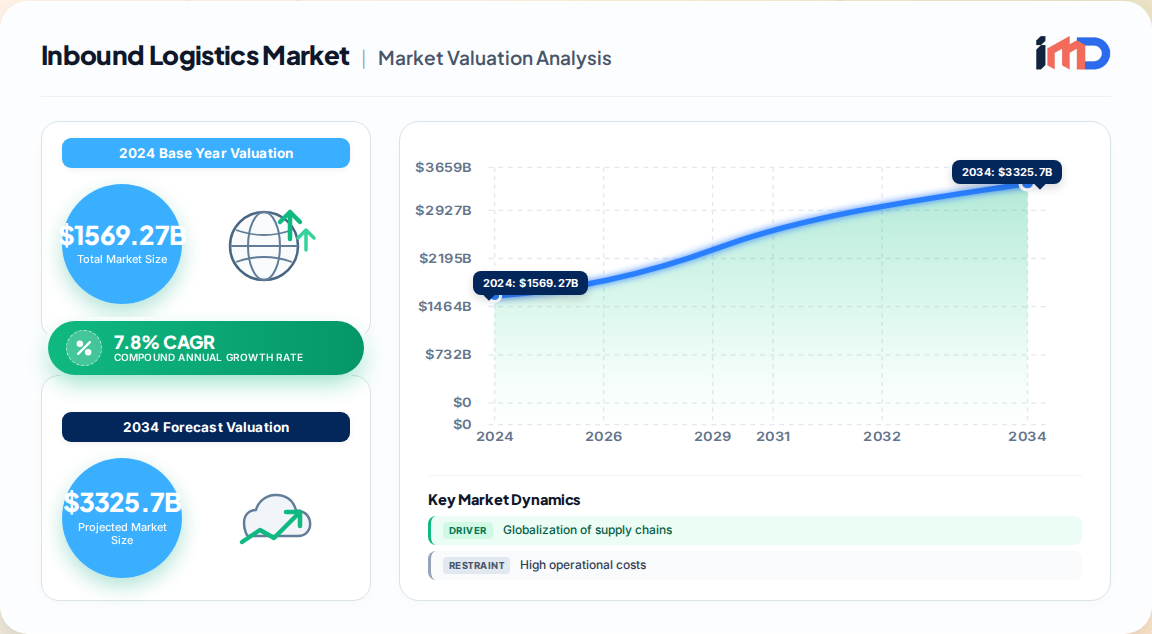
The global inbound logistics market is a critical enabler of industrial production and retail replenishment, encompassing the planning, execution, and management of raw materials, components, and finished goods from suppliers to manufacturers, warehouses, and distribution centers. Our proprietary primary research and expert interviews indicate the market was valued at USD 1,569.27 billion in 2024 and is projected to reach USD 2,410.6 billion by 2030, expanding at a CAGR of 7.8% from 2025 to 2030. This growth is underpinned by the increasing complexity of global supply chains, the relentless expansion of e-commerce, and the rapid adoption of digital and automated technologies.
Asia Pacific dominated the market in 2024, accounting for a 38.2% revenue share, driven by its manufacturing powerhouse status and expansive supplier networks. North America and Europe follow, characterized by advanced logistics infrastructure and stringent sustainability regulations. The market is characterized by the presence of large, integrated logistics providers offering end-to-end services, alongside specialized regional players and technology-driven startups.
Key market trends include the integration of Artificial Intelligence (AI) and the Internet of Things (IoT) for real-time visibility and predictive analytics, a strategic shift towards sustainable logistics practices, and the growing demand for multimodal transportation solutions. The transportation service segment leads the market, accounting for 45.7% of revenue in 2024, as companies seek reliable and efficient movement of goods across borders and within regions.
Drivers:
Restraints:
Key Trends:
The inbound logistics market is segmented into transportation, warehousing and storage, inventory management, procurement services, and others. In 2024, the transportation segment accounted for the largest share of 45.7%, driven by the critical need for efficient and reliable movement of goods across increasingly complex global supply chains.
Road transport dominated the market in 2024, holding a 52.8% share, attributed to its flexibility, cost-effectiveness, and extensive reach, particularly for short-haul and regional deliveries. The road segment benefits from continuous investments in highway infrastructure and the adoption of smart trucking technologies.
The retail and e-commerce segment dominated the market in 2024, accounting for 34.7% of the market share, as online shopping continues to surge, necessitating efficient inbound logistics to maintain inventory levels and meet rapid delivery expectations.
Asia Pacific dominated the global inbound logistics market in 2024, with a 38.2% revenue share, and is expected to be the fastest-growing region. The region's manufacturing hubs, such as China, India, and Southeast Asia, are major drivers, supported by increasing foreign direct investment and infrastructure development.
The inbound logistics market is highly competitive, with key players focusing on strategic initiatives such as mergers and acquisitions, technology investments, and service portfolio expansion to enhance their market presence.
Recent developments include investments in AI-driven platforms by major players to enhance predictive analytics and route optimization. For instance, several companies have launched control tower solutions that provide real-time visibility across inbound shipments. The market is also witnessing increased collaboration between logistics providers and technology firms to develop innovative solutions for last-mile and inbound delivery.
The inbound logistics market is intrinsically linked to global trade flows. According to official trade statistics from UN Comtrade and Eurostat, the volume of intermediate goods traded globally has grown steadily, reflecting the increasing fragmentation of production across borders. For example, in 2024, the EU road freight transport recorded over 13.2 billion tonnes of goods, with food products, beverages, and tobacco dominating the mix. This volume underscores the critical role of inbound logistics in managing the flow of raw materials and components.
Key supplier dynamics include the growing importance of near-shoring and friend-shoring strategies, as companies seek to mitigate supply chain risks. This is leading to a shift in trade patterns, with increased intra-regional trade in North America and Europe. Additionally, supplier collaboration and vendor-managed inventory (VMI) practices are becoming more prevalent, enabling better demand forecasting and inventory optimization. The integration of blockchain technology for supply chain transparency is also gaining traction, enhancing trust and security in supplier transactions.
| Aspects | Details |
|---|---|
| Study Period | 2020-2034 |
| Base Year | 2024 |
| Estimated Year | 2026 |
| Forecast Period | 2026-2034 |
| Historical Period | 2020-2025 |
| Growth Rate | CAGR of 7.8% from 2020-2034 |
| Segmentation |
|
By End Use
| By Geography |
|
The global inbound logistics market was valued at USD 1,569.27 billion in 2024 and is projected to reach USD 2,410.6 billion by 2030, growing at a CAGR of 7.8%.
Asia Pacific dominated the market in 2024, accounting for a 38.2% revenue share, driven by its manufacturing strength and expanding trade networks.
Key drivers include the globalization of supply chains, e-commerce expansion, cost optimization pressures, and technological advancements in AI and IoT.
Road transport held the largest share of 52.8% in 2024, due to its flexibility and cost-effectiveness for regional and short-haul deliveries.
Leading companies include DHL Supply Chain & Global Forwarding, Kuehne + Nagel, DB Schenker, DSV Panalpina, C.H. Robinson, Nippon Express, XPO Logistics, FedEx Logistics, and Maersk Logistics.
The air transport segment is expected to register the fastest CAGR, driven by the increasing demand for time-sensitive deliveries, particularly in pharmaceuticals and high-value goods.
Our rigorous research methodology combines multi-layered approaches with comprehensive quality assurance, ensuring precision, accuracy, and reliability in every market analysis.
| Stakeholder Role | Interview Share (%) |
|---|---|
| Supply Chain Director | 40% |
| Logistics Manager | 25% |
| Procurement Head | 20% |
| Operations Executive | 15% |
| Company Type | Representation (%) |
|---|---|
| 3PL Providers | 35% |
| Freight Forwarders | 25% |
| Shippers (Manufacturers/Retailers) | 30% |
| Logistics Technology Vendors | 10% |
 Related Reports
