1What is the size of the Hong Kong warehousing market?
The Hong Kong warehousing market was valued at USD 1.74 billion in 2025 and is projected to reach USD 1.85 billion in 2026, growing to USD 2.42 billion by 2031 at a 5.52% CAGR.
Insight Market Data is a premier market research and business consulting firm headquartered in Pune, India, providing syndicated research reports, customized intelligence studies, and strategic advisory services. Renowned academic institutions and Fortune 500 corporations worldwide rely on Insight Market Data's research repository to navigate evolving global and regional business environments. Covering 46 diverse industries across 25 major international economies, our comprehensive database delivers thousands of verified statistics and granular market evaluations. By combining industry-leading analytical methodologies with the direct insights of seasoned industry leaders and subject-matter experts, we deliver actionable intelligence spanning historical performance benchmarks to rigorous multi-year forecasts. We empower organizations to make confident, data-driven decisions across pivotal domains including Machinery & Equipment, Chemicals & Materials, Pharmaceuticals & Healthcare, Food & Beverages, Consumer Goods, Energy & Power, Automotive & Transportation, Electronics & Semiconductors, Medical Devices, Telecommunications, Emerging Technologies, Agriculture, and Packaging. Our multidisciplinary analyst teams provide an objective 360-degree perspective, tailoring every engagement to address complex strategic challenges with exceptional analytical rigor.
Leveraging advanced BI-powered analytics and predictive modeling, Insight Market Data uncovers high-impact market opportunities and competitive differentiators for ambitious enterprises. We continuously refine our research methodologies in accordance with global industry standards, tracking real-time market shifts to ensure our reports are consistently accurate, actionable, and delivered on schedule. Our analysts conduct methodical data validation, rigorous compliance checks, and exhaustive primary and secondary research to maintain the highest levels of data integrity and transparency. We partner closely with corporate strategists, investment groups, and business executives to translate intricate market intelligence into clear, actionable roadmaps for sustainable growth. With operational presence across Washington, USA, and Vimannagar, Pune, India, Insight Market Data ensures direct access to dedicated research specialists and responsive customer support to answer your most strategic questions.

 Hong Kong Warehousing Market
 by Facility Type (General Warehousing, Refrigerated Warehousing, Farm Product Warehousing, Hazardous Goods Warehousing, Bonded Warehousing), by Ownership Model (Private Warehouses, Public Warehouses, Bonded Warehouses), by End-User Industry (Manufacturing, Consumer Goods, Food and Beverage, Retail and E-commerce, Healthcare and Pharmaceuticals, Other End-user Industries), by Temperature Control (Ambient Storage, Cold Storage, Controlled Humidity Storage), by Automation Level (Manual Handling Facilities, Semi-automated Facilities, Fully Automated Facilities), by Service Type (Storage Only, Fulfilment and Distribution Services, Value-added Services (Kitting, Labelling)), by Hong Kong Island, by Kowloon, by New Territories, by Lantau Island Forecast 2026-2034

Research Associate

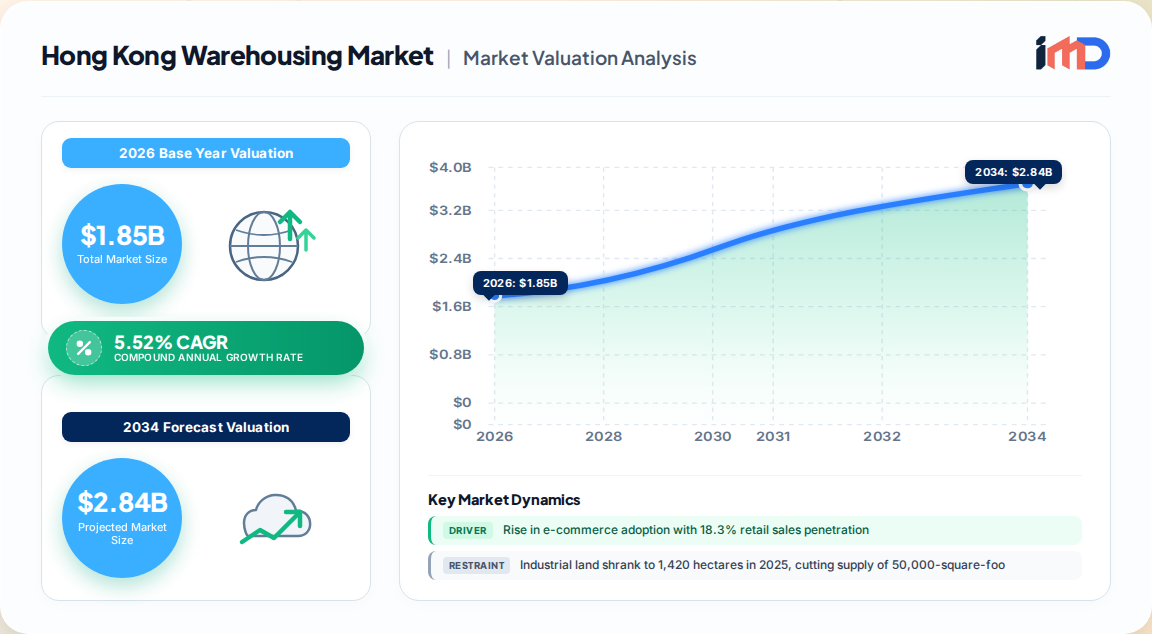
The Hong Kong warehousing market is projected to expand from USD 1.85 billion in 2026 to USD 2.42 billion by 2031, advancing at a 5.52% CAGR over the forecast period. This is not a story of volume expansion in a land-constrained territory, but one of value densification: operators are repurposing scarce industrial floor space into refrigerated, automated, and bonded environments that command premium rents.
Three structural forces define the market. First, e-commerce penetration reached 18.3% of retail sales in 2025, driving demand for urban micro-fulfillment nodes under 20,000 square feet. Second, the Hong Kong-Zhuhai-Macau Bridge has compressed cross-border transit from four hours to under 45 minutes, transforming Tuen Mun and Yuen Long into bonded e-fulfillment gateways. Third, pharmaceutical imports hit USD 8.2 billion in 2024, with biologics comprising 42% of the total, forcing cold-chain investment that disqualifies roughly 70% of ambient stock under Department of Health Good Distribution Practice rules.
| Market Metric | 2025 (Base) | 2026 | 2031 (Forecast) |
|---|---|---|---|
| Market Size (USD) | 1.74 Billion | 1.85 Billion | 2.42 Billion |
| Growth Rate (CAGR 2026-2031) | — | — | 5.52% |
| Refrigerated Warehousing Share | 37% | — | 6.57% CAGR |
| Private Warehouse Ownership Share | 46.50% | — | 6.49% CAGR |
| Retail & E-commerce End-User Share | 29.40% | — | 5.97% CAGR |
| Cold Storage Temperature-Control Share | 54% | — | 6.17% CAGR |
| Fulfillment & Distribution Service Share | 38.70% | — | 6.39% CAGR |
The growth trajectory is underpinned by six identifiable demand vectors, each with a measurable impact on the CAGR forecast.
Four constraints cap the market's upside potential.
Segment dynamics reveal a clear bifurcation between specialized, high-margin categories and commoditized general warehousing.
The market is characterized by low concentration, with no single operator commanding dominant share. Competitive intensity is moderate yet rising as global logistics real-estate investment trusts and mainland e-commerce platforms accelerate spend on smart facilities.
Major players include Kerry Logistics Network Limited, Goodman Hong Kong Logistics Partnership, ESR Cayman Limited, Dragon Crown Group Holdings Limited, and Sun Wah Cold Storage Limited, alongside China Resources Logistics, Chevalier Cold Storage and Logistics, SF Express (Hong Kong), JD Logistics, Cainiao, and Hacis.
Recent developments signal the strategic direction of the market:
Geographic distribution reflects the interplay of land availability, cross-border connectivity, and consumption density.
The warehousing value chain spans facility developers and REITs, third-party logistics operators, automation technology providers, and end-user industries. Key risks include:
The highest-value opportunities lie in three areas: cold-chain capacity for biologics and mRNA vaccines, where licensed specialists maintain full occupancy and pricing power; bonded e-fulfillment in Tuen Mun and Yuen Long, where bridge-driven transit times under 45 minutes support 25%+ margin premiums on reverse logistics; and automation-as-a-service models targeting mid-tier operators unable to shoulder full capital outlays. Operators willing to commit HKD 800 million (USD 103 million) to chilled, blockchain-enabled sites are positioned to capture disproportionate share of the USD 2.42 billion market by 2031.
| Aspects | Details |
|---|---|
| Study Period | 2020-2034 |
| Base Year | 2026 |
| Estimated Year | 2026 |
| Forecast Period | 2026-2034 |
| Historical Period | 2020-2025 |
| Growth Rate | CAGR of 5.52% from 2020-2034 |
| Segmentation |
|
By Ownership Model
By End-User Industry
By Temperature Control
By Automation Level
By Service Type
| By Geography |
|
The Hong Kong warehousing market was valued at USD 1.74 billion in 2025 and is projected to reach USD 1.85 billion in 2026, growing to USD 2.42 billion by 2031 at a 5.52% CAGR.
Refrigerated warehousing led with 37% revenue share in 2025 and is forecast to grow at a 6.57% CAGR, while cold storage accounted for 54% of the temperature-control segment.
Key operators include Kerry Logistics Network Limited, Goodman Hong Kong Logistics Partnership, ESR Cayman Limited, Dragon Crown Group Holdings Limited, and Sun Wah Cold Storage Limited, alongside China Resources Logistics and SF Express.
E-commerce adoption at 18.3% of retail sales, cross-border e-fulfillment via the Hong Kong-Zhuhai-Macau Bridge, and pharmaceutical cold-chain demand from USD 8.2 billion in imports are primary growth drivers.
Industrial land shrank to 1,420 hectares in 2025, pushing auction prices past HKD 8,500 per square foot, while build cycles of 28-36 months and fire safety codes constrain new capacity.
Our rigorous research methodology combines multi-layered approaches with comprehensive quality assurance, ensuring precision, accuracy, and reliability in every market analysis.
| Stakeholder Role | Interview Share (%) |
|---|---|
| Head of Supply Chain | 30% |
| Warehouse Operations Director | 30% |
| Cold Chain Compliance Manager | 20% |
| Logistics Real Estate Investment Director | 20% |
| Company Type | Representation (%) |
|---|---|
| Third-Party Logistics Operators | 30% |
| Cold-Chain Specialists | 25% |
| Industrial Real Estate Developers & REITs | 20% |
| Automation Technology Providers | 15% |
| End-User Retail & Pharmaceutical Distributors | 10% |
 Related Reports
