1What is the size of the commercial aircraft engine market in 2026?
Our proprietary primary research values the commercial aircraft engine market at USD 98.86 billion in 2026, expanding at a 3.45% CAGR to reach USD 117.13 billion by 2031.
Insight Market Data is a premier market research and business consulting firm headquartered in Pune, India, providing syndicated research reports, customized intelligence studies, and strategic advisory services. Renowned academic institutions and Fortune 500 corporations worldwide rely on Insight Market Data's research repository to navigate evolving global and regional business environments. Covering 46 diverse industries across 25 major international economies, our comprehensive database delivers thousands of verified statistics and granular market evaluations. By combining industry-leading analytical methodologies with the direct insights of seasoned industry leaders and subject-matter experts, we deliver actionable intelligence spanning historical performance benchmarks to rigorous multi-year forecasts. We empower organizations to make confident, data-driven decisions across pivotal domains including Machinery & Equipment, Chemicals & Materials, Pharmaceuticals & Healthcare, Food & Beverages, Consumer Goods, Energy & Power, Automotive & Transportation, Electronics & Semiconductors, Medical Devices, Telecommunications, Emerging Technologies, Agriculture, and Packaging. Our multidisciplinary analyst teams provide an objective 360-degree perspective, tailoring every engagement to address complex strategic challenges with exceptional analytical rigor.
Leveraging advanced BI-powered analytics and predictive modeling, Insight Market Data uncovers high-impact market opportunities and competitive differentiators for ambitious enterprises. We continuously refine our research methodologies in accordance with global industry standards, tracking real-time market shifts to ensure our reports are consistently accurate, actionable, and delivered on schedule. Our analysts conduct methodical data validation, rigorous compliance checks, and exhaustive primary and secondary research to maintain the highest levels of data integrity and transparency. We partner closely with corporate strategists, investment groups, and business executives to translate intricate market intelligence into clear, actionable roadmaps for sustainable growth. With operational presence across Washington, USA, and Vimannagar, Pune, India, Insight Market Data ensures direct access to dedicated research specialists and responsive customer support to answer your most strategic questions.
 Growth Strategies in Commercial Aircraft Engine Market
 by Engine Type (Turbofan, Turboprop), by Aircraft Type (Narrowbody, Widebody, Regional), by Technology (Conventional, GTF, Hybrid-electric), by Thrust Class (Less Than 10, 000 lbf, 10, 001–25, 000 lbf, 25, 001–50, 000 lbf, Above 50, 000 lbf), by Engine Component (Compressor, Turbine, Combustor, Fan), by End-User (OEM Factory-Fit, Replacement/Aftermarket), by North America (USA, Canada), by Europe (Germany, UK, France), by Asia Pacific (China, Japan, India, Southeast Asia), by South America (Brazil), by Middle East & Africa (UAE, Saudi Arabia, South Africa) Forecast 2026-2034

Research Associate


 Related Reports

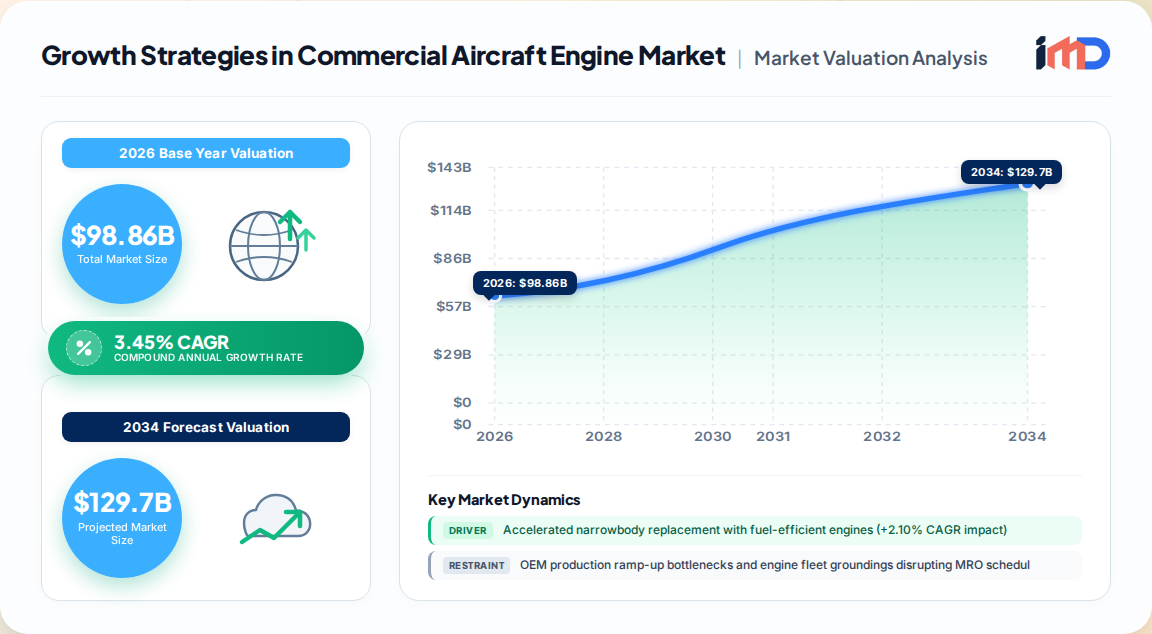
The commercial aircraft engine market is entering a decisive strategic window. Our proprietary primary research pegs the market at USD 98.86 billion in 2026, expanding at a 3.45% CAGR to reach USD 117.13 billion by 2031. This headline growth masks a far more consequential structural shift: lifecycle value is migrating decisively from new hardware to recurring aftermarket services, while a compressed next-generation propulsion race forces every participant to re-sequence capital, capacity, and certification investments.
Three forces define the strategic agenda through the forecast horizon:
Our analyst view is that 2026–2028 rewards those who convert utilization into disciplined service throughput; 2029–2035 rewards those who have secured certification and supplier position on open-fan, hybrid-electric, and military next-generation architectures.
The growth engine of commercial propulsion is no longer a single variable. Our demand model attributes CAGR contribution across five weighted drivers.
| Growth Driver | Estimated CAGR Impact | Primary Geography | Impact Horizon |
|---|---|---|---|
| Accelerated narrowbody replacement (LEAP/PW1100G) | +2.10% | Global; North America & Europe concentration | Short term (≤2 years) |
| Asia-Pacific LCC fleet expansion | +1.80% | Asia-Pacific core, Middle East spill-over | Medium term (2–4 years) |
| Ageing fleet pushing engine-MRO demand | +1.50% | Mature North America & Europe | Long term (≥4 years) |
| Unscheduled PW1100G and LEAP shop-visit surge | +1.30% | Asia-Pacific & North America acute | Short term (≤2 years) |
| Long-term SAF-backed offtake agreements | +1.20% | North America & Europe | Long term (≥4 years) |
Growth strategies that ignore capacity physics will underperform. Three constraints dominate our risk register:
Strategic implication: near-term revenue translation for aftermarket and MRO is moderated; utilization normalization is expected from 2027 as the incremental GTF workscope clears the main inspection wave.
The value chain reveals divergent margin pools. Our primary interviews indicate that aftermarket and MRO sustain a structural growth premium over OEM new supply through 2035.
| Value Chain Stage | Strategic Lever | Growth Premium Outlook |
|---|---|---|
| Upstream materials & forgings | Additive manufacturing, vertical integration, dual-sourcing | Moderate; margin defensibility via capacity control |
| Component manufacturing (turbine, compressor) | Turbine sections 45.87% of 2025 component value; compressor modules 4.21% CAGR | High on turbine; accelerating on compressor |
| Engine OEM assembly | New-build delivery discipline, thrust-rating certification speed | Volume-led; margin pressure from risk-transfer clauses |
| Aftermarket & MRO | Shop-visit throughput, proprietary repairs, PBH/LTSA capture | Structural premium; replacement channel 4.92% CAGR |
| Digital services | Digital-twin subscriptions, predictive maintenance | Early-stage, +0.90% CAGR contribution |
Our segmentation analysis identifies where growth capital should concentrate versus where it should be harvested.
| Segment Dimension | Largest Segment (2025 Share) | Fastest-Growing Segment (CAGR) |
|---|---|---|
| Engine Type | Turbofan (57.76%) | Turboprop (4.24%) |
| Aircraft Type | Narrowbody (61.27%) | Regional jet (5.3%) |
| Technology | Conventional (38.45%) | Hybrid-electric (5.21%) |
| Thrust Class | 25,001–50,000 lbf (41.34%) | Above 50,000 lbf (4.87%) |
| Engine Component | Turbine (45.87%) | Compressor (4.21%) |
| End-User | OEM factory-fit (61.35%) | Replacement/aftermarket (4.92%) |
| Region | 2025 Revenue Share | Growth Signal | Strategic Posture |
|---|---|---|---|
| Asia-Pacific | 36.87% | LCC fleet expansion; MRO pre-positioning in Bangalore, Ho Chi Minh City, Jakarta | Invest in capacity and spare-engine pools |
| North America | ~34% | Fastest regional expansion at 4.55% CAGR; defense procurement visibility | Defend installed base; capture digital services |
| Europe | ~24% | Ageing fleet MRO intensity; CFM56 shop visits up 35% YoY at leading MROs | Harvest aftermarket; selective SAF offtake |
| Middle East & Africa | ~9% | Fastest-growing region for fleet expansion; turboprop replacement demand | Early-mover partnerships |
| South America | ~4% | LCC growth and regional connectivity expansion | Watch-and-build |
The market is highly concentrated: the top five propulsion players collectively held 94% share in 2025, with GE Aerospace alone commanding over 34%.
Our strategic benchmarking of leading growth playbooks identifies four recurring strategies:
Recommended strategic priorities for 2026–2035:
| Aspects | Details |
|---|---|
| Study Period | 2020-2034 |
| Base Year | 2026 |
| Estimated Year | 2026 |
| Forecast Period | 2026-2034 |
| Historical Period | 2020-2025 |
| Growth Rate | CAGR of 3.45% from 2020-2034 |
| Segmentation |
|
By Technology
By Thrust Class
By Engine Component
By End-User
| By Geography |
|
Our proprietary primary research values the commercial aircraft engine market at USD 98.86 billion in 2026, expanding at a 3.45% CAGR to reach USD 117.13 billion by 2031.
North America is projected to register the fastest regional expansion at a 4.55% CAGR, while Asia-Pacific remains the largest market with 36.87% of 2025 revenue.
Leading strategies include aftermarket lock-in through long-term service agreements, MRO capacity pre-positioning in Asia-Pacific, material vertical integration and additive manufacturing, and portfolio optionality on next-generation open-fan and hybrid-electric architectures.
Turbofan engines held 57.76% of market share in 2025, while turboprops are forecast to grow at 4.24% CAGR through 2031 on thin-route replacement demand.
The top five players collectively held 94% share in 2025 and include GE Aerospace, Pratt & Whitney (RTX), Rolls-Royce, Safran, and MTU Aero Engines, with GE Aerospace alone commanding over 34%.
Our rigorous research methodology combines multi-layered approaches with comprehensive quality assurance, ensuring precision, accuracy, and reliability in every market analysis.
| Stakeholder Role | Interview Share (%) |
|---|---|
| VP of Propulsion Engineering | 30% |
| Director of Fleet Technical Procurement | 28% |
| MRO Operations Director | 24% |
| Chief Strategy Officer | 18% |
| Company Type | Representation (%) |
|---|---|
| Commercial Turbofan OEMs | 30% |
| Independent MRO Providers | 25% |
| Tier-1 Component Manufacturers | 20% |
| Material Forgings & Additive Manufacturing Suppliers | 15% |
| Airline Fleet Engineering Teams | 10% |