1What is the size of the Germany Courier, Express & Parcel (CEP) market?
The Germany CEP market is valued at USD 30.46 billion in 2026 and is forecast to reach USD 36.08 billion by 2031, growing at a 3.44% CAGR.
Insight Market Data is a premier market research and business consulting firm headquartered in Pune, India, providing syndicated research reports, customized intelligence studies, and strategic advisory services. Renowned academic institutions and Fortune 500 corporations worldwide rely on Insight Market Data's research repository to navigate evolving global and regional business environments. Covering 46 diverse industries across 25 major international economies, our comprehensive database delivers thousands of verified statistics and granular market evaluations. By combining industry-leading analytical methodologies with the direct insights of seasoned industry leaders and subject-matter experts, we deliver actionable intelligence spanning historical performance benchmarks to rigorous multi-year forecasts. We empower organizations to make confident, data-driven decisions across pivotal domains including Machinery & Equipment, Chemicals & Materials, Pharmaceuticals & Healthcare, Food & Beverages, Consumer Goods, Energy & Power, Automotive & Transportation, Electronics & Semiconductors, Medical Devices, Telecommunications, Emerging Technologies, Agriculture, and Packaging. Our multidisciplinary analyst teams provide an objective 360-degree perspective, tailoring every engagement to address complex strategic challenges with exceptional analytical rigor.
Leveraging advanced BI-powered analytics and predictive modeling, Insight Market Data uncovers high-impact market opportunities and competitive differentiators for ambitious enterprises. We continuously refine our research methodologies in accordance with global industry standards, tracking real-time market shifts to ensure our reports are consistently accurate, actionable, and delivered on schedule. Our analysts conduct methodical data validation, rigorous compliance checks, and exhaustive primary and secondary research to maintain the highest levels of data integrity and transparency. We partner closely with corporate strategists, investment groups, and business executives to translate intricate market intelligence into clear, actionable roadmaps for sustainable growth. With operational presence across Washington, USA, and Vimannagar, Pune, India, Insight Market Data ensures direct access to dedicated research specialists and responsive customer support to answer your most strategic questions.
 Germany Courier Express & Parcel (CEP) Market
 by Destination (Domestic, International), by Speed of Delivery (Express, Non-Express), by Model (B2B, B2C, C2C), by Shipment Weight (Light Weight, Medium Weight, Heavy Weight), by Mode of Transport (Air, Road, Others), by End User Industry (E-commerce, Healthcare, Services, Wholesale and Retail Trade, Manufacturing, Construction and Utilities, Others), by Bavaria, by North Rhine-Westphalia, by Baden-Württemberg, by Lower Saxony, by Hesse, by Berlin-Brandenburg, by Saxony, by Hamburg, by Other Forecast 2026-2034

Research Associate


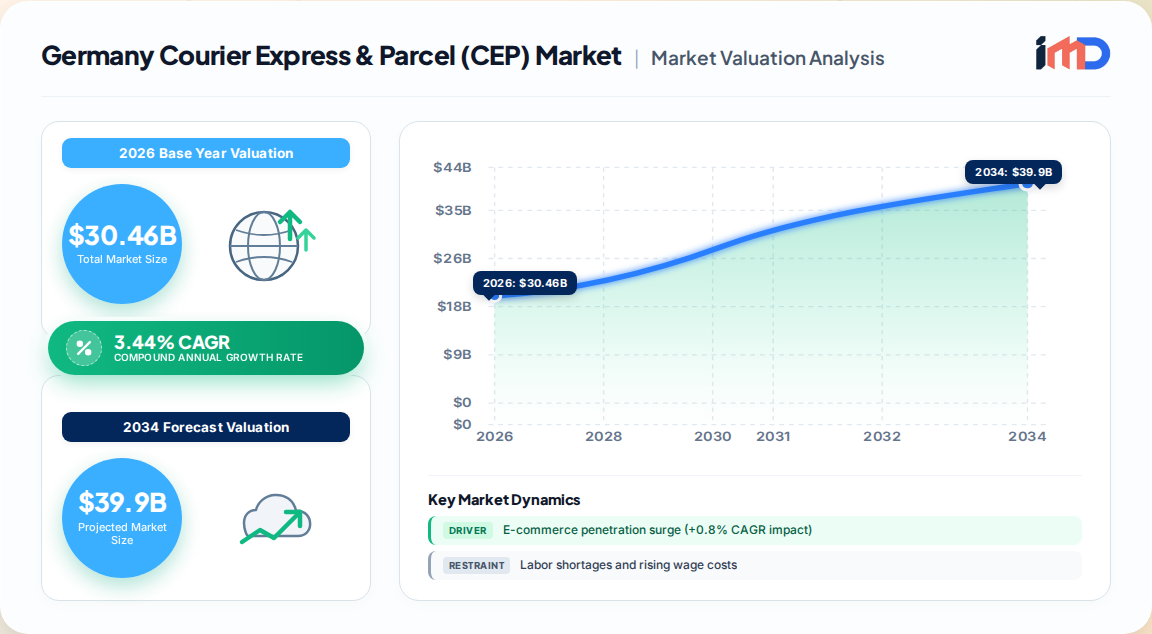
The Germany Courier, Express & Parcel (CEP) market represents one of Europe's most mature and densely contested logistics ecosystems. Our proprietary primary research estimates the market at USD 30.46 billion in 2026, expanding to USD 36.08 billion by 2031 at a 3.44% CAGR. This measured growth reflects a market transitioning from pandemic-era volume surges to a phase defined by service density, automation, and cost discipline.
Germany's position as Europe's manufacturing and export heartland, combined with its ~84 million population and high e-commerce penetration, creates a structurally resilient parcel base. Domestic shipments accounted for 66.25% of 2025 revenue, yet the fastest growth is occurring at the borders: intra-EU flows are advancing at 3.57% CAGR, with Poland emerging as a critical inbound corridor.
Key structural metrics shaping the market:
| Metric | 2025 Value / Share |
|---|---|
| Base year market size (2025) | USD 29.45 billion |
| Forecast market size (2031) | USD 36.08 billion |
| Forecast CAGR (2026–2031) | 3.44% |
| Domestic revenue share | 66.25% |
| B2C revenue share | 51.72% |
| E-commerce end-user share | 39.05% |
| Express delivery CAGR | 3.95% |
| Light-weight parcel share | 50.35% |
Growth is anchored by six quantified demand levers identified in our primary interview program. Each driver carries a distinct CAGR impact and timeline:
| Driver | CAGR Impact | Timeline | Geographic Relevance |
|---|---|---|---|
| E-commerce penetration surge | +0.8% | Medium term (2–4 yrs) | National, urban-centric |
| Same-day/next-day demand | +0.6% | Short term (≤2 yrs) | Major cities |
| Cross-border EU parcel growth | +0.4% | Long term (≥4 yrs) | Border corridors |
| Fleet electrification mandates | +0.3% | Medium term (2–4 yrs) | Emission-zone cities |
| Postal Act reform (network sharing) | +0.2% | Long term (≥4 yrs) | Nationwide |
| Micro-fulfillment expansion | +0.3% | Short term (≤2 yrs) | High-density metros |
Consumer expectations have reset. Time-definite delivery is now a baseline, not a premium. Carriers are densifying urban micro-hubs, deploying automated parcel lockers, and widening weekend operating windows to compress delivery radii.
Restraints are equally quantified and materially affect unit economics:
Our bottom-up modeling reveals a market where non-express volume dominates revenue but express commands premium growth.
By Speed of Delivery: Non-express retained 77.02% of 2025 revenue, while express services captured 3.95% CAGR — the fastest among delivery speeds. Express premiumization is driven by healthcare, automotive aftermarket, and B2B just-in-time flows.
By Business Model: B2C represented 51.72% of 2025 market size. C2C is the slowest-growing model at 2.87% CAGR, constrained by low average parcel values and high return rates.
By Shipment Weight: Light-weight parcels accounted for 50.35% of 2025 revenue; heavy parcels are forecast at 3.08% CAGR, supported by industrial and construction supply chains.
By Mode of Transport: Road held 39.25% of 2025 value; air transport is rising at 2.88% CAGR, reflecting cross-border express and high-value goods demand.
By End User: E-commerce dominated with 39.05% share in 2025; healthcare is projected at 3.55% CAGR, the fastest end-user segment, driven by temperature-controlled and time-critical medical logistics.
The German CEP market is of medium concentration, with five network operators shaping price and service benchmarks: DHL Group, Otto Group (including The Hermes Group), International Distributions Services (including GLS), UPS, and FedEx. Competitive density keeps service prices rational, but wage inflation and fleet electrification sustain operating-cost pressure.
Recent strategic developments observed in our primary research:
Network reliability remains the decisive competitive variable. German consumers place a premium on on-time performance, making route optimization and micro-hub density essential investments. Operators also leverage Germany's central European location to consolidate intra-EU traffic, converting the nation into a preferred staging ground for continental parcel flows.
Germany's CEP activity is concentrated in its industrial and population belts. North Rhine-Westphalia, Bavaria, and Baden-Württemberg collectively represent over half of national parcel volume, anchored by manufacturing clusters and dense urban centers.
Cross-border dynamics are reshaping network design. Roughly 24% of German e-shoppers bought goods from other EU states in 2024, translating into 15% of Germany's inbound cross-border parcel count. Polish merchants hold 5.5% share of Germany-bound items, anchoring a north-east corridor that benefits from daily line-haul frequency and automated sortation at consolidated gateways in Leipzig and Frankfurt.
Germany's trade infrastructure underpins this flow. As a World Bank WITS reporting economy, Germany's merchandise trade remains among the world's largest, and its central position within the EU single market makes it both an origin and destination hub for intra-EU CEP traffic.
The CEP value chain comprises four primary layers: (1) first-mile pickup and consolidation; (2) line-haul and sortation; (3) last-mile delivery; and (4) reverse logistics and returns.
First-mile: Increasingly automated via handheld scanning and dynamic route assignment. Micro-fulfillment centers in high-density metros are shortening pickup radii.
Sortation: Large-scale hubs in Leipzig and Frankfurt serve as gateway nodes for intra-EU flows. Robotic sortation and automated parcel hubs are improving throughput while reducing labor dependency.
Last-mile: The costliest segment. Electric vans, e-cargo bikes, and parcel lockers are being deployed to navigate low-emission zones and reduce stop-time per parcel.
Reverse logistics: Return labels integrated into e-commerce platforms sustain two-way traffic, but packaging waste scrutiny is pushing carriers toward reusable and recyclable solutions.
Key supply chain risks include driver scarcity, energy price volatility, and regulatory compliance costs. The sector's workforce deficit exceeded 70,000 truck drivers by late 2024, prompting aggressive hiring bonuses and tuition-paid licensing programs.
Our opportunity assessment identifies four high-conviction white spaces:
Investment activity across the CEP ecosystem remains robust. Logistics providers are expanding air cargo capacity, building large-scale fulfillment centers, and developing regional sorting hubs to accommodate rising parcel volumes. Strategic partnerships between logistics companies, e-commerce platforms, and technology providers are accelerating infrastructure modernization.
The Germany CEP market is a mature, USD 30.46 billion ecosystem in 2026, poised to reach USD 36.08 billion by 2031 at 3.44% CAGR. Growth will be neither explosive nor stagnant; it will be selective. Carriers that convert volume growth into lower cost per stop through automation, route density, and out-of-home delivery will preserve margins. Those that fail to address labor scarcity, electrification costs, and service reliability will cede share in a market where German consumers and businesses accept no compromise on on-time performance.
| Aspects | Details |
|---|---|
| Study Period | 2020-2034 |
| Base Year | 2026 |
| Estimated Year | 2026 |
| Forecast Period | 2026-2034 |
| Historical Period | 2020-2025 |
| Growth Rate | CAGR of 3.44% from 2020-2034 |
| Segmentation |
|
By Model
By Shipment Weight
By Mode of Transport
By End User Industry
| By Geography |
|
The Germany CEP market is valued at USD 30.46 billion in 2026 and is forecast to reach USD 36.08 billion by 2031, growing at a 3.44% CAGR.
Business-to-consumer (B2C) deliveries represented 51.72% of the Germany CEP market size in 2025, driven by high e-commerce penetration and omnichannel retail.
DHL Group, Otto Group (including The Hermes Group), International Distributions Services (including GLS), UPS, and FedEx are the major companies operating in the Germany CEP market.
Express services are growing at 3.95% CAGR (2026–2031), the fastest among delivery speeds, while healthcare is the fastest-growing end-user segment at 3.55% CAGR.
Domestic shipments held 66.25% of the Germany CEP market share in 2025, while intra-EU international flows are advancing at 3.57% CAGR between 2026 and 2031.
Our rigorous research methodology combines multi-layered approaches with comprehensive quality assurance, ensuring precision, accuracy, and reliability in every market analysis.
| Stakeholder Role | Interview Share (%) |
|---|---|
| Chief Operating Officer | 30% |
| Head of Last-Mile Operations | 25% |
| Procurement Director | 25% |
| Regulatory Affairs Manager | 20% |
| Company Type | Representation (%) |
|---|---|
| CEP Network Operators | 35% |
| Last-Mile Delivery Fleet Owners | 25% |
| E-commerce Fulfillment Platforms | 20% |
| Parcel Locker & Automation Providers | 12% |
| Freight Forwarders & Customs Brokers | 8% |
 Related Reports
