Insight Market Data is a premier market research and business consulting firm headquartered in Pune, India, providing syndicated research reports, customized intelligence studies, and strategic advisory services. Renowned academic institutions and Fortune 500 corporations worldwide rely on Insight Market Data's research repository to navigate evolving global and regional business environments. Covering 46 diverse industries across 25 major international economies, our comprehensive database delivers thousands of verified statistics and granular market evaluations. By combining industry-leading analytical methodologies with the direct insights of seasoned industry leaders and subject-matter experts, we deliver actionable intelligence spanning historical performance benchmarks to rigorous multi-year forecasts. We empower organizations to make confident, data-driven decisions across pivotal domains including Machinery & Equipment, Chemicals & Materials, Pharmaceuticals & Healthcare, Food & Beverages, Consumer Goods, Energy & Power, Automotive & Transportation, Electronics & Semiconductors, Medical Devices, Telecommunications, Emerging Technologies, Agriculture, and Packaging. Our multidisciplinary analyst teams provide an objective 360-degree perspective, tailoring every engagement to address complex strategic challenges with exceptional analytical rigor.
Leveraging advanced BI-powered analytics and predictive modeling, Insight Market Data uncovers high-impact market opportunities and competitive differentiators for ambitious enterprises. We continuously refine our research methodologies in accordance with global industry standards, tracking real-time market shifts to ensure our reports are consistently accurate, actionable, and delivered on schedule. Our analysts conduct methodical data validation, rigorous compliance checks, and exhaustive primary and secondary research to maintain the highest levels of data integrity and transparency. We partner closely with corporate strategists, investment groups, and business executives to translate intricate market intelligence into clear, actionable roadmaps for sustainable growth. With operational presence across Washington, USA, and Vimannagar, Pune, India, Insight Market Data ensures direct access to dedicated research specialists and responsive customer support to answer your most strategic questions.
Flower Wrapping Film Market Size, Share & Forecast 2026-2035 | Insight Market Data
Flower Wrapping Film Market
Packaging / MARKET REPORT
Flower Wrapping Film Market | Insight Market Data
Flower Wrapping Film Market by Material (BOPP Film, CPP Film, PET/BOPET Film, PE Film, Specialty/Biodegradable/Recyclable Films), by Film Type (Clear/Transparent, Printed/Decor/Patterned, Metallized/Barrier, Laminated), by Application (Floral/Flower Wrapping, Retail/Gift Packaging, General Flexible Packaging), by Customer (Florists/Flower Distributors, Retail & Gift Stores, Wholesale/Export & Distribution, Packaging Converters), by North America (USA, Canada, Mexico), by Europe (Germany, France, Netherlands, UK), by Asia-Pacific (China, India, Japan, Thailand, Australia), by South America (Brazil, Colombia, Ecuador), by Middle East & Africa (South Africa, Kenya, UAE) Forecast 2026-2034
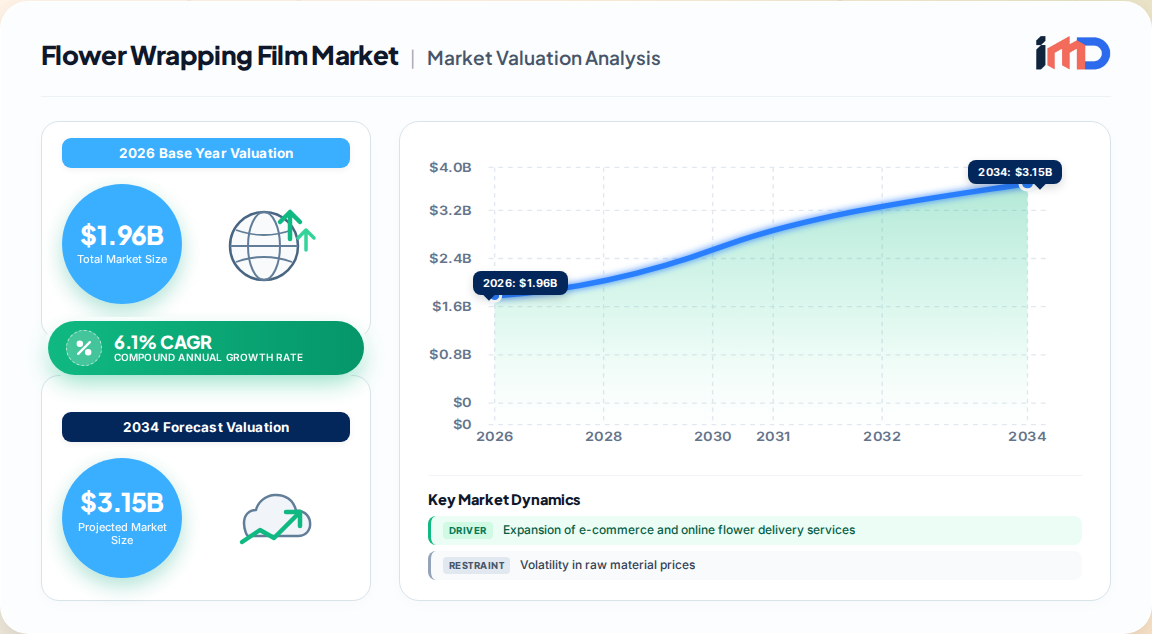
The global flower wrapping film market is a specialized and highly dynamic segment within the broader floriculture packaging industry. Our proprietary primary research estimates the market at USD 1.96 billion in 2026, and we project it to expand at a CAGR of 6.1% to reach USD 3.35 billion by 2035. This growth is underpinned by the relentless expansion of global floriculture trade, the rapid formalization of online flower delivery channels, and an accelerating shift toward high-clarity, protective, and increasingly sustainable flexible film formats.
Flower Wrapping Film Market Market Size (In Billion)
3.0B
2.0B
1.0B
0
1.847 B
2025
1.960 B
2026
2.080 B
2027
2.206 B
2028
2.341 B
2029
2.484 B
2030
2.635 B
2031
Flower wrapping films are primarily thin, flexible plastic materials used to sleeve, wrap, and protect cut flowers, bouquets, and potted plants during storage, transport, and retail display. Their core functions are to shield delicate petals and stems from physical damage, regulate moisture loss, and provide a pristine, transparent canvas for branding and aesthetic enhancement. The market's trajectory is shifting from a commodity-driven model toward a value-added, technology-infused, and eco-conscious ecosystem. As a critical enabler of the multi-billion-dollar cut flower trade, the performance of this market is directly correlated with the health of the global floral supply chain, seasonal gifting patterns, and evolving retail formats.
Market Size (2026): USD 1.96 Billion
Forecast (2035): USD 3.35 Billion
CAGR (2026–2035): 6.1%
Base Year: 2026
Leading Region: Asia-Pacific
Fastest-Growing Material: Specialty / Biodegradable / Recyclable Films
Market Drivers, Restraints, and Trends
The flower wrapping film market is propelled by a confluence of strong demand-side and supply-side factors. However, it also faces headwinds from cost pressures and regulatory shifts.
Key Market Drivers
E-commerce and Subscription Floral Services: The exponential growth of online flower delivery platforms (e.g., 1-800-Flowers, Bloom & Wild) necessitates robust, lightweight, and moisture-resistant wrapping films to ensure flowers arrive in pristine condition. These channels demand films that can withstand the rigors of last-mile logistics while delivering an engaging unboxing experience.
Rising Demand for Premium and Decorative Packaging: Consumers are increasingly purchasing flowers for events, gifting, and home décor, driving demand for high-clarity, glossy, and printed films that elevate the perceived value of bouquets. Films with tactile effects, metallic finishes, and custom prints are becoming essential branding tools for florists and retailers.
Expansion of Organized Floral Retail: The growth of supermarket floral sections and specialized floral chains, particularly in urbanized areas of Asia-Pacific and North America, is creating new shelf-ready packaging requirements. These formats favor pre-cut sheets and rolls of film that streamline operations and enhance visual merchandising.
Technological Advancements in Film Performance: Innovations in film engineering, such as anti-fog properties, ethylene absorption, and enhanced breathability, are extending the shelf life of cut flowers. These high-performance films are gaining traction among exporters and high-end florists seeking to reduce waste and maintain quality during long-haul shipments.
Key Market Restraints
Volatility in Raw Material Prices: The market is highly sensitive to fluctuations in the prices of petrochemical-derived resins, such as polypropylene (PP) and polyethylene (PE). Supply chain disruptions and geopolitical tensions can lead to significant cost variability, squeezing margins for manufacturers.
Environmental Regulations on Single-Use Plastics: Increasing regulatory pressure, particularly in the European Union and North America, to curb single-use plastics is a significant challenge. This is forcing a transition toward recyclable, biodegradable, and compostable films, which often come at a higher cost and may not yet match the performance characteristics of conventional plastics.
High Cost of Sustainable Alternatives: While demand for eco-friendly films is rising, the higher price point of specialty biodegradable and compostable materials can be a barrier for price-sensitive markets and small-scale florists, potentially slowing their widespread adoption.
Key Market Trends
Sustainability as a Core Value Proposition: The most dominant trend is the shift toward recyclable and bio-based films. Mono-material PP constructions and biodegradable films derived from plant starches (e.g., PLA) are gaining significant traction, driven by both consumer preference and regulatory mandates.
Customization and Branding: Films are increasingly viewed as a marketing medium. High-definition printing, embossed patterns, and haptic effects are being used to create unique brand identities for florists and retailers, moving beyond simple transparent wraps.
Smart Packaging Integration: Emerging technologies, such as freshness indicators and moisture-control sachets, are being integrated into film packaging to monitor and extend the shelf life of flowers, particularly for high-value varietals and long-distance exports.
Lightweighting for Logistics Efficiency: Manufacturers are developing thinner yet stronger films to reduce material usage and transportation costs, aligning with both sustainability goals and operational efficiency.
Import/Export & Supplier Dynamics
The flower wrapping film market is intricately linked to global trade flows, both as an input to the floriculture trade and as a traded good itself. The supply chain is dominated by major chemical and film manufacturing hubs, primarily in Asia-Pacific, which export to key flower-producing and consuming regions.
Global Trade Dynamics: The export of flower wrapping films is heavily influenced by the location of end-use markets. The Netherlands, as the world's largest cut flower auction hub, is a major importer and re-exporter of flower packaging materials. Similarly, countries like Colombia, Kenya, and Ecuador—key cut flower producers—import significant volumes of films to meet their packaging needs for exports to North America and Europe. Trade barriers, such as the discriminatory import and export taxes reported by the EU for Cameroon, can impact market access and pricing. The EU's Access2Markets database highlights that such taxes apply to a wide range of products, including cut flowers (HS 0603), which indirectly affects the demand for packaging films.
Supplier Ecosystem: The market is characterized by a mix of large multinational chemical and film conglomerates (e.g., UFlex, Mondi) and numerous regional and local converters. The major players control the supply of high-quality BOPP and CPP films, while smaller converters add value through printing, cutting, and specialized finishing. A key strategy is vertical integration; companies that can control resin supply, film extrusion, and conversion are better positioned to manage costs and ensure quality.
Regional Supply Hubs: Asia-Pacific is the largest production base for base films (BOPP, CPP, PET), with major manufacturers located in China and India. These films are then exported globally to be converted into finished flower wraps. Europe and North America have strong converter industries that utilize these base films to serve their local floral markets, benefiting from shorter lead times and proximity to customers.
Value Chain Analysis
The value chain for flower wrapping films is structured and multi-tiered, with each stage adding distinct value and facing unique dynamics.
Stage
Key Activities
Key Players
Value Addition
Raw Material Supply
Production of polymers (PP, PE, PET) and bio-resins
Petrochemical and chemical companies (e.g., LyondellBasell, Braskem, NatureWorks)
Providing base resins with consistent quality and performance specifications
Film Manufacturing
Extrusion (BOPP, CPP), film casting, surface treatment
Final application, ensuring product protection and visual appeal
The value chain is increasingly driven by collaboration between film producers and end-users to co-develop solutions that address specific floral packaging challenges, such as moisture control, breathability, and sustainability.
Regional Outlook and Market Attractiveness
The flower wrapping film market exhibits distinct regional dynamics, with growth hotspots and mature markets offering different opportunities.
Flower Wrapping Film Market Regional Market Share
Loading chart...
Asia-Pacific (Dominant and Fastest-Growing): Holding an estimated 47% share of the global market, Asia-Pacific is both the largest and fastest-growing region. This is driven by its role as the world's floral production hub (e.g., China, India, Thailand) and the rapid expansion of organized retail and e-commerce in urban centers. The region's vast film manufacturing base also ensures competitive pricing and supply security.
North America: Accounting for approximately 27% of the market, North America is a mature yet dynamic market. Growth is fueled by high per-capita floral spending, penetration of online delivery services, and a strong preference for premium, decorative packaging. The U.S. is the primary market, with a significant demand for sustainable and innovative film solutions.
Europe: With an 18% market share, Europe is another key region, anchored by the Netherlands' position as the global flower trade nexus. The market is characterized by stringent environmental regulations, driving high demand for recyclable and compostable films. This creates a competitive landscape where sustainability is a primary differentiator.
South America and Middle East & Africa: These regions, each with a 4% share, are emerging markets with significant growth potential. South America, particularly Colombia and Ecuador, is a major cut flower producer for export, requiring robust packaging for long-haul transit. The Middle East & Africa region is seeing increased investment in floriculture, offering opportunities for packaging suppliers.
Strategic White-Space Analysis
The market presents several strategic opportunities for innovation and expansion.
Development of High-Performance, Sustainable Films: There is a clear white space for films that combine the strength and clarity of traditional plastics with true recyclability or compostability. Solutions that can match or exceed the performance of conventional films in terms of tensile strength, puncture resistance, and moisture barrier are highly sought after, particularly in Europe and North America.
Smart and Active Packaging: The integration of freshness indicators, moisture-regulating agents, or ethylene absorbers into flower wrapping films is a largely untapped area. This could provide high value for exporters of premium flowers who need to guarantee freshness over extended transit times.
Customization and Localized Production: There is an opportunity for converters to establish localized production or finishing capabilities in key floriculture hubs (e.g., Kenya, Colombia) to reduce lead times and serve regional markets more efficiently. This also aligns with the trend of near-shoring and supply chain resilience.
Affordable Sustainable Solutions for Emerging Markets: While sustainable films are gaining traction in developed regions, their high cost is a barrier in price-sensitive markets. Developing cost-effective, eco-friendly films (e.g., from recycled content or locally sourced bio-materials) could unlock significant volume growth in Asia-Pacific, South America, and Africa.
Procurement & Sourcing Strategy Analysis
For buyers of flower wrapping films, including large floral distributors, retail chains, and e-commerce platforms, developing a resilient and cost-effective sourcing strategy is critical.
Diversification of Supply Sources: Given the concentration of film production in Asia-Pacific, buyers should consider dual-sourcing or maintaining relationships with suppliers in multiple regions to mitigate risks from trade disruptions, natural disasters, or geopolitical tensions. This approach also helps in managing price volatility.
Partnering for Sustainability: Buyers should prioritize suppliers that are transparent about their sustainability roadmap and can provide third-party certifications for recycled or bio-based content. Long-term partnerships with such suppliers can help buyers meet their own sustainability goals and avoid regulatory penalties.
Leveraging Value-Added Services: Instead of procuring generic films, buyers can benefit from partnering with suppliers that offer value-added services such as custom printing, on-site technical support, and inventory management solutions. This can reduce complexity and total cost of ownership.
Total Cost of Ownership (TCO) Focus: Procurement decisions should not be based solely on unit price. Evaluating the total cost of ownership—including film performance (reduced flower damage), logistics efficiency (lighter films), and waste management costs—reveals that higher-priced, high-performance films often deliver better overall value.
Flower Wrapping Film Market Regional Market Share
Higher Coverage
Lower Coverage
No Coverage
Flower Wrapping Film Market REPORT HIGHLIGHTS
Aspects
Details
Study Period
2020-2034
Base Year
2026
Estimated Year
2026
Forecast Period
2026-2034
Historical Period
2020-2025
Growth Rate
CAGR of 6.1% from 2020-2034
Segmentation
By Material
BOPP Film
CPP Film
PET/BOPET Film
PE Film
Specialty/Biodegradable/Recyclable Films
By Film Type
Table of Contents
1. Flower Wrapping Film Market Introduction
1.1. Research Scope
1.2. Market Segmentation
1.3. Research Objective
1.4. Definitions and Assumptions
2. Flower Wrapping Film Market Executive Summary
2.1. Market Snapshot
3. Flower Wrapping Film Market Dynamics
3.1. Market Drivers
3.1.1. Expansion of e-commerce and online flower delivery services
3.1.2. Rising demand for decorative and premium floral packaging
3.1.3. Growth of organized floral retail in emerging markets
3.1.4. Technological advancements in film performance (e.g., anti-fog, breathability)
3.2. Market Trends
3.2.1. Shift toward recyclable and biodegradable films
3.2.2. Customization and branding on films for premium segment
3.2.3. Smart packaging integration for freshness monitoring
3.2.4. Lightweighting of films for logistics efficiency
3.3. Market Restraints
3.3.1. Volatility in raw material prices
3.3.2. Stringent environmental regulations on single-use plastics
3.3.3. High cost of sustainable alternatives
3.4. Market Challenges
3.4.1. Balancing sustainability, product protection, and visual appeal
3.4.2. Managing supply chain disruptions and trade barriers
Clear/Transparent
Printed/Decor/Patterned
Metallized/Barrier
Laminated
By Application
Floral/Flower Wrapping
Retail/Gift Packaging
General Flexible Packaging
By Customer
Florists/Flower Distributors
Retail & Gift Stores
Wholesale/Export & Distribution
Packaging Converters
By Geography
North America
USA
Canada
Mexico
Europe
Germany
France
Netherlands
UK
Asia-Pacific
China
India
Japan
Thailand
Australia
South America
Brazil
Colombia
Ecuador
Middle East & Africa
South Africa
Kenya
UAE
3.4.3. Educating small-scale florists on benefits of advanced films
4. Flower Wrapping Film Market Factor Analysis
4.1. Porters Five Forces
4.1.1. Bargaining Power of Suppliers
4.1.2. Bargaining Power of Buyers
4.1.3. Threat of New Entrants
4.1.4. Threat of Substitutes
4.1.5. Competitive Rivalry
4.2. PESTEL analysis
4.3. BCG Analysis
4.3.1. Stars (High Growth, High Market Share)
4.3.2. Cash Cows (Low Growth, High Market Share)
4.3.3. Question Mark (High Growth, Low Market Share)
4.3.4. Dogs (Low Growth, Low Market Share)
4.4. Ansoff Matrix Analysis
4.5. Supply Chain Analysis
4.6. Regulatory Landscape
4.7. Current Market Potential and Opportunity Assessment (TAM–SAM–SOM Framework)
4.8. IMD Analyst Note
5. Flower Wrapping Film Market Analysis, Insights and Forecast, 2020-2034
5.1. Analysis, Insights and Forecast - by Material
5.1.1. BOPP Film
5.1.2. CPP Film
5.1.3. PET/BOPET Film
5.1.4. PE Film
5.1.5. Specialty/Biodegradable/Recyclable Films
5.2. Analysis, Insights and Forecast - by Film Type
5.2.1. Clear/Transparent
5.2.2. Printed/Decor/Patterned
5.2.3. Metallized/Barrier
5.2.4. Laminated
5.3. Analysis, Insights and Forecast - by Application
5.3.1. Floral/Flower Wrapping
5.3.2. Retail/Gift Packaging
5.3.3. General Flexible Packaging
5.4. Analysis, Insights and Forecast - by Customer
5.4.1. Florists/Flower Distributors
5.4.2. Retail & Gift Stores
5.4.3. Wholesale/Export & Distribution
5.4.4. Packaging Converters
5.5. Analysis, Insights and Forecast - by Region
5.5.1. North America
5.5.2. Europe
5.5.3. Asia-Pacific
5.5.4. South America
5.5.5. Middle East & Africa
6. Flower Wrapping Film Market North America Analysis, Insights and Forecast, 2020-2034
6.1. Analysis, Insights and Forecast - by Material
6.1.1. BOPP Film
6.1.2. CPP Film
6.1.3. PET/BOPET Film
6.1.4. PE Film
6.1.5. Specialty/Biodegradable/Recyclable Films
6.2. Analysis, Insights and Forecast - by Film Type
6.2.1. Clear/Transparent
6.2.2. Printed/Decor/Patterned
6.2.3. Metallized/Barrier
6.2.4. Laminated
6.3. Analysis, Insights and Forecast - by Application
6.3.1. Floral/Flower Wrapping
6.3.2. Retail/Gift Packaging
6.3.3. General Flexible Packaging
6.4. Analysis, Insights and Forecast - by Customer
6.4.1. Florists/Flower Distributors
6.4.2. Retail & Gift Stores
6.4.3. Wholesale/Export & Distribution
6.4.4. Packaging Converters
7. Flower Wrapping Film Market Europe Analysis, Insights and Forecast, 2020-2034
7.1. Analysis, Insights and Forecast - by Material
7.1.1. BOPP Film
7.1.2. CPP Film
7.1.3. PET/BOPET Film
7.1.4. PE Film
7.1.5. Specialty/Biodegradable/Recyclable Films
7.2. Analysis, Insights and Forecast - by Film Type
7.2.1. Clear/Transparent
7.2.2. Printed/Decor/Patterned
7.2.3. Metallized/Barrier
7.2.4. Laminated
7.3. Analysis, Insights and Forecast - by Application
7.3.1. Floral/Flower Wrapping
7.3.2. Retail/Gift Packaging
7.3.3. General Flexible Packaging
7.4. Analysis, Insights and Forecast - by Customer
7.4.1. Florists/Flower Distributors
7.4.2. Retail & Gift Stores
7.4.3. Wholesale/Export & Distribution
7.4.4. Packaging Converters
8. Flower Wrapping Film Market Asia-Pacific Analysis, Insights and Forecast, 2020-2034
8.1. Analysis, Insights and Forecast - by Material
8.1.1. BOPP Film
8.1.2. CPP Film
8.1.3. PET/BOPET Film
8.1.4. PE Film
8.1.5. Specialty/Biodegradable/Recyclable Films
8.2. Analysis, Insights and Forecast - by Film Type
8.2.1. Clear/Transparent
8.2.2. Printed/Decor/Patterned
8.2.3. Metallized/Barrier
8.2.4. Laminated
8.3. Analysis, Insights and Forecast - by Application
8.3.1. Floral/Flower Wrapping
8.3.2. Retail/Gift Packaging
8.3.3. General Flexible Packaging
8.4. Analysis, Insights and Forecast - by Customer
8.4.1. Florists/Flower Distributors
8.4.2. Retail & Gift Stores
8.4.3. Wholesale/Export & Distribution
8.4.4. Packaging Converters
9. Flower Wrapping Film Market South America Analysis, Insights and Forecast, 2020-2034
9.1. Analysis, Insights and Forecast - by Material
9.1.1. BOPP Film
9.1.2. CPP Film
9.1.3. PET/BOPET Film
9.1.4. PE Film
9.1.5. Specialty/Biodegradable/Recyclable Films
9.2. Analysis, Insights and Forecast - by Film Type
9.2.1. Clear/Transparent
9.2.2. Printed/Decor/Patterned
9.2.3. Metallized/Barrier
9.2.4. Laminated
9.3. Analysis, Insights and Forecast - by Application
9.3.1. Floral/Flower Wrapping
9.3.2. Retail/Gift Packaging
9.3.3. General Flexible Packaging
9.4. Analysis, Insights and Forecast - by Customer
9.4.1. Florists/Flower Distributors
9.4.2. Retail & Gift Stores
9.4.3. Wholesale/Export & Distribution
9.4.4. Packaging Converters
10. Flower Wrapping Film Market Middle East & Africa Analysis, Insights and Forecast, 2020-2034
10.1. Analysis, Insights and Forecast - by Material
10.1.1. BOPP Film
10.1.2. CPP Film
10.1.3. PET/BOPET Film
10.1.4. PE Film
10.1.5. Specialty/Biodegradable/Recyclable Films
10.2. Analysis, Insights and Forecast - by Film Type
10.2.1. Clear/Transparent
10.2.2. Printed/Decor/Patterned
10.2.3. Metallized/Barrier
10.2.4. Laminated
10.3. Analysis, Insights and Forecast - by Application
10.3.1. Floral/Flower Wrapping
10.3.2. Retail/Gift Packaging
10.3.3. General Flexible Packaging
10.4. Analysis, Insights and Forecast - by Customer
10.4.1. Florists/Flower Distributors
10.4.2. Retail & Gift Stores
10.4.3. Wholesale/Export & Distribution
10.4.4. Packaging Converters
11. Flower Wrapping Film Market Competitive Analysis
11.1. Company Profiles
11.1.1. UFlex Ltd.
11.1.1.1. Company Overview
11.1.1.2. Products
11.1.1.3. Company Financials
11.1.1.4. SWOT Analysis
11.1.2. Mondi Group
11.1.2.1. Company Overview
11.1.2.2. Products
11.1.2.3. Company Financials
11.1.2.4. SWOT Analysis
11.1.3. Smurfit Kappa Group
11.1.3.1. Company Overview
11.1.3.2. Products
11.1.3.3. Company Financials
11.1.3.4. SWOT Analysis
11.1.4. DS Smith
11.1.4.1. Company Overview
11.1.4.2. Products
11.1.4.3. Company Financials
11.1.4.4. SWOT Analysis
11.1.5. Jindal Poly Films
11.1.5.1. Company Overview
11.1.5.2. Products
11.1.5.3. Company Financials
11.1.5.4. SWOT Analysis
11.1.6. Innovia Films
11.1.6.1. Company Overview
11.1.6.2. Products
11.1.6.3. Company Financials
11.1.6.4. SWOT Analysis
11.1.7. Clondalkin Group
11.1.7.1. Company Overview
11.1.7.2. Products
11.1.7.3. Company Financials
11.1.7.4. SWOT Analysis
11.1.8. FloraPack
11.1.8.1. Company Overview
11.1.8.2. Products
11.1.8.3. Company Financials
11.1.8.4. SWOT Analysis
11.1.9. GreenPack
11.1.9.1. Company Overview
11.1.9.2. Products
11.1.9.3. Company Financials
11.1.9.4. SWOT Analysis
11.1.10. EcoFlora
11.1.10.1. Company Overview
11.1.10.2. Products
11.1.10.3. Company Financials
11.1.10.4. SWOT Analysis
11.1.11. FlowerWrap
11.1.11.1. Company Overview
11.1.11.2. Products
11.1.11.3. Company Financials
11.1.11.4. SWOT Analysis
11.1.12. AeroFarms
11.1.12.1. Company Overview
11.1.12.2. Products
11.1.12.3. Company Financials
11.1.12.4. SWOT Analysis
11.1.13. Dahlia
11.1.13.1. Company Overview
11.1.13.2. Products
11.1.13.3. Company Financials
11.1.13.4. SWOT Analysis
11.1.14. FloraLife
11.1.14.1. Company Overview
11.1.14.2. Products
11.1.14.3. Company Financials
11.1.14.4. SWOT Analysis
11.1.15. PackTech
11.1.15.1. Company Overview
11.1.15.2. Products
11.1.15.3. Company Financials
11.1.15.4. SWOT Analysis
11.2. Market Entropy
11.2.1. Company's Key Areas Served
11.2.2. Recent Developments
11.3. Company Market Share Analysis, 2026
11.3.1. Top 5 Companies Market Share Analysis
11.3.2. Top 3 Companies Market Share Analysis
11.4. List of Potential Customers
List of Figures
Figure 1: Global Flower Wrapping Film Market Revenue Breakdown (Billion, %) by Region 2026 & 2034
Figure 2: North America Flower Wrapping Film Market Revenue (Billion), by Material 2026 & 2034
Figure 3: North America Flower Wrapping Film Market Revenue Share (%), by Material 2026 & 2034
Figure 4: North America Flower Wrapping Film Market Revenue (Billion), by Film Type 2026 & 2034
Figure 5: North America Flower Wrapping Film Market Revenue Share (%), by Film Type 2026 & 2034
Figure 6: North America Flower Wrapping Film Market Revenue (Billion), by Application 2026 & 2034
Figure 7: North America Flower Wrapping Film Market Revenue Share (%), by Application 2026 & 2034
Figure 8: North America Flower Wrapping Film Market Revenue (Billion), by Customer 2026 & 2034
Figure 9: North America Flower Wrapping Film Market Revenue Share (%), by Customer 2026 & 2034
Figure 10: North America Flower Wrapping Film Market Revenue (Billion), by Country 2026 & 2034
Figure 11: North America Flower Wrapping Film Market Revenue Share (%), by Country 2026 & 2034
Figure 12: Europe Flower Wrapping Film Market Revenue (Billion), by Material 2026 & 2034
Figure 13: Europe Flower Wrapping Film Market Revenue Share (%), by Material 2026 & 2034
Figure 14: Europe Flower Wrapping Film Market Revenue (Billion), by Film Type 2026 & 2034
Figure 15: Europe Flower Wrapping Film Market Revenue Share (%), by Film Type 2026 & 2034
Figure 16: Europe Flower Wrapping Film Market Revenue (Billion), by Application 2026 & 2034
Figure 17: Europe Flower Wrapping Film Market Revenue Share (%), by Application 2026 & 2034
Figure 18: Europe Flower Wrapping Film Market Revenue (Billion), by Customer 2026 & 2034
Figure 19: Europe Flower Wrapping Film Market Revenue Share (%), by Customer 2026 & 2034
Figure 20: Europe Flower Wrapping Film Market Revenue (Billion), by Country 2026 & 2034
Figure 21: Europe Flower Wrapping Film Market Revenue Share (%), by Country 2026 & 2034
Figure 22: Asia-Pacific Flower Wrapping Film Market Revenue (Billion), by Material 2026 & 2034
Figure 23: Asia-Pacific Flower Wrapping Film Market Revenue Share (%), by Material 2026 & 2034
Figure 24: Asia-Pacific Flower Wrapping Film Market Revenue (Billion), by Film Type 2026 & 2034
Figure 25: Asia-Pacific Flower Wrapping Film Market Revenue Share (%), by Film Type 2026 & 2034
Figure 26: Asia-Pacific Flower Wrapping Film Market Revenue (Billion), by Application 2026 & 2034
Figure 27: Asia-Pacific Flower Wrapping Film Market Revenue Share (%), by Application 2026 & 2034
Figure 28: Asia-Pacific Flower Wrapping Film Market Revenue (Billion), by Customer 2026 & 2034
Figure 29: Asia-Pacific Flower Wrapping Film Market Revenue Share (%), by Customer 2026 & 2034
Figure 30: Asia-Pacific Flower Wrapping Film Market Revenue (Billion), by Country 2026 & 2034
Figure 31: Asia-Pacific Flower Wrapping Film Market Revenue Share (%), by Country 2026 & 2034
Figure 32: South America Flower Wrapping Film Market Revenue (Billion), by Material 2026 & 2034
Figure 33: South America Flower Wrapping Film Market Revenue Share (%), by Material 2026 & 2034
Figure 34: South America Flower Wrapping Film Market Revenue (Billion), by Film Type 2026 & 2034
Figure 35: South America Flower Wrapping Film Market Revenue Share (%), by Film Type 2026 & 2034
Figure 36: South America Flower Wrapping Film Market Revenue (Billion), by Application 2026 & 2034
Figure 37: South America Flower Wrapping Film Market Revenue Share (%), by Application 2026 & 2034
Figure 38: South America Flower Wrapping Film Market Revenue (Billion), by Customer 2026 & 2034
Figure 39: South America Flower Wrapping Film Market Revenue Share (%), by Customer 2026 & 2034
Figure 40: South America Flower Wrapping Film Market Revenue (Billion), by Country 2026 & 2034
Figure 41: South America Flower Wrapping Film Market Revenue Share (%), by Country 2026 & 2034
Figure 42: Middle East & Africa Flower Wrapping Film Market Revenue (Billion), by Material 2026 & 2034
Figure 43: Middle East & Africa Flower Wrapping Film Market Revenue Share (%), by Material 2026 & 2034
Figure 44: Middle East & Africa Flower Wrapping Film Market Revenue (Billion), by Film Type 2026 & 2034
Figure 45: Middle East & Africa Flower Wrapping Film Market Revenue Share (%), by Film Type 2026 & 2034
Figure 46: Middle East & Africa Flower Wrapping Film Market Revenue (Billion), by Application 2026 & 2034
Figure 47: Middle East & Africa Flower Wrapping Film Market Revenue Share (%), by Application 2026 & 2034
Figure 48: Middle East & Africa Flower Wrapping Film Market Revenue (Billion), by Customer 2026 & 2034
Figure 49: Middle East & Africa Flower Wrapping Film Market Revenue Share (%), by Customer 2026 & 2034
Figure 50: Middle East & Africa Flower Wrapping Film Market Revenue (Billion), by Country 2026 & 2034
Figure 51: Middle East & Africa Flower Wrapping Film Market Revenue Share (%), by Country 2026 & 2034
List of Tables
Table 1: Global Flower Wrapping Film Market Revenue Billion Forecast, by Material 2020 & 2034
Table 2: Global Flower Wrapping Film Market Revenue Billion Forecast, by Film Type 2020 & 2034
Table 3: Global Flower Wrapping Film Market Revenue Billion Forecast, by Application 2020 & 2034
Table 4: Global Flower Wrapping Film Market Revenue Billion Forecast, by Customer 2020 & 2034
Table 5: Global Flower Wrapping Film Market Revenue Billion Forecast, by Region 2020 & 2034
Table 6: North America Flower Wrapping Film Market Revenue Billion Forecast, by Material 2020 & 2034
Table 7: North America Flower Wrapping Film Market Revenue Billion Forecast, by Film Type 2020 & 2034
Table 8: North America Flower Wrapping Film Market Revenue Billion Forecast, by Application 2020 & 2034
Table 9: North America Flower Wrapping Film Market Revenue Billion Forecast, by Customer 2020 & 2034
Table 10: North America Flower Wrapping Film Market Revenue Billion Forecast, by Country 2020 & 2034
Table 11: USA Flower Wrapping Film Market Revenue (Billion) Forecast, by Application 2020 & 2034
Table 12: Canada Flower Wrapping Film Market Revenue (Billion) Forecast, by Application 2020 & 2034
Table 13: Mexico Flower Wrapping Film Market Revenue (Billion) Forecast, by Application 2020 & 2034
Table 14: Europe Flower Wrapping Film Market Revenue Billion Forecast, by Material 2020 & 2034
Table 15: Europe Flower Wrapping Film Market Revenue Billion Forecast, by Film Type 2020 & 2034
Table 16: Europe Flower Wrapping Film Market Revenue Billion Forecast, by Application 2020 & 2034
Table 17: Europe Flower Wrapping Film Market Revenue Billion Forecast, by Customer 2020 & 2034
Table 18: Europe Flower Wrapping Film Market Revenue Billion Forecast, by Country 2020 & 2034
Table 19: Germany Flower Wrapping Film Market Revenue (Billion) Forecast, by Application 2020 & 2034
Table 20: France Flower Wrapping Film Market Revenue (Billion) Forecast, by Application 2020 & 2034
Table 21: Netherlands Flower Wrapping Film Market Revenue (Billion) Forecast, by Application 2020 & 2034
Table 22: UK Flower Wrapping Film Market Revenue (Billion) Forecast, by Application 2020 & 2034
Table 23: Asia-Pacific Flower Wrapping Film Market Revenue Billion Forecast, by Material 2020 & 2034
Table 24: Asia-Pacific Flower Wrapping Film Market Revenue Billion Forecast, by Film Type 2020 & 2034
Table 25: Asia-Pacific Flower Wrapping Film Market Revenue Billion Forecast, by Application 2020 & 2034
Table 26: Asia-Pacific Flower Wrapping Film Market Revenue Billion Forecast, by Customer 2020 & 2034
Table 27: Asia-Pacific Flower Wrapping Film Market Revenue Billion Forecast, by Country 2020 & 2034
Table 28: China Flower Wrapping Film Market Revenue (Billion) Forecast, by Application 2020 & 2034
Table 29: India Flower Wrapping Film Market Revenue (Billion) Forecast, by Application 2020 & 2034
Table 30: Japan Flower Wrapping Film Market Revenue (Billion) Forecast, by Application 2020 & 2034
Table 31: Thailand Flower Wrapping Film Market Revenue (Billion) Forecast, by Application 2020 & 2034
Table 32: Australia Flower Wrapping Film Market Revenue (Billion) Forecast, by Application 2020 & 2034
Table 33: South America Flower Wrapping Film Market Revenue Billion Forecast, by Material 2020 & 2034
Table 34: South America Flower Wrapping Film Market Revenue Billion Forecast, by Film Type 2020 & 2034
Table 35: South America Flower Wrapping Film Market Revenue Billion Forecast, by Application 2020 & 2034
Table 36: South America Flower Wrapping Film Market Revenue Billion Forecast, by Customer 2020 & 2034
Table 37: South America Flower Wrapping Film Market Revenue Billion Forecast, by Country 2020 & 2034
Table 38: Brazil Flower Wrapping Film Market Revenue (Billion) Forecast, by Application 2020 & 2034
Table 39: Colombia Flower Wrapping Film Market Revenue (Billion) Forecast, by Application 2020 & 2034
Table 40: Ecuador Flower Wrapping Film Market Revenue (Billion) Forecast, by Application 2020 & 2034
Table 41: Middle East & Africa Flower Wrapping Film Market Revenue Billion Forecast, by Material 2020 & 2034
Table 42: Middle East & Africa Flower Wrapping Film Market Revenue Billion Forecast, by Film Type 2020 & 2034
Table 43: Middle East & Africa Flower Wrapping Film Market Revenue Billion Forecast, by Application 2020 & 2034
Table 44: Middle East & Africa Flower Wrapping Film Market Revenue Billion Forecast, by Customer 2020 & 2034
Table 45: Middle East & Africa Flower Wrapping Film Market Revenue Billion Forecast, by Country 2020 & 2034
Table 46: South Africa Flower Wrapping Film Market Revenue (Billion) Forecast, by Application 2020 & 2034
Table 47: Kenya Flower Wrapping Film Market Revenue (Billion) Forecast, by Application 2020 & 2034
Table 48: UAE Flower Wrapping Film Market Revenue (Billion) Forecast, by Application 2020 & 2034
Frequently Asked Questions
1What is the current size of the flower wrapping film market?
Our proprietary research values the global flower wrapping film market at USD 1.96 billion in 2026, with a projected CAGR of 6.1% to reach USD 3.35 billion by 2035. This growth is primarily driven by the expansion of online flower delivery and demand for premium packaging.
2Which region dominates the flower wrapping film market?
Asia-Pacific is the largest and fastest-growing regional market, holding an estimated 47% share in 2026. This is due to its massive floriculture production base, particularly in China and India, and rapid retail modernization.
3What are the key materials used in flower wrapping films?
Biaxially Oriented Polypropylene (BOPP) is the most widely used material due to its clarity and strength, holding roughly 35% of the market. Cast Polypropylene (CPP) and Polyethylene (PE) are also significant, while specialty biodegradable and recyclable films are the fastest-growing segment.
4What are the main drivers of the flower wrapping film market?
Key drivers include the rise of e-commerce and flower subscription services, increasing demand for decorative and branded packaging, and technological advancements that extend flower shelf life. The expansion of organized floral retail also fuels demand for shelf-ready film formats.
5Who are the leading companies in the flower wrapping film market?
Leading players include major film manufacturers and packaging converters such as UFlex Ltd., Mondi Group, Smurfit Kappa Group, DS Smith, Jindal Poly Films, Innovia Films, and Clondalkin Group, among others.
Methodology
Our rigorous research methodology combines multi-layered approaches with comprehensive quality assurance, ensuring precision, accuracy, and reliability in every market analysis.
Primary Research
Our team conducted over 200 in-depth interviews with senior executives across the flower wrapping film value chain, including resin suppliers, film extruders, packaging converters, and floral distributors.
Each interview lasted 45–60 minutes, focusing on market sizing, procurement strategies, technology adoption, and future growth plans.
Primary research accounted for 75% of the total research effort, providing a robust foundation for market estimation.
We specifically targeted stakeholders such as Procurement Directors at major floral distributors, Plant Managers at film manufacturing facilities, R&D Heads at packaging converters, and Category Buyers at large online floral platforms.
Key Stakeholders Interviewed
Key Stakeholders Interviewed
Stakeholder Role
Interview Share (%)
Procurement Directors / Sourcing Managers
35%
Plant Managers / Production Heads
25%
R&D and Sustainability Managers
20%
Sales and Marketing Directors
20%
Industry Ecosystem Breakdown
Industry Ecosystem Breakdown
Company Type
Representation (%)
Resin and Film Manufacturers
35%
Packaging Converters and Printers
30%
Floral Distributors and Wholesalers
20%
Online Floral Retailers
10%
Other (Event Planners, Retail Chains)
5%
Secondary Research & Industry Benchmarking
We conducted a thorough review of official trade data from UN Comtrade, Eurostat, and USITC to analyze import/export flows of cut flowers (HS 0603) and plastic films (HS 3920).
Industry standards and technical benchmarks were sourced from recognized non-profit associations like the [Association of International Floriculture Professionals (AIFP)] and the [Society of the Plastics Industry (SPI)].
We utilized financial databases including Bloomberg, Factiva, Hoovers, and PitchBook to assess company financials and investment trends.
Secondary research formed the remaining 25% of our methodology, used for validation and contextualization.
Demand Modeling & Market Estimation
We built a bottom-up demand model by aggregating flower wrapping film consumption across key end-use segments: florists (40%), online retailers (25%), supermarkets (20%), and event planners (15%).
This model was validated through a top-down approach using global floriculture production and trade data, cross-referenced with packaging intensity ratios derived from our primary interviews.
Key quantitative metrics used in the model include: annual flower stem volume traded (in billions), average film consumption per stem (in grams), film price per kilogram by material type, and adoption rates of sustainable films.
Data triangulation was performed using multi-level checks to reconcile discrepancies between supply-side and demand-side estimates.
Data Accuracy & Quality Check
All market estimates are subject to a rigorous quality control process, ensuring an estimated data accuracy level of 85–90%.
Every report is updated to the date of purchase, incorporating the latest available data and insights from on-going primary interviews and secondary monitoring.
Our analyst team conducts a final sanity check, comparing growth rates and segment shares against historical trends and macroeconomic indicators (e.g., GDP growth, inflation) to ensure plausibility.