1What is the size of the Europe online grocery delivery market?
The Europe online grocery delivery market was valued at USD 118.6 Billion in 2025 and is projected to reach USD 496.8 Billion by 2034, growing at a CAGR of 17.4%.
Insight Market Data is a premier market research and business consulting firm headquartered in Pune, India, providing syndicated research reports, customized intelligence studies, and strategic advisory services. Renowned academic institutions and Fortune 500 corporations worldwide rely on Insight Market Data's research repository to navigate evolving global and regional business environments. Covering 46 diverse industries across 25 major international economies, our comprehensive database delivers thousands of verified statistics and granular market evaluations. By combining industry-leading analytical methodologies with the direct insights of seasoned industry leaders and subject-matter experts, we deliver actionable intelligence spanning historical performance benchmarks to rigorous multi-year forecasts. We empower organizations to make confident, data-driven decisions across pivotal domains including Machinery & Equipment, Chemicals & Materials, Pharmaceuticals & Healthcare, Food & Beverages, Consumer Goods, Energy & Power, Automotive & Transportation, Electronics & Semiconductors, Medical Devices, Telecommunications, Emerging Technologies, Agriculture, and Packaging. Our multidisciplinary analyst teams provide an objective 360-degree perspective, tailoring every engagement to address complex strategic challenges with exceptional analytical rigor.
Leveraging advanced BI-powered analytics and predictive modeling, Insight Market Data uncovers high-impact market opportunities and competitive differentiators for ambitious enterprises. We continuously refine our research methodologies in accordance with global industry standards, tracking real-time market shifts to ensure our reports are consistently accurate, actionable, and delivered on schedule. Our analysts conduct methodical data validation, rigorous compliance checks, and exhaustive primary and secondary research to maintain the highest levels of data integrity and transparency. We partner closely with corporate strategists, investment groups, and business executives to translate intricate market intelligence into clear, actionable roadmaps for sustainable growth. With operational presence across Washington, USA, and Vimannagar, Pune, India, Insight Market Data ensures direct access to dedicated research specialists and responsive customer support to answer your most strategic questions.
 Europe Online Grocery Delivery Market
 by Platform (App-Based, Web-Based), by Product Type (Staples & Cooking Essentials, Vegetables & Fruits, Dairy Products, Snacks, Meat & Seafood, Others), by Delivery Type (Scheduled Delivery, Instant/Quick Delivery), by Business Model (Pure Marketplace, Hybrid Marketplace, Others), by Western Europe (UK, France, Germany, Netherlands, Belgium), by Northern Europe (Sweden, Denmark, Norway, Finland), by Southern Europe (Spain, Italy, Portugal, Greece), by Central & Eastern Europe (Poland, Czech Republic, Romania, Hungary), by Rest of Europe Forecast 2026-2034

Research Associate


 Related Reports

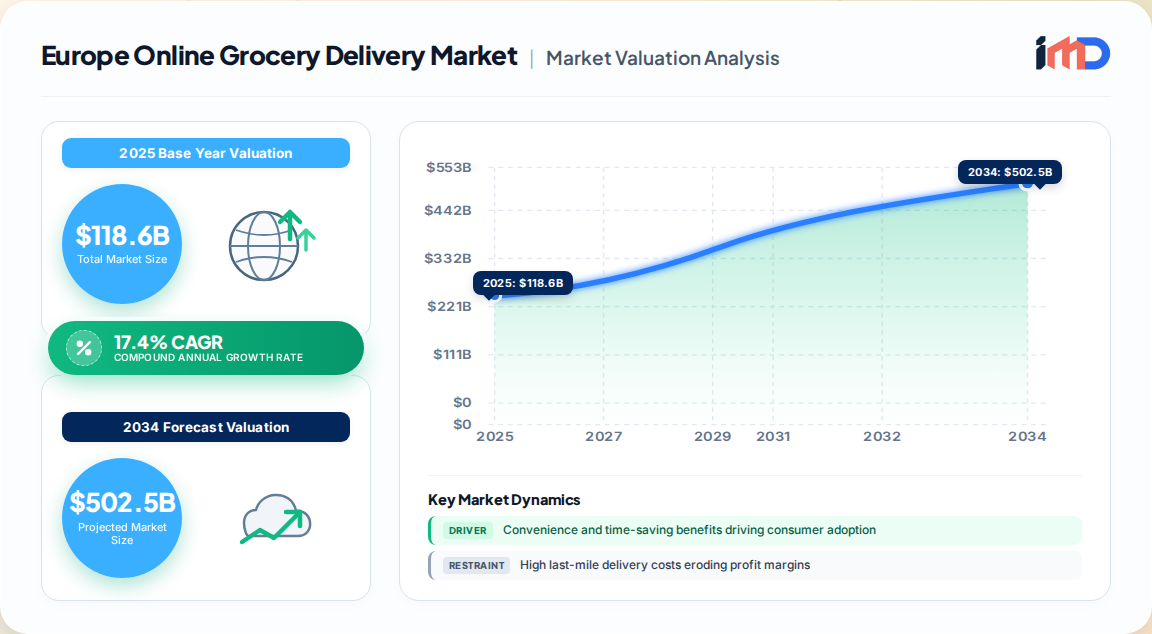
The Europe Online Grocery Delivery Market is undergoing a structural transformation, evolving from a pandemic-era convenience channel into a mature, digitally integrated retail ecosystem. Our proprietary primary research estimates the market at USD 118.6 Billion in 2025, having expanded at a robust 19.2% CAGR over the 2019-2024 period. Looking forward, we project the market to reach USD 496.8 Billion by 2034, registering a 17.4% CAGR (2026-2034).
This growth is not merely a continuation of the 2020-2021 surge; it reflects a fundamental shift in grocery procurement behavior across the continent. While the initial spike was driven by necessity during lockdowns, current expansion is anchored in sustained consumer adoption among younger demographics, aggressive omnichannel investment by incumbent brick-and-mortar retailers, and the maturation of last-mile logistics infrastructure.
Europe remains the world's second-largest regional market for online grocery delivery, behind Asia-Pacific, accounting for approximately 24% of global GMV. However, its per-capita online grocery spend is the highest globally, at an estimated USD 142 per annum, versus USD 86 in North America. This premium is driven by dense urban populations, high digital literacy, and a strong regulatory push toward sustainable, consolidated delivery models.
The European online grocery delivery market is shaped by a distinct set of demand-side and supply-side forces that differ markedly from other global regions.
Market Drivers:
Market Restraints:
The European market exhibits distinct segmentation patterns that inform strategic prioritization for operators.
| Segment | Sub-Segment | 2025 Share (%) | Projected CAGR (2026-2034) |
|---|---|---|---|
| By Platform | App-Based | 67.4% | 18.8% |
| Web-Based | 32.6% | 14.2% | |
| By Product Type | Staples & Cooking Essentials | 31.2% | 15.1% |
| Vegetables & Fruits | 26.5% | 17.9% | |
| Dairy Products | 14.8% | 16.3% | |
| Snacks | 12.1% | 19.4% | |
| Meat & Seafood | 10.4% | 18.2% | |
| Others | 5.0% | 13.6% | |
| By Delivery Type | Scheduled Delivery | 68.3% | 14.9% |
| Instant/Quick Delivery | 31.7% | 24.5% | |
| By Business Model | Pure Marketplace | 48.2% | 16.1% |
| Hybrid Marketplace | 41.5% | 19.7% | |
| Others (Direct-to-Consumer) | 10.3% | 12.4% |
Platform Insights: App-based ordering dominates, accounting for roughly two-thirds of transactions, driven by push notification engagement and loyalty program integration. However, web-based ordering remains resilient among older demographics (55+) and for planned weekly shops.
Delivery Type Insights: Scheduled delivery retains the majority share, favored for large weekly baskets. However, instant delivery (under 3 hours) is the fastest-growing segment, propelled by younger urban consumers and the expansion of dark store networks in major metropolitan areas.
Business Model Insights: Pure marketplaces (platforms aggregating third-party sellers) hold the largest share, but hybrid marketplaces (where the platform controls inventory and fulfillment) are gaining ground due to better quality control and higher margins.
The European online grocery delivery market is characterized by significant heterogeneity across sub-regions.
Western Europe (38% share, 2025): The most mature market, led by the UK, France, and Germany. The UK is the continent's largest single market, with online grocery penetration exceeding 16% of total grocery sales. France and Germany follow, though with lower penetration rates (approximately 9% and 7%, respectively), indicating substantial untapped potential.
Northern Europe (24% share): High digital adoption and strong consumer trust in online retail make the Nordics a highly developed market. Sweden and the Netherlands are notable for high e-grocery penetration and a strong presence of hybrid marketplace models.
Southern Europe (18% share): Spain and Italy are key growth engines. In Spain, the market is projected to grow at a 20.1% CAGR (2026-2034), driven by urbanization and the expansion of quick commerce in Barcelona and Madrid.
Central & Eastern Europe (14% share): The fastest-growing sub-region, albeit from a smaller base. Poland, the Czech Republic, and Romania are witnessing rapid digitization and the expansion of online marketplaces, supported by EU digital infrastructure funding.
Rest of Europe (6% share): Includes smaller markets such as Greece, Portugal, and the Baltic states, where e-grocery adoption is growing steadily but remains constrained by logistics infrastructure.
The European online grocery delivery market is moderately consolidated, with distinct competitive tiers.
Tier 1: Incumbent Omnichannel Retailers
Tier 2: Pure-Play and Quick Commerce Platforms
Tier 3: Marketplaces and Technology Enablers
Strategic Developments (2023-2025):
The online grocery delivery value chain in Europe is complex, involving multiple actors from farm to doorstep.
| Value Chain Stage | Key Activities | Major Players (Examples) |
|---|---|---|
| Sourcing & Procurement | Direct sourcing from farms, cooperatives, and food manufacturers; private-label development | Edeka, Carrefour, Tesco |
| Fulfillment & Warehousing | Operation of dark stores, micro-fulfillment centers, and store-based picking | Ahold Delhaize, Getir, Gorillas |
| Last-Mile Delivery | Route optimization, fleet management (electric vehicles, cargo bikes), courier management | Glovo, Deliveroo, Tesco |
| Technology & Platform | E-commerce platform development, app-based ordering, payment gateways, AI-driven personalization | Amazon, Ocado Technology, platform providers |
| Customer Interface | App/web storefront, customer service, loyalty programs | All major retailers and platforms |
Supply Chain Risk Assessment:
The European online grocery delivery market is exposed to several supply chain risks:
Given the intra-European nature of the grocery supply chain, formal import/export data specific to online grocery delivery is not directly applicable. However, the supplier dynamics are critical to understanding market operations.
Our analysis identifies several high-potential strategic opportunities in the European online grocery delivery market:
The Ansoff Matrix provides a strategic framework for growth opportunities in the European online grocery delivery market.
| Existing Markets | New Markets | |
|---|---|---|
| Existing Products | Market Penetration: Increase order frequency and basket size through loyalty programs, targeted promotions, and improved app experience. | Market Development: Expand into underpenetrated geographies (Germany, Italy) and customer segments (seniors, rural consumers). |
| New Products | Product Development: Introduce new product categories (e.g., meal kits, ready-to-eat meals, pet care) and value-added services (e.g., recipe-based shopping). | Diversification: Enter adjacent markets such as B2B grocery delivery, food service, and health and wellness products. |
The Europe online grocery delivery market is poised for sustained, profitable growth, albeit at a more moderate pace than the pandemic years. The market is shifting from a growth-at-all-costs mentality to a focus on unit economics and customer lifetime value.
Key Recommendations for Stakeholders:
| Aspects | Details |
|---|---|
| Study Period | 2020-2034 |
| Base Year | 2025 |
| Estimated Year | 2026 |
| Forecast Period | 2026-2034 |
| Historical Period | 2020-2025 |
| Growth Rate | CAGR of 17.4% from 2020-2034 |
| Segmentation |
|
By Delivery Type
By Business Model
| By Geography |
|
The Europe online grocery delivery market was valued at USD 118.6 Billion in 2025 and is projected to reach USD 496.8 Billion by 2034, growing at a CAGR of 17.4%.
The United Kingdom is the largest single market, with online grocery penetration exceeding 16% of total grocery sales, followed by France and Germany.
Key drivers include the expansion of omnichannel retail models by incumbents, the rapid growth of quick commerce in urban areas, high smartphone penetration, and the increasing popularity of subscription-based delivery services.
Challenges include high last-mile delivery costs, regulatory constraints on urban logistics, labor shortages, and consumer reluctance to purchase fresh produce online.
The instant/quick delivery segment is the fastest-growing, projected to expand at a CAGR of 24.5% from 2026 to 2034, driven by young urban consumers and dark store expansion.
Key players include Tesco, Carrefour, Ahold Delhaize, Edeka, Getir, Gorillas, Glovo, Amazon Fresh, and Deliveroo, among others.
Our rigorous research methodology combines multi-layered approaches with comprehensive quality assurance, ensuring precision, accuracy, and reliability in every market analysis.
| Stakeholder Role | Interview Share (%) |
|---|---|
| Chief Digital Officer / E-commerce Director | 35% |
| Supply Chain & Logistics Manager | 30% |
| Head of Category Management | 20% |
| Marketing & Customer Insights Manager | 15% |
| Company Type | Representation (%) |
|---|---|
| Online Grocery Retailers (Incumbents & Pure-Plays) | 40% |
| Quick Commerce Platforms | 25% |
| Logistics & Delivery Service Providers | 20% |
| Technology & Platform Enablers | 10% |
| Suppliers & Food Producers | 5% |