1What is the size of the Europe DIY Home Improvement Market?
The market was valued at USD 116.70 billion in 2025 and is projected to reach USD 171.34 billion by 2034, growing at a CAGR of 4.36% from 2026 to 2034.
Insight Market Data is a premier market research and business consulting firm headquartered in Pune, India, providing syndicated research reports, customized intelligence studies, and strategic advisory services. Renowned academic institutions and Fortune 500 corporations worldwide rely on Insight Market Data's research repository to navigate evolving global and regional business environments. Covering 46 diverse industries across 25 major international economies, our comprehensive database delivers thousands of verified statistics and granular market evaluations. By combining industry-leading analytical methodologies with the direct insights of seasoned industry leaders and subject-matter experts, we deliver actionable intelligence spanning historical performance benchmarks to rigorous multi-year forecasts. We empower organizations to make confident, data-driven decisions across pivotal domains including Machinery & Equipment, Chemicals & Materials, Pharmaceuticals & Healthcare, Food & Beverages, Consumer Goods, Energy & Power, Automotive & Transportation, Electronics & Semiconductors, Medical Devices, Telecommunications, Emerging Technologies, Agriculture, and Packaging. Our multidisciplinary analyst teams provide an objective 360-degree perspective, tailoring every engagement to address complex strategic challenges with exceptional analytical rigor.
Leveraging advanced BI-powered analytics and predictive modeling, Insight Market Data uncovers high-impact market opportunities and competitive differentiators for ambitious enterprises. We continuously refine our research methodologies in accordance with global industry standards, tracking real-time market shifts to ensure our reports are consistently accurate, actionable, and delivered on schedule. Our analysts conduct methodical data validation, rigorous compliance checks, and exhaustive primary and secondary research to maintain the highest levels of data integrity and transparency. We partner closely with corporate strategists, investment groups, and business executives to translate intricate market intelligence into clear, actionable roadmaps for sustainable growth. With operational presence across Washington, USA, and Vimannagar, Pune, India, Insight Market Data ensures direct access to dedicated research specialists and responsive customer support to answer your most strategic questions.
 Europe DIY Home Improvement Market
 by Home Section (Kitchen Improvement & Additions, System Upgrades, Bathroom & Plumbing, Outdoor & Garden), by Project Type (Do It For Me (DIFM), Do It Yourself (DIY)), by Distribution Channel (Offline, Online), by Product (Lumber and Landscape Management, Decor and Indoor Garden, Kitchen, Painting and Wallpaper, Others), by Germany, by France, by UK, by Italy, by Spain, by Netherlands, by Sweden, by Denmark, by Switzerland, by Rest of Europe Forecast 2026-2034

Research Associate


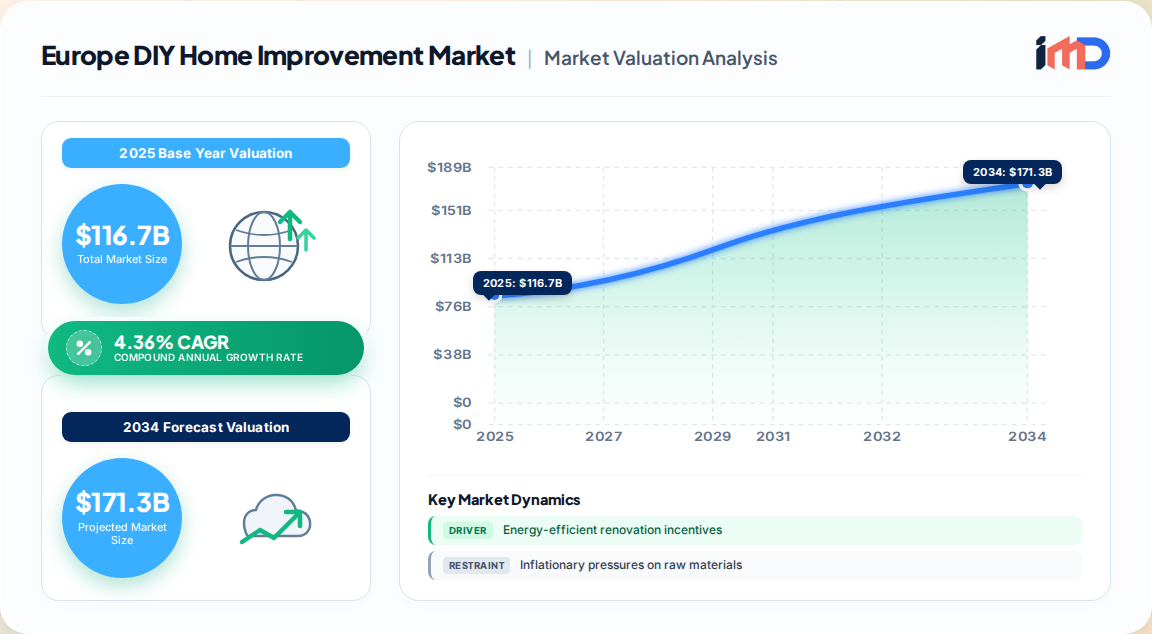
The Europe DIY Home Improvement Market represents a resilient and evolving pillar of the region's residential construction and retail landscape. Our proprietary first-party research estimates the market at USD 116.70 billion in 2025, with a projected expansion to USD 171.34 billion by 2034, registering a steady CAGR of 4.36% over the forecast period (2026–2034). This growth is underpinned by a structural shift in homeowner behavior, where self-directed renovation is increasingly viewed as both a value-accretive asset strategy and a lifestyle expression.
Eurostat data indicates that over 70% of EU households own their homes, creating a fertile base for improvement activity. Urbanization rates exceeding 75% in Germany and France further concentrate demand for space-maximizing, efficiency-driven upgrades. The market is transitioning from a purely transactional retail model to an integrated ecosystem of digital planning tools, sustainable materials, and professional-grade DIY solutions.
The Europe DIY Home Improvement Market is segmented by home section, project type, distribution channel, and country. Our analysis reveals distinct growth patterns across these categories.
| Segment | Base Year Share (2025) | Growth Outlook (CAGR 2026–2034) | Key Insights |
|---|---|---|---|
| By Home Section | |||
| Kitchen Improvement & Additions | 28.4% | Moderate | Central living space modernizations and smart appliance integration drive demand. |
| System Upgrades | — | 14.4% | Fastest-growing, propelled by renewable energy integrations (solar, heat pumps). |
| Bathroom & Plumbing | — | Steady | Aging infrastructure and water-efficiency retrofits sustain replacement cycles. |
| By Project Type | |||
| Do It For Me (DIFM) | Leading share | Stable | Anchored by project complexity, professional expertise, and subsidy access. |
| Do It Yourself (DIY) | — | 12.4% | Driven by online tutorials, remote work shifts, and cost-conscious millennials. |
| By Distribution Channel | |||
| Offline (Retail Stores) | Dominant | Moderate | DIY stores and specialty retailers remain the primary purchase channel. |
| Online | — | 7.9% (global benchmark) | Fastest-growing channel; click-and-collect and AR visualization enhance conversion. |
Germany leads the European market with a 22.4% share, supported by a robust economy, high homeownership, and generous energy retrofit subsidies. France and the UK follow, with urbanization and compact living solutions driving demand for space-saving DIY projects. Southern Europe (Italy, Spain) presents significant renovation opportunities due to aging housing stock, while Nordic countries (Sweden, Denmark) exhibit high adoption of smart home technologies.
The market is highly competitive, featuring multinational retailers and cooperative groups leveraging digital transformation, sustainability initiatives, and omnichannel strategies.
Key strategic imperatives include predictive analytics for inventory management, AR-enabled project planning, and partnerships with smart-home technology providers.
The European DIY home improvement value chain spans raw material suppliers, manufacturers, distributors, and retailers. Digitalization is reshaping each stage:
The integration of augmented reality (AR) in project planning is lowering entry barriers for DIYers, while digital content creators (e.g., influencer tutorials) drive demand for specific product bundles.
Europe remains a net importer of certain DIY products, particularly power tools and specialty hardware from Asia-Pacific. However, intra-European trade dominates for lumber, paints, and building materials. Key supply chain risks include commodity price volatility and logistics disruptions. Retailers are increasingly nearshoring production of modular kitchen components to Eastern Europe to reduce lead times and carbon footprints.
| Aspects | Details |
|---|---|
| Study Period | 2020-2034 |
| Base Year | 2025 |
| Estimated Year | 2026 |
| Forecast Period | 2026-2034 |
| Historical Period | 2020-2025 |
| Growth Rate | CAGR of 4.36% from 2020-2034 |
| Segmentation |
|

Analyst at Providence Strategic Partners at Petaling Jaya
I have received the report already. Thanks you for your help.it has been a pleasure working with you. Thank you again for a good quality report

Internationalization Director
Yes, as a matter of fact we are totally satisfied with both reports that we have purchased and will continue to do so during this process of the internationalization of our brand.

Head of Product Management and Marketing
We are using your report, and it gave us valuable information."

Regional Director, Marketing and Business Development
We've received the report and have reviewed the content. Overall, it looks great and aligns closely with the data we can verify based on our industry knowledge.

VP of Sales
Thank you very much for sharing the report. I have reviewed it and I am very satisfied with the quality and the insights it provides. It will certainly be valuable for our internal discussions.
By Distribution Channel
By Product
| By Geography |
|
The market was valued at USD 116.70 billion in 2025 and is projected to reach USD 171.34 billion by 2034, growing at a CAGR of 4.36% from 2026 to 2034.
Germany holds the largest share at 22.4% in 2025, driven by high homeownership and energy retrofit subsidies.
Rising demand for energy-efficient renovations, an aging housing stock, and digital empowerment tools are primary growth drivers.
System upgrades (e.g., solar panels, heat pumps) are the fastest-growing home section at a CAGR of 14.4%, while DIY project type grows at 12.4%.
Our rigorous research methodology combines multi-layered approaches with comprehensive quality assurance, ensuring precision, accuracy, and reliability in every market analysis.
| Stakeholder Role | Interview Share (%) |
|---|---|
| Procurement Director | 30% |
| Category Manager | 25% |
| Sustainability Officer | 20% |
| Retail Operations Head | 15% |
| Marketing Director | 10% |
| Company Type | Representation (%) |
|---|---|
| Home Improvement Retailers | 35% |
| Building Material Manufacturers | 25% |
| Power Tool & Equipment OEMs | 20% |
| E-commerce Platforms | 15% |
| Modular Kitchen & System Providers | 5% |
 Related Reports
