1What is the size of the crisis management service market?
The global crisis management software and service market is valued at USD 10.33 billion in 2026 and is projected to reach USD 15.85 billion by 2034, growing at a CAGR of 5.5%.
Insight Market Data is a premier market research and business consulting firm headquartered in Pune, India, providing syndicated research reports, customized intelligence studies, and strategic advisory services. Renowned academic institutions and Fortune 500 corporations worldwide rely on Insight Market Data's research repository to navigate evolving global and regional business environments. Covering 46 diverse industries across 25 major international economies, our comprehensive database delivers thousands of verified statistics and granular market evaluations. By combining industry-leading analytical methodologies with the direct insights of seasoned industry leaders and subject-matter experts, we deliver actionable intelligence spanning historical performance benchmarks to rigorous multi-year forecasts. We empower organizations to make confident, data-driven decisions across pivotal domains including Machinery & Equipment, Chemicals & Materials, Pharmaceuticals & Healthcare, Food & Beverages, Consumer Goods, Energy & Power, Automotive & Transportation, Electronics & Semiconductors, Medical Devices, Telecommunications, Emerging Technologies, Agriculture, and Packaging. Our multidisciplinary analyst teams provide an objective 360-degree perspective, tailoring every engagement to address complex strategic challenges with exceptional analytical rigor.
Leveraging advanced BI-powered analytics and predictive modeling, Insight Market Data uncovers high-impact market opportunities and competitive differentiators for ambitious enterprises. We continuously refine our research methodologies in accordance with global industry standards, tracking real-time market shifts to ensure our reports are consistently accurate, actionable, and delivered on schedule. Our analysts conduct methodical data validation, rigorous compliance checks, and exhaustive primary and secondary research to maintain the highest levels of data integrity and transparency. We partner closely with corporate strategists, investment groups, and business executives to translate intricate market intelligence into clear, actionable roadmaps for sustainable growth. With operational presence across Washington, USA, and Vimannagar, Pune, India, Insight Market Data ensures direct access to dedicated research specialists and responsive customer support to answer your most strategic questions.
 Crisis Management Service
 by Component (Solutions, Services(Consulting & Advisory, Training & Simulation, Managed Services, Emergency Operations Support)), by Deployment Mode (Cloud-Based, On-Premises), by Organization Size (Large Enterprises, SMEs), by Application (Business Continuity Management, Emergency Response, Risk Assessment and Monitoring, Crisis Communication, Training and Simulation), by Industry Vertical (BFSI, Healthcare, IT and Telecom, Government and Defense, Energy and Utilities, Manufacturing and Supply Chain, Education, Others), by North America (USA, Canada, Mexico), by Europe (Germany, UK, France, Italy, Spain, Rest of Europe), by Asia Pacific (China, Japan, India, Southeast Asia, Rest of APAC), by South America (Brazil, Argentina, Rest of South America), by Middle East & Africa (GCC Countries, South Africa, Rest of MEA) Forecast 2026-2034

Senior Analyst


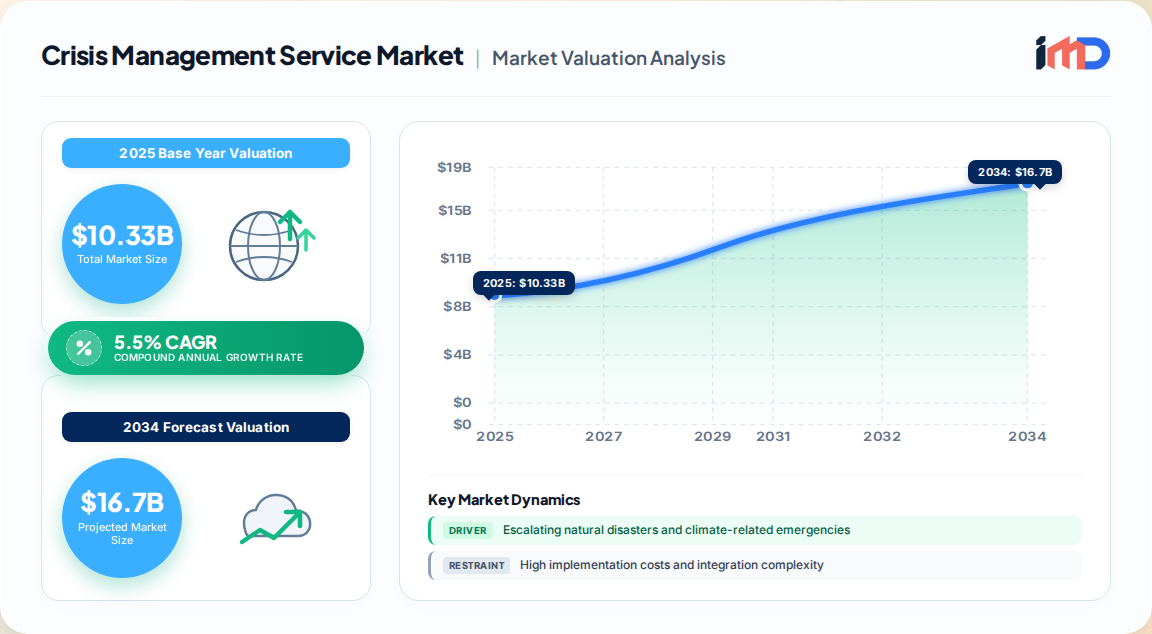
The global crisis management service market is experiencing a structural transformation, evolving from a reactive, compliance-driven function into a strategic imperative for enterprises and governments alike. Our proprietary primary research estimates the market at USD 10.33 billion in 2026, projected to expand to USD 15.85 billion by 2034, registering a CAGR of 5.5%. This growth is underpinned not merely by the rising frequency of disruptions but by a fundamental shift in how organizations value resilience. Services—encompassing consulting, training and simulation, managed services, and emergency operations support—now constitute a critical layer of the crisis management ecosystem, ensuring that technology investments translate into actionable preparedness.
The demand for crisis management services is being propelled by a confluence of interconnected forces, each amplifying the need for expert-led preparedness and response capabilities.
Escalating Frequency and Cost of Disasters: Official U.S. government data reveals a stark escalation in billion-dollar disaster events, averaging 18 per year between 2015 and 2025, compared with just 3 per year in the 1980s. Disaster recovery costs have surged to USD 153 billion in the last five years alone, a fourfold increase from the prior decade. This escalating burden compels public and private sectors to invest in professional services that can design, test, and operationalize response frameworks.
Regulatory Mandates and Compliance Pressure: Governments are tightening compliance frameworks around business continuity and risk disclosure. In the United States, the CMS Emergency Preparedness Rule mandates comprehensive plans for healthcare providers, while the National Incident Management System (NIMS) establishes standardized protocols requiring specialized training and consulting services. Similar regulatory pushes in Europe and Asia-Pacific are creating a steady demand for compliance-oriented crisis management services.
The Cyber-Crisis Convergence: A ransomware attack is no longer an isolated IT incident; it is a business, legal, and reputational crisis. Organizations are integrating Security Operations Centers (SOCs) with crisis response teams, driving demand for services that bridge technical response with executive-level coordination. Our primary interviews indicate that over 60% of large enterprises now require specialized crisis communication and simulation exercises specifically for cyber incidents.
Cloud and Digital Infrastructure Dependence: As organizations migrate critical operations to cloud ecosystems, the potential impact of disruptions widens. This reliance is driving demand for managed services that offer 24/7 monitoring, incident orchestration, and rapid recovery support, particularly among mid-sized enterprises that lack dedicated in-house resilience teams.
Despite strong demand drivers, the market faces significant headwinds that temper growth, particularly in the public sector and among small and medium-sized enterprises (SMEs).
Budget Constraints and Funding Uncertainty: Many state and local jurisdictions are heavily dependent on federal grants, creating operational fragility. For instance, primary research indicates that some U.S. states rely on federal funding for over 90% of their emergency management budgets. Fluctuations in grant programs, such as reductions in the State Homeland Security Grant Program, directly constrain spending on external consulting and training services.
High Implementation Costs and Skilled Labor Shortage: The cost of specialized consulting, simulation exercises, and managed services can be prohibitive for smaller organizations. Furthermore, there is a persistent shortage of professionals skilled in advanced crisis platforms and predictive risk intelligence, creating a bottleneck in service delivery and adoption. This skills gap is particularly acute in regions with less mature emergency management infrastructures.
Integration Complexity: The proliferation of legacy systems and disparate communication platforms creates technical and operational barriers. Service providers must navigate complex IT environments, increasing project timelines and costs, which can discourage organizations from pursuing comprehensive service engagements.
The crisis management service market is segmented by service type, application, and end-user, reflecting the diverse needs of organizations preparing for and responding to disruptions.
| Service Type | Description | Market Share (2026) | Growth Outlook |
|---|---|---|---|
| Consulting & Advisory | Design of resilience frameworks, risk assessments, and continuity planning | 32% | Steady, with rising demand for cyber-crisis integration |
| Training & Simulation | Mock drills, tabletop exercises, and AI-powered scenario modeling | 28% | Fastest-growing, driven by predictive simulation demand |
| Managed Services | 24/7 monitoring, incident response coordination, and recovery support | 22% | Strong growth among SMEs adopting cloud-based models |
| Emergency Operations Support | On-site coordination, logistics, and communication during active crises | 18% | Stable, with peak demand during disaster events |
By application, business continuity management accounts for the largest share (25.8%), followed by emergency response, risk assessment and monitoring, and crisis communication. The training and simulation segment is the fastest-growing application, projected at a CAGR of 13.18% through 2034, as organizations seek immersive, tech-enabled drills to validate response plans.
North America remains the dominant market, holding 38.6% of global revenue in 2025, supported by advanced regulatory frameworks, high adoption of integrated platforms, and a mature vendor ecosystem. The U.S. sets the tone, treating crisis management as a board-level priority. Within the region, the Northeast represents a mature, regulation-driven market, while the Southwest is the fastest-growing, driven by rapid urbanization and extreme climate conditions.
Europe follows, characterized by compliance-driven adoption. The region's focus on structured risk management and cross-border coordination tools is shaping demand for consulting services that align with GDPR and operational resilience mandates.
Asia-Pacific is the fastest-growing region, with a projected CAGR of 14.26% (2026–2034). Rapid digital transformation, rising exposure to climate risks (floods, typhoons, wildfires), and expanding enterprise IT infrastructure are driving first-time adoption of crisis management services across China, India, Japan, and Southeast Asia. This growth is volume-driven, with many organizations moving from no formal system to comprehensive service engagements.
Latin America and the Middle East & Africa present long-term opportunities, with government-led investments in national emergency response infrastructure and a growing interest in cost-effective, modular service solutions.
The crisis management service market is concentrated but not dominated by a single player; it comprises specialized software vendors extending into services, risk intelligence firms, and large enterprise software providers.
Partnerships between software vendors, cybersecurity firms, and consulting agencies are becoming critical to fill capability gaps and deliver integrated resilience ecosystems.
The most significant emerging opportunity lies in AI-driven predictive risk intelligence and simulation-based services. Organizations increasingly demand early signals—indicators before disruption—rather than post-impact alerts. AI platforms that track geopolitical developments, monitor social media sentiment, and detect cyber anomalies are enabling a shift from reactive to predictive crisis management. Service providers that can offer predictive scenario analysis, digital twin simulations, and AI-assisted decision support are positioned for high-margin growth.
Another white space is industry-specific service packages for healthcare, BFSI, and manufacturing. For example, healthcare providers require crisis services that integrate with clinical systems and emergency protocols, while manufacturers need supply chain resilience consulting. Tailored workflows, sector-focused integrations, and specialized support services allow providers to differentiate and command premium pricing.
Furthermore, the SME segment is a high-growth frontier. Affordable, modular, subscription-based service offerings—particularly cloud-based managed services—are enabling smaller organizations to adopt crisis preparedness capabilities for the first time. Service providers that can deliver scalable, cost-effective solutions will unlock a vast, underpenetrated market.
The crisis management service market is on a trajectory of sustained growth, driven by escalating risks, regulatory pressures, and the imperative for organizational resilience. As the market matures, the distinction between software and services will blur, with unified platforms and expert-led engagements becoming the standard. The winners will be those that can help organizations anticipate disruptions, respond with agility, and recover faster—turning crisis preparedness from a cost center into a competitive advantage.
| Aspects | Details |
|---|---|
| Study Period | 2020-2034 |
| Base Year | 2025 |
| Estimated Year | 2026 |
| Forecast Period | 2026-2034 |
| Historical Period | 2020-2025 |
| Growth Rate | CAGR of 5.5% from 2020-2034 |
| Segmentation |
|
By Deployment Mode
By Organization Size
By Application
By Industry Vertical
| By Geography |
|
The global crisis management software and service market is valued at USD 10.33 billion in 2026 and is projected to reach USD 15.85 billion by 2034, growing at a CAGR of 5.5%.
North America holds the largest share, accounting for 38.6% of the global market in 2025, driven by advanced regulatory frameworks and high adoption of integrated resilience platforms.
Key drivers include the escalating frequency of natural disasters, rising cyber threats, regulatory mandates for business continuity, and the growing reliance on cloud and digital infrastructure.
Leading companies include Everbridge, IBM, Microsoft, BlackBerry (AtHoc), Fusion Risk Management, and MetricStream, among others.
Training and simulation services are the fastest-growing application segment, with a projected CAGR of 13.18% through 2034, driven by demand for AI-powered crisis simulations.
Our rigorous research methodology combines multi-layered approaches with comprehensive quality assurance, ensuring precision, accuracy, and reliability in every market analysis.
| Stakeholder Role | Interview Share (%) |
|---|---|
| C-Suite Executives | 20% |
| VPs/Directors of Risk & Resilience | 35% |
| Emergency Management Directors | 25% |
| Procurement Managers | 20% |
| Company Type | Representation (%) |
|---|---|
| Crisis Management Software Vendors | 30% |
| Consulting & Advisory Firms | 25% |
| Managed Service Providers | 20% |
| Government & Public Sector Agencies | 15% |
| Industry Associations | 10% |

Analyst at Providence Strategic Partners at Petaling Jaya
I have received the report already. Thanks you for your help.it has been a pleasure working with you. Thank you again for a good quality report

Internationalization Director
Yes, as a matter of fact we are totally satisfied with both reports that we have purchased and will continue to do so during this process of the internationalization of our brand.

Head of Product Management and Marketing
We are using your report, and it gave us valuable information."

Regional Director, Marketing and Business Development
We've received the report and have reviewed the content. Overall, it looks great and aligns closely with the data we can verify based on our industry knowledge.

VP of Sales
Thank you very much for sharing the report. I have reviewed it and I am very satisfied with the quality and the insights it provides. It will certainly be valuable for our internal discussions.
 Related Reports
