1What is the apartment hotel market size in 2025?
Our primary research values the global apartment hotel market at approximately USD 12.45 billion in 2025, with a projected expansion to USD 43.4 billion by 2034 at a blended CAGR of 14.8%.
Insight Market Data is a premier market research and business consulting firm headquartered in Pune, India, providing syndicated research reports, customized intelligence studies, and strategic advisory services. Renowned academic institutions and Fortune 500 corporations worldwide rely on Insight Market Data's research repository to navigate evolving global and regional business environments. Covering 46 diverse industries across 25 major international economies, our comprehensive database delivers thousands of verified statistics and granular market evaluations. By combining industry-leading analytical methodologies with the direct insights of seasoned industry leaders and subject-matter experts, we deliver actionable intelligence spanning historical performance benchmarks to rigorous multi-year forecasts. We empower organizations to make confident, data-driven decisions across pivotal domains including Machinery & Equipment, Chemicals & Materials, Pharmaceuticals & Healthcare, Food & Beverages, Consumer Goods, Energy & Power, Automotive & Transportation, Electronics & Semiconductors, Medical Devices, Telecommunications, Emerging Technologies, Agriculture, and Packaging. Our multidisciplinary analyst teams provide an objective 360-degree perspective, tailoring every engagement to address complex strategic challenges with exceptional analytical rigor.
Leveraging advanced BI-powered analytics and predictive modeling, Insight Market Data uncovers high-impact market opportunities and competitive differentiators for ambitious enterprises. We continuously refine our research methodologies in accordance with global industry standards, tracking real-time market shifts to ensure our reports are consistently accurate, actionable, and delivered on schedule. Our analysts conduct methodical data validation, rigorous compliance checks, and exhaustive primary and secondary research to maintain the highest levels of data integrity and transparency. We partner closely with corporate strategists, investment groups, and business executives to translate intricate market intelligence into clear, actionable roadmaps for sustainable growth. With operational presence across Washington, USA, and Vimannagar, Pune, India, Insight Market Data ensures direct access to dedicated research specialists and responsive customer support to answer your most strategic questions.
 Apartment Hotel Market
 by Type (Studio Apartments, One-Bedroom Apartments, Two-Bedroom Apartments, Others), by End User (Corporate/Business Traveller, Leisure Traveller, Expats And Relocators, Others), by Booking Channel (Online Booking, Offline Booking), by Duration of Stay (Short Term, Long Term), by Price Range (Luxury Serviced Apartments, Mid-Range Serviced Apartments, Budget Serviced Apartments), by Room Range (Economic Range, Middle Range, Luxury Range), by North America (United States, Canada, Mexico), by Europe (Germany, United Kingdom, France, Italy, Spain, Russia, Sweden, Denmark, Switzerland, Luxembourg), by Asia Pacific (China, India, Japan, South Korea, Australia, Singapore, Taiwan, South East Asia), by South America (Brazil, Argentina, Colombia, Peru, Chile), by Middle East (Turkey, Saudi Arabia, UAE, Egypt, Qatar), by Africa (South Africa, East Africa, West Africa, North Africa) Forecast 2026-2034

Research Associate

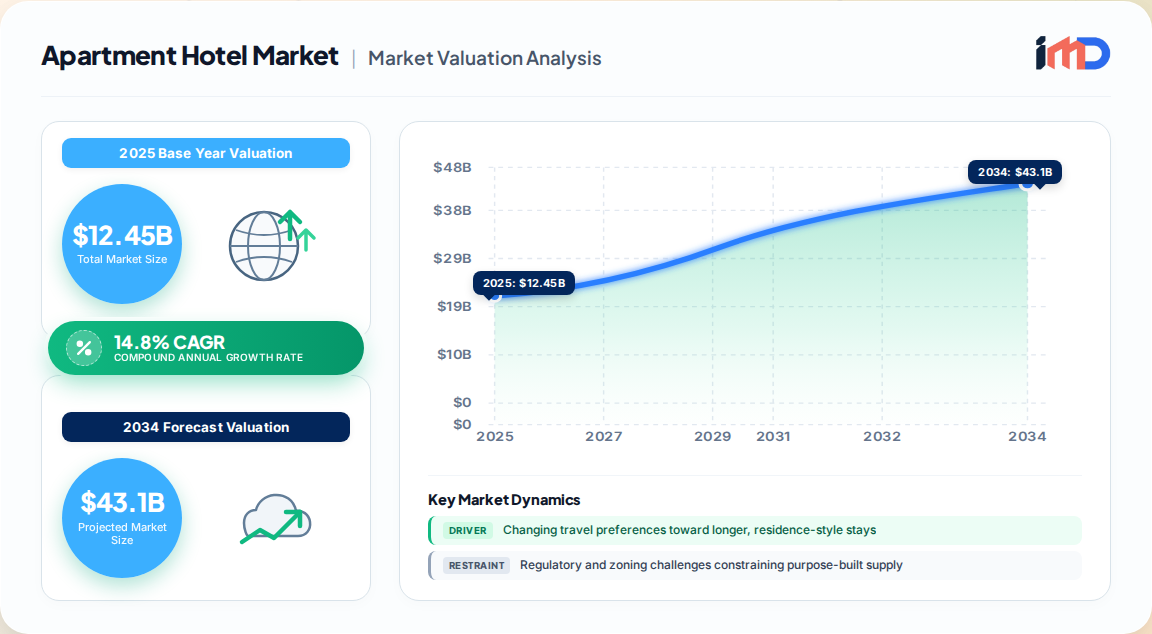
The global apartment hotel market is undergoing a structural re-rating within the broader hospitality economy. Our proprietary primary research estimates the market at USD 12.45 billion in 2025, expanding to USD 43.4 billion by 2034 at a blended CAGR of 14.8%. This trajectory is materially faster than the conventional hotel sector, which grows at roughly 4.6% annually according to official tourism satellite benchmarks.
The category is best understood as the convergence of three historically distinct supply pools: upscale extended-stay hotels, serviced apartments, and professionally managed short-term rentals. Demand-side pull comes overwhelmingly from travelers whose stay exceeds five nights and who value kitchen facilities, laundry access and residential privacy over nightly housekeeping and lobby amenities.
Four demand forces underpin our forecast model. Each was validated through structured interviews with operators, asset managers and corporate travel buyers.
Changing travel preferences and lifestyle trends. Travelers increasingly treat accommodation as a temporary residence rather than a service environment. The share of bookings exceeding one week has risen sharply, and guests explicitly compare kitchen provision, workspace ergonomics and laundry access before rate.
Corporate mobility and project-based employment. Cross-border assignments, consulting engagements and infrastructure projects generate predictable, weekday-heavy demand with low seasonal volatility. This is precisely the profile that apartment hotels monetize best, supporting higher occupancy stability than leisure-dependent hotels.
Cost efficiency versus full-service hotels. For stays beyond roughly five nights, the apartment hotel model delivers measurable savings on total cost of stay. Operators benefit from lower labor intensity per occupied room-night and reduced food and beverage exposure, improving risk-adjusted returns for owners.
Regulatory tightening on unlicensed short-term rentals. Municipal restrictions on whole-home short-term letting in major gateway cities are redirecting professionally compliant, purpose-built supply into the formal apartment hotel category.
The category is not without friction. Our panel of developers and operators identified the following as the most binding constraints through 2030.
Studios and one-bedroom units constitute the operational core of the category. Two-bedroom and larger configurations capture relocating families and multi-person project teams, and carry higher ADR but lower turnover. The upscale extended-stay tier is the single most dominant positioning, blending premium amenities, spacious suites and central locations to serve business travelers, families and long-stay tourists.
| Segment | Demand Characteristic | Strategic Role |
|---|---|---|
| Studio Apartments | Solo business travelers, short-to-medium stays | Volume engine; highest occupancy |
| One-Bedroom Apartments | Couples, single assignees, 1–3 month stays | Core revenue contributor |
| Two-Bedroom Apartments | Families, relocators, project teams | Highest ADR per unit |
| Others (lofts, penthouses, multi-key) | Premium and group demand | Margin accretive, niche supply |
Corporate and business travelers account for roughly 50–52% of category revenue, driven by flexible accommodation needs on extended assignments. Leisure travelers form the second pillar, increasingly booking apartment hotels for multi-week vacations. Expats and relocators represent a smaller but highly stable, contract-driven cohort with the longest average lengths of stay.
Direct booking is the leading channel at roughly 45–49% of transactions, reflecting corporate contract structures and customer preference for rate flexibility and personalized service. Online travel agencies remain essential for leisure discovery and new-property ramp-up. Corporate contracts sit between the two, offering volume certainty at negotiated rates.
Short-term stays (under 30 nights) represent approximately 64–65% of transactions, but long-term stays drive revenue stability and lower customer acquisition cost per room-night. By price band, mid-range and upscale serviced apartments dominate value, while luxury serviced apartments are the fastest-growing tier in Asia-Pacific and the Middle East.
Asia-Pacific is the growth engine of the category. Gateway markets including Singapore, Hong Kong, Tokyo, Shanghai and Bangalore combine dense corporate travel with constrained residential supply, supporting premium ADR. China and India are the largest country-level contributors, with India identified as the fastest-growing major market in extended-stay formats at a projected 12.9% CAGR through 2036.
Europe demonstrates the strongest operational resilience in the category. Cross-border corporate mobility, project-based employment and extended leisure stays support weekday-balanced demand. Germany, the United Kingdom and France anchor volume, while Southern and Central European markets are expanding as operators reposition underperforming hotels into apartment hotel formats.
North America is the most mature and highest-revenue region, anchored by the United States. Extended-stay formats have consistently outperformed traditional lodging categories on RevPAR, and disciplined supply additions have preserved rate integrity. Corporate housing demand, employee relocation and project work remain the primary demand engines.
These regions represent the highest-growth frontier. Middle East markets, led by the UAE, Saudi Arabia and Turkey, are expanding at approximately 6.5–7.0% CAGR on the upscale extended-stay base, driven by mega-project employment and religious and business tourism. South America and Africa remain smaller but are scaling from low bases as international operators enter.
| Region | 2025 Market Share | Growth Profile |
|---|---|---|
| Asia-Pacific | ~34% | Fastest-growing; premium tier expansion |
| Europe | ~29% | Resilient, corporate-contract anchored |
| North America | ~27% | Mature, highest absolute revenue |
| Middle East & Africa | ~7% | High-growth frontier |
| South America | ~4% | Emerging, low-base expansion |
The competitive field is bifurcated. Global hospitality chains and dedicated serviced-residence operators command portfolio scale, distribution and corporate account relationships. Regional operators compete on localized expertise, owner economics and tailored service. Property management companies are increasingly entering the category, intensifying competition on asset-light terms.
Leading positions are held by The Ascott Limited, Frasers Hospitality and Marriott International, alongside extended-stay specialists such as Extended Stay America, Hyatt House and Sonesta ES Suites. Regional operators including Adina Apartment Hotels hold meaningful share in Europe and Australia.
| Model | Revenue Mechanism | Key Advantage |
|---|---|---|
| Management contract | Base + incentive fee | Asset-light brand expansion |
| Franchise | Royalty on rooms revenue | Rapid unit growth |
| Master lease | Fixed rent to owner | Full operating control |
| Owner-operated | Direct room revenue | Margin retention |
| Aspects | Details |
|---|---|
| Study Period | 2020-2034 |
| Base Year | 2025 |
| Estimated Year | 2026 |
| Forecast Period | 2026-2034 |
| Historical Period | 2020-2025 |
| Growth Rate | CAGR of 14.8% from 2020-2034 |
| Segmentation |
|
By Booking Channel
By Duration of Stay
By Price Range
By Room Range
| By Geography |
|
Our primary research values the global apartment hotel market at approximately USD 12.45 billion in 2025, with a projected expansion to USD 43.4 billion by 2034 at a blended CAGR of 14.8%.
Asia-Pacific is the largest and fastest-growing region, accounting for roughly 34% of global revenue in 2025, supported by dense corporate travel in markets such as China, India and Singapore.
Corporate and business travelers represent the dominant cohort at approximately 50–52% of category revenue, driven by extended assignments, relocation and project-based work.
Apartment hotels offer kitchen facilities, laundry access and residential space that appeal to stays exceeding five nights, delivering cost savings for guests and lower labor intensity and more stable RevPAR for operators.
Direct booking accounts for roughly 45–49% of transactions, supported by corporate contracts, rate flexibility and customer preference for personalized service.
India is the fastest-growing major country market, projected to expand at a 12.9% CAGR through 2036, followed by China at approximately 11.2%.
Our rigorous research methodology combines multi-layered approaches with comprehensive quality assurance, ensuring precision, accuracy, and reliability in every market analysis.
| Stakeholder Role | Interview Share (%) |
|---|---|
| Chief Commercial Officer | 30% |
| Vice President of Asset Management | 28% |
| Director of Corporate Housing | 24% |
| Senior Development Director | 18% |
| Company Type | Representation (%) |
|---|---|
| Hotel and Serviced Apartment Brand Operators | 32% |
| Institutional Owners and REITs | 24% |
| Property Management and Master-Lease Companies | 20% |
| Corporate Travel and Relocation Firms | 16% |
| Online Distribution and Channel Partners | 8% |

 Related Reports
