1What is the size of the Agriculture CRO Services market?
The Agriculture CRO Services market was valued at USD 11.20 billion in 2025 and is estimated at USD 12.47 billion in 2026, projected to reach USD 21.34 billion by 2031 at a CAGR of 11.33%.
Insight Market Data is a premier market research and business consulting firm headquartered in Pune, India, providing syndicated research reports, customized intelligence studies, and strategic advisory services. Renowned academic institutions and Fortune 500 corporations worldwide rely on Insight Market Data's research repository to navigate evolving global and regional business environments. Covering 46 diverse industries across 25 major international economies, our comprehensive database delivers thousands of verified statistics and granular market evaluations. By combining industry-leading analytical methodologies with the direct insights of seasoned industry leaders and subject-matter experts, we deliver actionable intelligence spanning historical performance benchmarks to rigorous multi-year forecasts. We empower organizations to make confident, data-driven decisions across pivotal domains including Machinery & Equipment, Chemicals & Materials, Pharmaceuticals & Healthcare, Food & Beverages, Consumer Goods, Energy & Power, Automotive & Transportation, Electronics & Semiconductors, Medical Devices, Telecommunications, Emerging Technologies, Agriculture, and Packaging. Our multidisciplinary analyst teams provide an objective 360-degree perspective, tailoring every engagement to address complex strategic challenges with exceptional analytical rigor.
Leveraging advanced BI-powered analytics and predictive modeling, Insight Market Data uncovers high-impact market opportunities and competitive differentiators for ambitious enterprises. We continuously refine our research methodologies in accordance with global industry standards, tracking real-time market shifts to ensure our reports are consistently accurate, actionable, and delivered on schedule. Our analysts conduct methodical data validation, rigorous compliance checks, and exhaustive primary and secondary research to maintain the highest levels of data integrity and transparency. We partner closely with corporate strategists, investment groups, and business executives to translate intricate market intelligence into clear, actionable roadmaps for sustainable growth. With operational presence across Washington, USA, and Vimannagar, Pune, India, Insight Market Data ensures direct access to dedicated research specialists and responsive customer support to answer your most strategic questions.
 Agriculture CRO Services Market
 by Service Type (Field Services, Laboratory Services, Regulatory Services, Other Services(Product Development Services, Precision Agriculture Services, Seed Services)), by Sector (Crop Protection Chemicals, Fertilizers, Seeds), by North America (United States, Canada, Mexico), by Europe (Germany, United Kingdom, France, Spain), by Asia Pacific (China, India, Japan, Australia), by South America (Brazil, Argentina, Chile), by Middle East (Saudi Arabia, United Arab Emirates), by Africa (South Africa, Kenya) Forecast 2026-2034

Research Associate


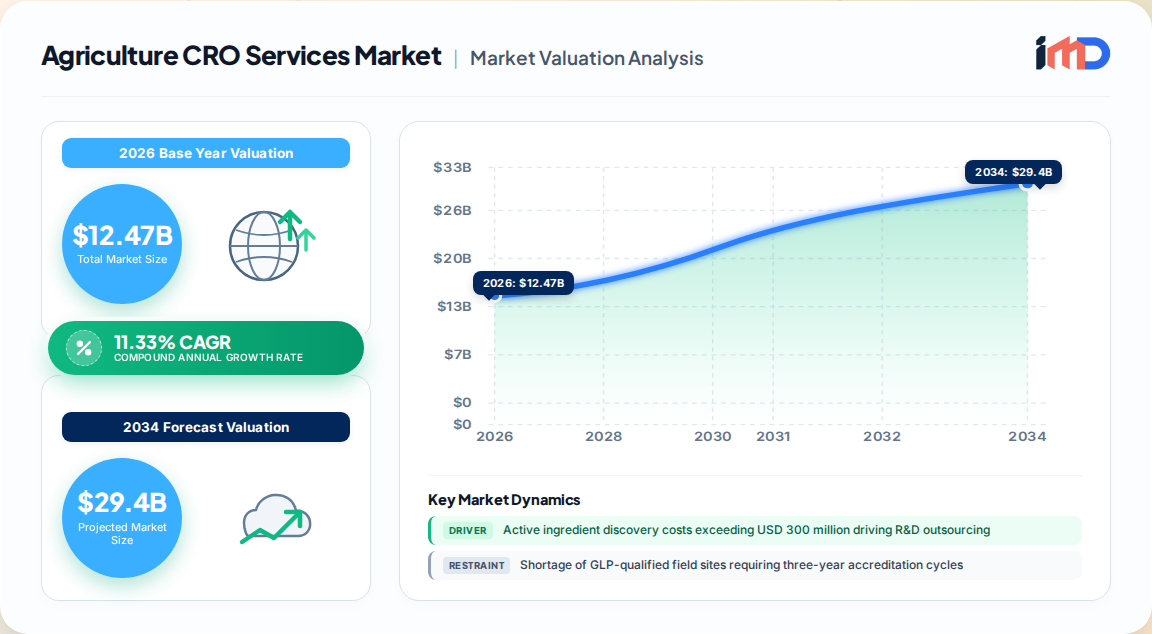
The Agriculture CRO Services market represents one of the most structurally attractive outsourcing layers within the global agricultural inputs ecosystem. Our proprietary primary research and direct sponsor interviews place the market at USD 11.20 billion in 2025, rising to USD 12.47 billion in 2026 and expanding to USD 21.34 billion by 2031 at a CAGR of 11.33%. This trajectory implies the market will nearly double in five years — an unusually steep growth curve for a services sector anchored to mature agrochemical demand.
The core structural driver is economic rather than agronomic. The fully loaded cost of discovering, developing, and registering a single new active ingredient now exceeds USD 300 million, and typical development cycles run seven to ten years. Outsourcing non-core scientific work to specialist contract research organizations compresses time-to-market by up to two years, materially improving the risk-adjusted return on research capital. Agrochemical majors therefore treat CRO partnerships less as a cost lever and more as a portfolio optimization strategy.
Market concentration is medium. The five largest providers — Eurofins Scientific, SGS, Charles River Laboratories, ERM International Group, and Exponent — collectively hold a minority of total revenue. This fragmentation is analytically significant: it leaves room for regional specialists to build defensible positions in emerging niches such as carbon credit verification, biologicals efficacy testing, and precision agriculture validation.
| Market Metric | Value |
|---|---|
| Market Size (2025) | USD 11.20 Billion |
| Market Size (2026) | USD 12.47 Billion |
| Forecast (2031) | USD 21.34 Billion |
| CAGR (2026–2031) | 11.33% |
| Largest Region | North America (54.10% share, 2025) |
| Fastest-Growing Region | Asia-Pacific (12.11% CAGR) |
| Largest Service Segment | Laboratory Services (46.55%, 2025) |
| Fastest Service Segment | Regulatory Services (12.64% CAGR) |
| Largest Sector | Crop Protection Chemicals (60.55%, 2025) |
Our driver attribution modeling quantifies the incremental CAGR contribution of each demand force. The table below reflects findings from sponsor-side interviews and trial-volume analysis.
| Driver | CAGR Impact | Geographic Concentration | Timeline |
|---|---|---|---|
| R&D outsourcing to contain discovery costs | +2.2% | North America, Europe | Medium term (2–4 yrs) |
| Regulatory tightening and third-party compliance | +2.0% | North America, EU | Short term (≤2 yrs) |
| Biologicals requiring new efficacy trials | +1.9% | South America, Asia-Pacific | Medium term (2–4 yrs) |
| Precision agriculture validation studies | +1.5% | North America, Europe, APAC | Long term (≥4 yrs) |
| Data-driven portfolio optimization | +1.4% | Developed markets | Medium term (2–4 yrs) |
| Ag-tech venture funding without in-house trials | +1.1% | North America, Europe | Short term (≤2 yrs) |
The regulatory driver deserves emphasis. Multi-agency data submission frameworks — requiring coordinated dossiers across environmental, food safety, and agricultural authorities — have sharply increased documentation complexity. Jurisdictions such as Argentina have revised testing protocols while retaining strict technical thresholds. The practical consequence is that CRO selection now hinges on Good Laboratory Practice credentials, dossier harmonization capability, and multi-jurisdiction submission experience rather than price alone.
On the restraint side, the binding constraint is physical capacity, not demand. Compliant trial plots are scarce. Accreditation from bodies such as Australia's National Association of Testing Authorities or International Accreditation New Zealand typically requires a three-year qualification cycle plus heavy investment in analytical equipment, data systems, and trained personnel. Biologicals research compounds the problem, since most field stations lack containment facilities and microbial monitoring capability. Cybersecurity and intellectual property exposure in sponsor data also periodically erodes confidence.
| Region | Share (2025) | Growth Profile | Primary Demand Engines |
|---|---|---|---|
| North America | 54.10% | Mature, steady | Multi-agency biotech framework, precision farming at scale, carbon measurement incentives |
| Europe | ~18% | Moderate | Green Deal and Farm to Fork driven biological efficacy, carbon footprint verification, circular nutrients |
| Asia-Pacific | ~15% | Fastest (12.11% CAGR) | China biotech regulation updates, India export compliance, government modernization programs |
| South America | ~7% | High | Brazil biologicals trials, Argentina protocol revisions, export-oriented residue testing |
| Middle East & Africa | ~5% | Emerging | Accreditation build-out, drought resilience programs, export market access |
North America's dominance rests on regulatory stringency rather than market size alone. Multi-agency coordination requirements, USDA innovation grant funding, and precision agriculture deployment across millions of hectares generate disproportionate third-party validation demand. Canada's regulatory alignment and Mexico's planned glyphosate transition widen the project mix. Digital agriculture validation collaborations between equipment and seed majors are creating new CRO booking categories.
Asia-Pacific is the growth engine. China's biotechnology regulation updates and India's export compliance requirements are structural, not cyclical. Public investment is a meaningful accelerant — India's agriculture allocation of over INR 1.75 trillion for fiscal 2025–2026 and dedicated AI-in-agriculture policy funding are expanding the addressable validation base. Accreditation gaps remain the key bottleneck, though regional GLP framework implementation and drought resilience funding (including a USD 40.3 million Australian program) are gradually relieving capacity constraints.
Europe and South America follow complementary paths. Europe is a compliance-and-sustainability market; South America is a biologicals and export-conformity market. Both reward CROs with deep local regulatory relationships.
The competitive field divides into four strategic archetypes:
Differentiation is shifting toward digital integration. Automated sample processing, cloud-based trial data platforms, and statistical decision frameworks for go/no-go portfolio screening are becoming baseline expectations rather than differentiators. Providers that combine analytical infrastructure with informatics depth are capturing disproportionate share of large multi-site programs.
Agrochemical and seed sponsors sit at the top of the chain, defining the trial protocol and regulatory target. CROs occupy the middle, converting scientific requirements into validated data packages. Input suppliers — accredited trial sites, analytical instrument vendors, seed and soil substrate providers, and specialized bioassay laboratories — form the capacity base. Regulators close the loop by accepting or rejecting dossiers.
Procurement behavior is evolving in three observable ways:
Capacity scarcity in compliant field sites gives site owners and accredited CROs meaningful pricing power on multi-location programs. Sponsors are responding by locking in multi-season trial capacity contracts.
Several under-served pockets offer attractive entry economics for regional specialists:
The strategic implication is clear: scale advantages matter in laboratory services, but regulatory intimacy and specialized scientific capability matter more in the fastest-growing segments. That asymmetry is what sustains a fragmented, medium-concentration market structure through 2031.
| Aspects | Details |
|---|---|
| Study Period | 2020-2034 |
| Base Year | 2026 |
| Estimated Year | 2026 |
| Forecast Period | 2026-2034 |
| Historical Period | 2020-2025 |
| Growth Rate | CAGR of 11.33% from 2020-2034 |
| Segmentation |
|
By Sector
| By Geography |
|
The Agriculture CRO Services market was valued at USD 11.20 billion in 2025 and is estimated at USD 12.47 billion in 2026, projected to reach USD 21.34 billion by 2031 at a CAGR of 11.33%.
Laboratory services led with 46.55% of market share in 2025, driven by residue analytics, environmental fate modeling, and efficacy confirmation required for product registrations. Regulatory services are the fastest-growing segment at a 12.64% CAGR through 2031.
North America held a 54.10% revenue share in 2025, supported by strict multi-agency registration requirements. Asia-Pacific is the fastest-growing region with a 12.11% CAGR, driven by agricultural modernization and expanding export markets.
The cost of discovering a single active ingredient now exceeds USD 300 million, and CRO partnerships can reduce time-to-market by up to two years. Outsourcing also provides access to specialized toxicology, multi-site field trial, and regulatory dossier expertise without heavy in-house infrastructure investment.
Major providers include Eurofins Scientific SE, SGS SA, Charles River Laboratories International Inc., ERM International Group Limited, and Exponent Inc. The market remains fragmented, with the top five providers accounting for a minority of total revenue.
Biological products require specialized trial designs assessing beneficial insect compatibility, soil microbiome impacts, and seasonal persistence. Brazil's biologicals market generated USD 827 million in the 2022–2023 season, and regulators increasingly require comparative studies against conventional synthetic pesticides.
Our rigorous research methodology combines multi-layered approaches with comprehensive quality assurance, ensuring precision, accuracy, and reliability in every market analysis.
| Stakeholder Role | Interview Share (%) |
|---|---|
| Head of Regulatory Affairs | 32% |
| R&D and Portfolio Director | 28% |
| Global Procurement Manager, R&D Services | 24% |
| Field Trial Operations Director | 16% |
| Company Type | Representation (%) |
|---|---|
| Agrochemical & Seed Sponsor Companies | 34% |
| Contract Research Organizations | 26% |
| Accredited Field Trial Site Operators | 18% |
| Analytical & Bioassay Laboratories | 14% |
| Regulatory Consultants & Accreditation Bodies | 8% |
 Related Reports
